Literature review
6.1. Fertility
The economics literature on fertility starts with Malthus (1798). He believed that an economy’s population had a natural size. This size was limited by the economy’s fixed factors, in particular land.
A society’s population would increase, until its standard of living fell down to a subsistence level, reigning in further expansion. When an economy’s population exceeded its natural size either poverty stricken parents would voluntarily reduce their family size or their family size would involuntarily decline due to famine induced disease.Two classic papers on fertility in modern macroeconomics are by Razin and Ben-Zion (1975) and Becker and Barro (1988). The Razin and Ben-Zion (1975) model is similar to the setup presented in Section 2. They develop a small-open-economy overlappinggenerations model of fertility where kids simply enter their parents’ utility function in the same way as other goods - say as in (1). The Becker and Barro (1988) model is more sophisticated, but harder to work with. It is an overlapping generations model, too, but now parents care about the utility of their children in addition to the number of kids. Since a parent cares about the happiness of his child who will in turn care about the happiness of his child (and so on, ad nauseam), the Becker and Barro (1988) model reformulates as an infinitely-lived representative agent model.
A milestone in the demographic transitions literature is a paper by Galor and Weil (2000). Over epochs of European history, fertility has followed a ∩-shaped pattern. Galor and Weil (2000) develop a model of this pattern by combining elements of Malthus (1798) and Razin and Ben-Zion (1975). They also allow for a human capital decision in the spirit of Becker and Tomes (1986). In addition they make two key assumptions: first, technological progress is an increasing function of population size, and second, the return on education rises with the rate of technological advance.
In their framework, the world rests in a Malthusian equilibrium for a long time. Per-capita income remains more or less constant over time. All increases in aggregate income induced by technological progress are absorbed by expansions in the population. As the population slowly grows bigger, the pace of technological progress begins to pick up and the economy exits the Malthusian regime. At first parents use the extra income generated by technological advance to have more kids, since the return on education is still low. As the rate of technological progress accelerates the return to education rises, and parents choose to have fewer kids but invest more in them.[157]A calibrated model that delivers a transition from Malthusian stagnation to growth, accompanied by a demographic transition from high to low fertility is presented in Doepke (2004). The engine in his analysis is a Becker and Barro (1988) style model modified to allow for parental human capital investment in children. He uses the model to study the role of social policies in shaping the demographic transition of a country - more on this later.
Fernandez-Villaverde (2001) examines the ability of technological advance to explain, quantitatively, the fall in British fertility. He uses a variant of the Becker and Barro (1988) and Becker and Tomes (1986) frameworks to do this. In his analysis capital and skilled labor are complements in production. As the capital stock rises with economic development, this creates an impetus for parents to substitute away from having a large number of uneducated children toward having a small number of educated ones.
Little work has been done on the underlying cause of the baby boom. The best known hypothesis is by Easterlin (1987). The generation that spawned the baby boom grew up during the hard times of the Great Depression and World War II. As a result, this generation had low material aspirations. They then entered the work force in the 1940s and 1950s, a good time economically speaking.
Given their low material aspirations, they used family formation as an outlet for their earnings. This hypothesis is empirically flawed on several grounds.[158] First, there was no break in the trend for fertility during the Great Depression. Second, fertility in many OECD countries started to rise before the start of World War II. Third, at the peak of the baby boom (1960) the most fertile cohort of women (those in the 20 to 24 year old age group) were simply too young for either the Great Depression or World War II to have had much of an impact on them - they were not alive during the Great Depression and were less than 9 years old at the end of World War II.6.2. The economics of household production
The economic importance of household production was probably first recognized in a classic book by Reid (1934). Reid (1934, p. v) felt that “the productive work of the household has been overlooked, even though more workers are engaged in it than any other single industry”. She carefully reported and analyzed the uses of time and capital by households of the era. The data was fragmentary then, and sadly still is. Reid (1934) knew in theory that labor-saving household capital could reduce the amount of time spent on housework, but the just emerging evidence at the time suggested that this effect was modest (see Table XIII, p. 91).
In a famous paper Becker (1965) develops the modern approach to household production: the treatment of the household as a small factory or plant using inputs, such as labor, capital and raw materials, to produce some sort of home goods. This is the notion underlying the household production functions (2) and (42) used in Sections 2 and 5. Benhabib, Rogerson and Wright (1991) introduce household production theory into a dynamic general equilibrium model in order to study the movement of labor over the business cycle. The idea is that in favorable economic times households may temporarily move labor out of the home sector to take advantage of good market opportunities, thereby increasing the elasticity of labor supply.
Parente, Rogerson and Wright (2000) use a similar framework to investigate whether household production can explain cross-country income differentials. This is very much in the spirit of Reid (1934, pp. 165-166), who observed that the “(g)oods resulting from household production receive no market valuation..She reports (p. 167) an estimate placing the value of housewives’ services at $15.3 billion in 1918 compared with a national income of $61 billion. Last, Rios-Rull (1993) inserts household production into an overlapping generations model to examine its impact on the time allocations of skilled versus unskilled labor. In his framework, skilled labor (relative to unskilled labor) will tend to substitute market goods or services for labor in household production.6.3. Structural change
Two well-known models of structural change have been developed by Echevarria (1997) and Laitner (2000). Laitner (2000) presents a closed-economy model with two sectors, viz agriculture and manufacturing. Two key features of the analysis are that the demand for agricultural goods has a zero income elasticity after a certain consumption level, and that production in the agricultural sector is subject to technological progress. As the state of technology advances in the agricultural sector less labor is required to satisfy the fixed demand for agricultural goods. Echevarria (1997) develops a more general three-sector model, which she solves numerically. Restrictions on tastes and technologies that allow for tractable solutions to models with structural change are developed in Kongsamut, Rebelo and Xie (2001). Caselli and Coleman (2001) study the process of regional convergence in the U.S. between the agricultural South and manufacturing North. They argue that declining costs of education, which allow the skills essential for manufacturing to be picked up more easily, play an important role in explaining the pattern of convergence in wages between the South and North. In particular, this latter feature allows convergence to obtain without a fall (in fact with a rise) in farm, relative to nonfarm, wages.
Last, in Western economies there has been a secular shift in employment out of manufacturing into services. The growth of the service sector in several European countries, however, has been encumbered by institutional rigidities. These services have been provided by the household sector instead. This phenomena is analyzed by Rogerson (2002).Now, the model presented in Section 3 has a single good that can be produced by one or both of two sectors, interpreted as agriculture and manufacturing. The pace of technological progress is assumed to be faster in the latter sector. This draws labor into manufacturing. A similar assumption is made in Hansen and Prescott (2002) who model the transition from the pre-industrial to the modern era. Grafted onto the model developed in Section 3 is a fertility decision a la Razin and Ben-Zion (1975). Also overlaid onto the framework is a human capital decision along the lines of Becker and Tomes (1986). Here parents care about the earnings that their kids will make, as in the Galor and Weil (2000) framework, as opposed to the level of their human capital - see (17).
It is easy to modify the framework developed in Section 3 to allow for two types of goods in tastes, agricultural and manufactured. By endowing agricultural goods with a lower income elasticity than manufactured ones an extra channel for structural change can be added.[159] In fact, a similar device is already employed in the model of the baby bust and baby boom in Section 2. Observe that the term c > O in (1) operates to lower the income elasticity of children relative to market goods. As income rises a parent switches resources away from children toward the consumption of market goods. [Interestingly, Jones (2001) sets c < 0. This raises the income elasticity of children relative to market goods. Hence, fertility will be low when a person is poor. Jones (2001) uses this to generate the left-hand side of the ∩-shaped pattern in fertility. The right-hand side obtains by assuming an isoelastic utility function in consumption, (c + c)ρ∕ρ (for ρ ≤ 1), that is less curved than ln(c + c) in c + c; i.e., by picking p > 0.[160] Therefore, at high levels of income, as income rises the marginal utility of consumption falls slower than the marginal utility of kids.
This generates a decline in fertility.]6.4. Child labor
Both demographers and economists have long stressed the economic value of children in societies. Adam Smith (1973, p. 173) said, when speaking of colonial America:
Labour there is so well rewarded that a numerous family of children, instead of being a burden, is a source of opulence and prosperity to the parents. The labour of each child, before it can leave their house, is computed to be worth a hundred pounds clear gain to them.
Likewise Gary Becker (1960, p. 213) states:
It is possible that in the mid-nineteenth century children were a net producer’s good, providing rather than using income.
Noted demographer John Caldwell (1982) has argued that there are two types of societies: pre-transitional and post-transitional. The former are characterized by net flows from children to parents while the latter are characterized by net flows in the opposite direction - some of the flows from children to parents may be in the form old-age support for the latter. [For an application of the Caldwell hypothesis to the demographic transition literature, see Boldrin and Jones (2002).]
Now suppose that the net present value of a kid is positive and that the prime motivation for having children is wealth maximization. Then fertility rates should be close to their biological maximum. This does not seem to have been observed. While children undoubtedly made important contributions to the family income, as these quotes attest, most historical research suggests that it would have been very unlikely that the net present value of children could have been positive. Economic historian Nardinelli (1990) presents a comprehensive review of the literature on the cost of children and argues that it is extremely unlikely that children were capital goods. Economic demographer Mueller (1976) has shown that even under the most plausible assumptions, the net worth of children in peasant societies is negative and concludes “(i)n sum, the aggregate model and the life-cycle model agree in showing that children have negative economic value in peasant agriculture” (p. 145). The huge literature on slavery provides a clearer picture on the productivity of child labor in preindustrial societies. Fogel and Engerman (1974, p. 153) report that “prior to age twenty-six, the accumulated expenditures by planters on slaves were greater than the average accumulated income which they took from them”. While critics have questioned their estimated rates of return, even higher estimates do not make children profitable in the short run. And surely if slave children had negative net worth, it seems likely that free children in agricultural societies would have had negative value. The basic problem is that children can earn very little for the first decade or so of their lives. Yet, they must be maintained. Discounting makes it difficult to overcome the front-end costs of raising children.[161]
Now, even if the net-present value of a child’s earnings to his parents is negative the possibility of child labor may significantly defray the cost of bearing him or increase the cost of educating him - as is evident from the first-order condition (34). As such, it can still have a big influence on an adult’s fertility decision, as well as on a parent’s decision about educating his child. Doepke (2004) examines the impact that child labor laws and educational subsidies may have on fertility and growth - note that compulsory schooling laws can effectively limit child labor as well as subsidize schooling. Both policies operate to promote a higher level of human capital investment and faster fertility decline. Surprisingly, ruling out child labor turns out to be much more effective than subsidizing education in speeding up the demographic transition from high to low
fertility. Hazan and Berdugo (2002) also argue that outlawing child labor expedites this transition process.
Last, in the model presented in Section 4 a rise in the demand for skilled labor leads to a decline in the use of child labor. If family size was variable, as in Section 3, then smaller families would result too. Doepke and Zilibotti (2003) use this mechanism to model the enactment of child labor laws as a country develops. Child labor substitutes in production for unskilled adult labor. Therefore, on this hand, unskilled adult labor gains from outlawing child labor. On the other hand, unskilled adults will earn income by letting their children work. At early stages of economic development most adults will be unskilled and families will be large. There will not be much support for child labor laws. Now, suppose that the return to skill rises over time due to economic development. As more and more unskilled families choose to have fewer children, and to educate them, the political equilibrium shifts to favoring a ban on child labor.
7.5. Female labor-force participation
The economic analysis of female labor-force participation began with the pioneering works of Mincer (1962) and Cain (1966). The massive rise in female labor-force participation over the course of the twentieth century has attracted a lot of notice from labor economists. Much attention has been devoted to examining the extent to which the rise in real wages and the narrowing of the gender gap can account for the rise in laborforce participation. The narrowing of the gender gap has been analyzed by Blau and Kahn (2000) and Goldin (1990). Galor and Weil (1996) provide an interesting general equilibrium model in which the increase in women’s wages and labor-force participation is a by-product of the process of development where capital accumulation raises women’s wages relative to men’s wages. The underlying mechanism is that capital is more complementary to women’s labor than it is to men’s labor. Consequently capital accumulation will lead to greater increases in women’s wages than men’s wages. In a similar vein, Jones, Manuelli and McGrattan (2003) argue that decreases in the gender wage gap can account for increases in average hours worked by married females for the time period between 1950 and 1990.
It is easy to introduce the gender gap in the framework developed in Section 5. Recall that the model implies that a general increase in wages will have no effect on labor-force participation. This is proved in Lemma 5 and is easy to see from Equations (43) and (44). A rise in w will lead to an equiproportionate increase in cy and hence will have no impact on h. Now suppose Equation (41) is changed to read

Here φ represents the gender gap, or the ratio of female to male wages. Males and females each have a time endowment of 0.5. Males are presumed always to work full time. Females can vary their market labor supply, 0.5 — h. The efficiency condition for h will once again be given by (43), but now the left-hand side will be multiplied by φ. It
is easy to deduce that an increase in φ will lead to an increase in h, since cy will rise by less than φ.32 Observe that unlike the Galor and Weil (1996) setup, but like the Jones, Manuelli and McGrattan (2003) one, the gender gap is taken to be exogenous.
Empirically speaking, the gender gap did not move much between 1930 and 1980. More specifically, data from Blau and Kahn (2000) suggest that between 1955 and 1980, the period associated with enormous increases in the labor force participation rate, the gap remained almost constant.[162] In 1969, the female-to-male weekly wage ratio was 0.56 and this number rose merely to 0.58 by 1979 [see Blau (1998, Table 4, p. 129)]. Unless labor supply elasticities for women are quite high, the narrowing down of the gender gap can only be a small part of the explanation. Additionally, the gender gap may have narrowed dramatically between 1820 and 1880 [Goldin (1987, Figure 3, p. 215)] with probably little rise in married female labor-force participation (given the very low rate in 1890). All of this suggests that something else was going on, in addition to the narrowing of the gender gap, which led women to enter the labor force, such as the introduction of labor-saving household goods. On this, perhaps the introduction of such goods increased the elasticity of female labor supply. Intriguingly, the data suggest that for the 1900-1930 period married women’s uncompensated wage elasticities of labor-force participation were close to zero, while in the middle of the century women’s uncompensated wage elasticities were quite high - as high as 1.5 in some studies.[163]
An interesting and related development fact is that female labor-force participation is U shaped over the course of economic development - see Goldin (1995). The U-shaped pattern is very prominent in the cross-section. She believes that the trough of the U for the U.S. was reached around 1920. A simple modification of the model introduced in Section 5 can be used to account for the U shape. Imagine adding a subsistence consumption constraint. When incomes are very low and consumption is below subsistence, women go out to work in order to achieve the subsistence level of consumption. As incomes rise with technological advance in the market sector, the income effect associated with easing the subsistence constraint dominates the substitution effect (holding fixed the household production function) and time spent in the paid labor force decreases. In other words, the declining portion of the U associated with the pre-1920 era can be accounted for. After 1920 the introduction of labor-saving appliances associated with technological progress in the home sector could have led to more women entering into the workforce. Thus, growth theory can go a long way toward accounting for the entire time path of married female labor-force participation over the course of economic development.
32 Note that Equation (44) will change to
у w[0.5 + φ(0.5 — h) — q]
cy = ----------------------------
1 + β
There are other explanations of the rise in female labor-force participation. The effect of World War II has received some attention, for instance. Goldin (1991) investigates the effects of World War II on women’s labor-force participation and finds that a little over half of the women who entered the labor market during the war years exited by 1950. Another possibility is that attitudes toward working women might have changed considerably and this encouraged women to enter into the paid labor force. While this is hard to know, one can look at social surveys across time to gain a better understanding. After reviewing public opinion poll evidence, Oppenheimer (1970, p. 51) concludes “it seems unlikely that we can attribute much of the enormous postwar increases in married women’s labor force participation to a change in attitudes about the propriety of their working”. On this, Fernandez, Fogli and Olivetti (2004) present evidence suggesting that a man is more likely to have a working wife if his own mother worked than if she did not. In particular, men who had mothers who worked in World War II had a higher likelihood of marrying working women than those who did not. They develop a model where attitudes toward working women become more receptive over time. This idea complements those set out in Section 5. The famous sociologist William F. Ogburn hypothesized that culture and social institutions evolve, often with a lag, to technological progress in the economy (or presumably to other events such as wars). Ogburn (1965, p. 85) said:
Unlike the natural environment, the technological environment is a huge mass in rapid motion. It is no wonder then that our society with its numerous institutions and organizations has an almost impossible task in adjusting to this whirling technological environment. It should be no surprise to sociologists that the various forms and shapes which our social institutions take and the many shifts in their function are the result of adjustments - not to a changing natural environment, not to a changing biological heritage - but to adaptations to a changing technology.
Acknowledgements
Matthias Doepke, Nezih Guner and Baris Kaymak are thanked for comments. Financial support from the NSF (award number 0136055) is gratefully acknowledged.
Appendix:
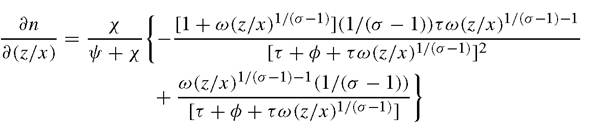
A.1: Supporting calculations for Lemmas 2 and 4
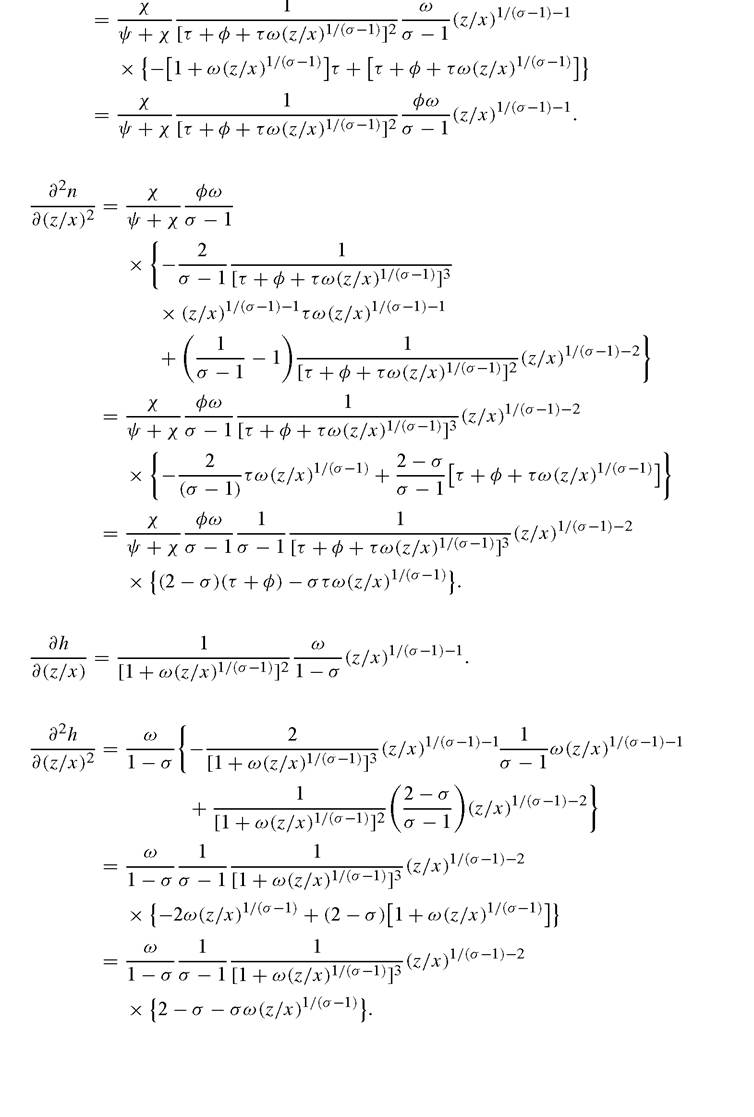
A.2: Supporting calculations for Lemmas 5 and 6

References
Becker, G.S. (1960). “An economic analysis of fertility”. In: A Report of the National Bureau of Economic Research, Demographic and Economic Change in Developed Countries: A Conference of the Universities-National Bureau Committee for Economic Research. Princeton University Press, Princeton, NJ, pp. 209-231.
Becker, G.S. (1965). “Atheory ofthe allocation oftime”. Economic Journal 75 (299), 493-517.
Becker, G.S., Barro, R.J. (1988). “A reformulation ofthe economic theory of fertility”. The Quarterly Journal of Economics 103 (1), 1-25.
Becker, G.S., Tomes, N. (1986). “Human capital and the rise and fall of families”. Journal of Labor Economics 4 (3), part 2, S1-S39.
Benhabib, J., Rogerson, R., Wright, R. (1991). “Homework in macroeconomics: Household production and aggregate fluctuations”. Journal of Political Economy 99 (6), 1166-1187.
Blau, F.D. (1998). “Trends in the well-being of American women, 1970-1995”. Journal of Economic Literature 36 (1), 112-165.
Blau, F.D., Kahn, L.M. (2000). “Gender differences in pay”. The Journal of Economic Perspectives 14 (4), 75-99.
Boldrin, M., Jones, L.E. (2002). “Mortality, fertility and savings in a Malthusian economy”. Review of Economic Dynamics 5 (4), 775-814.
Cain, G.G. (1966). Married Women in the Labor Force: An Economic Analysis. University of Chicago Press, Chicago.
Caldwell, J.C. (1982). Theory of Fertility Decline. Academic Press, London.
Caplow, T., Hicks, L., Wattenberg, B.J. (2001). The First Measured Century: An Illustrated Guide to Trends in America, 1900-2000. The AEI Press, Washington, DC.
Caselli, F., Coleman II, W.J. (2001). “The U.S. structural transformation and regional convergence: A reinterpretation”. Journal of Political Economy 109 (3), 585-616.
Doepke, M. (2004). “Accounting for fertility decline during the transition to growth”. Journal of Economic Growth 9 (3), 347-383.
Doepke, M. (2005). “Child mortality and fertility decline: Does the Barro-Becker model fit the facts?”. Journal of Population Economics 18 (2), in press.
Doepke, M., Zilibotti, F. (2003). “Macroeconomics of child labor regulation”. StaffReport 354. Federal Reserve Bank of Minneapolis, submited for publication in American Economic Review.
Easterlin, R.A. (1987). “Easterlin hypothesis”. In: Eatwell, J., Milgate, M., Newman, P. (Eds.), The New Palgrave: A Dictionary of Economics, vol. 2. Macmillan Press Ltd, London, pp. 1-4.
Echevarria, C. (1997). “Changes in sectoral composition associated with economic growth”. International Economic Review 38 (2), 431-452.
Eisenberg, M.J. (1988). “Compulsory attendance legislation in America, 1870-1915”. Unpublished Ph.D. Dissertation. Department of Economics, University of Pennsylvania.
Federal Reserve Bank of Dallas (1998). The Right Stuff: America’s Move to Mass Customization. 1998 Annual Report. Federal Reserve Bank of Dallas, Dallas, TX.
Fernandez-Villaverde, J. (2001). “Was Malthus right? Economic growth and population dynamics”. Unpublished Paper. Department of Economics, University of Pennsylvania.
Fernandez, R., Fogli, A., Olivetti, C. (2004). “Mothers and sons: Preference formation and female labor force dynamics”. The Quarterly Journal of Economics 119 (4), 1249-1299.
Fogel, R.W., Engerman, S.L. (1974). Time on the Cross: The Economics of American Negro Slavery. Little, Brown and Company, Boston.
Galor, O., Weil, D.N. (1996). “The gender gap, fertility, and growth”. American Economic Review 86 (3), 374-387.
Galor, O., Weil, D.N. (2000). “Population, technology and growth: From Malthusian stagnation to the demographic transition and beyond”. American Economic Review 90 (4), 806-828.
Goldin, C. (1987). “Women’s Employment and Technological Change: A Historical Perspective”. In: Hartmann, H. (Ed.), Computer Chips and Paper Clips: Technology and Women’s Employment, vol. II. National Academy Press, Washington, DC, pp. 185-222.
Goldin, C. (1990). Understanding the Gender Gap: An Economic History of American Women. Oxford University Press, New York.
Goldin, C. (1991). “The role of World War II in the rise of women’s employment”. American Economic Review 81 (4), 741-756.
Goldin, C. (1995). “The U-shaped female labor force function in economic development and economic history”. In: Schultz, T.P. (Ed.), Investment in Women’s Human Capital and Economic Development. University of Chicago Press, Chicago, pp. 61-90.
Greenwood, J., Seshadri, A. (2002). “The U.S. demographic transition”. American Economic Review (Papers and Proceedings) 92 (2), 153-159.
Greenwood, J., Seshadri, A., Vandenbroucke, G. (2005). “The baby boom and baby bust”. American Economic Review 95 (1), 183-207.
Greenwood, J., Seshadri, A., Yorukoglu, M. (2005). “Engines of liberation”. Review of Economic Studies 72 (1), 109-133.
Hansen, G., Prescott, E.C. (2002). “Malthus to Solow”. American Economic Review 92 (4), 1205-1217.
Hazan, M., Berdugo, B. (2002). “Child labor, fertility, and economic growth”. The Economic Journal 112 (482), 810-828.
Jones, C.I. (2001). “Was an industrial revolution inevitable? Economic growth over the very long run”. Advances in Macroeconomics 1 (2), Article 1.
Jones, L., Manuelli, R.E., McGrattan, E. (2003). “Why are married women working so much?”. Research Department Staff Report 317. Federal Reserve Bank of Minneapolis.
Kongsamut, P, Rebelo, S.T., Xie, D. (2001). “Beyond Balanced Growth”. Review of Economic Studies 68 (4), 869-882.
Laitner, J. (2000). “Structural change and economic growth”. Review of Economic Studies 67 (3), 545-561.
Landes, W., Solmon, L. (1972). “Compulsory schooling legislation: An economic analysis of law and social change in the nineteenth century”. Journal of Economic History 32 (1), 54-91.
Lebergott, S. (1964). Manpower in Economic Growth: The American Record Since 1800. McGraw-Hill Book Company, New York.
Lebergott, S. (1976). The American Economy: Income, Wealth and Want. Princeton University Press, Princeton, NJ.
Lebergott, S. (1993). Pursuing Happiness: American Consumers in the Twentieth Century. Princeton University Press, Princeton, NJ.
Malthus, T.R. (1798). An Essay on the Principle of Population as It Affects the Future Improvement of Society with Remarks on the Speculations of Mr. Godwin, M. Condorcet, and Other Writers. J. Johnson, London.
Margo, R.A., Finegan, T.A. (1996). “Compulsory schooling legislation and school attendance in turn-of-the- century America: A “Natural Experiment” approach”. Economic Letters 53 (1), 103-110.
Mincer, J. (1962). “Labor force participation of married women: A study of labor supply”. In: Lewis, G.H. (Ed.), Aspects of Labor Economics: A conference of the Universities-National Bureau Committee for Economic Research. Princeton University Press, Princeton, NJ, pp. 63-105.
Mueller, E. (1976). “The Economic Value of Children in Peasant Agriculture”. In: Ridker, R.G. (Ed.), Population and Development: The Search for Selective Interventions. Johns Hopkins University Press, Baltimore, pp. 98-153.
Nardinelli, C. (1990). Child Labor and the Industrial Revolution. Indiana University Press, Bloomington.
Ogburn, W.F. (1965). “Technology as Environment”. In: Ogburn, W.F. (Ed.), On Cultural and Social Change: Selected Papers. The University of Chicago Press, Chicago, pp. 78-85.
Oppenheimer, V.K. (1970). The Female Labor Force in the United States: Demographic and Economic Factors Governing Its Growth and Changing Composition. Institute of International Studies University of California, Berkeley, CA.
Parente, S.L., Rogerson, R., Wright, R. (2000). “Homework in development economics: Household production and the Wealth of Nations”. Journal of Political Economy 108 (4), 680-687.
Ramsey, F.P. (1928). “A mathematical theory of savings”. Economic Journal 38 (152), 543-559.
Razin, A., Ben-Zion, U. (1975). “An intergenerational model of population growth”. American Economic Review 65 (5), 923-933.
Reid, M.G. (1934). Economics of Household Production. John Wiley & Sons Inc., New York.
Rios-Rull, J.-V. (1993). “Working in the market, working at home, and the acquisition of skills: A generalequilibrium approach”. American Economic Review 83 (4), 893-907.
Rogerson, R. (2002). “The evolution of OECD employment, 1960-2000: The role of structural transformation”. Unpublished Paper. Department of Economics, Arizona State University.
Smith, A. (1973). The Wealth of Nations. Penguin Books Ltd, Harmondsworth.
Solow, R.M. (1956). “A contribution to the theory of economic growth”. The Quarterly Journal of Economics 70 (1), 65-94.
U.S. Bureau of the Census (1975). Historical Statistics of the United States: Colonial Times to 1970. U.S. Bureau of the Census, Washington, DC.
Zelizer, V.A. (1994). Pricing the Priceless Child: The Changing Social Value of Children. Princeton University Press, New York.
More on the topic Literature review:
- Abstract
- Introduction
- Conclusion
- Voluntary counselling and HIV testing
- REVIEW OF FORENSIC ASSESSMENT INSTRUMENTS
- In this Propter Honoris Respectum, I want to begin by quoting from a review that I had the pleasure of writing some years ago of one of Tom Shaffer’s books:
- Foundational Questions in Modern Constitutionalism
- Strategies Derived from the Dialogue Metaphor
- Conclusion
- Sexually Transmitted Diseases