Voluntary counselling and HIV testing
Diagnosis of infected individuals has an important role in secondary prevention, because it allows infected individuals to benefit from treatment to reduce the chance of progression to severe immunodeficiency.
Identifying those who are HIV positive in order to work with them to prevent onward virus transmission is also fundamental to primary HIV prevention.Routine HIV antibody testing of pregnant women is now recommended throughout the UK. Positive women can then benefit from antiretroviral therapy to prevent perinatal transmission of HIV and advice to avoid transmission through breast feeding. Detailed recommendations on the management of HIV positive pregnant women is dealt with in chapter 12.
HIV counselling and testing is widely available in many clinical settings in the UK, particularly in genitourinary medicine (GUM) clinics. Counselling for HIV testing was originally developed in the pre-antiretroviral therapy era and much of the content focused on the nature and interpretation of the test, and the advantages and disadvantages of knowing ones' status in the context of an untreatable infection. All clients were also advised on risk-reduction strategies to prevent the acquisition or transmission of HIV through sex or injecting drug use. In the era of HAART, GUM clinics are increasingly offering routine testing and counselling as part of their clinical services in order to identify HIV positives.
The effectiveness of testing and counselling services in achieving behavioural change for primary prevention is limited and somewhat confusing. Brief client-centred counselling has been shown to be an effective strategy in reducing future STI acquisition in only one large-scale trial, while another study demonstrated its effectiveness in different developing countries using behavioural change endpoints. However, two major reviews of the effectiveness literature have concluded that testing and counselling are only effective as primary prevention strategies for achieving sexual behaviour change within carefully defined groups, including in-treatment drug users, commercial sex workers and post-test counselling and support for those who receive a positive result. Nevertheless, for its secondary prevention benefits and primary prevention value with specific groups, voluntary
Contact addresses and numbers for further information
• National AIDS Helpline: 0800 567123
• Health Development Agency, Trevelyan House, 30 Great Peter Street, London SW1P 2HW.
Tel: 020 7222 5300• National Aids Trust, New City Cloisters, 196 Old Street, London EC1V 9FR. Tel: 020 7814 6767
• The Terrence Higgins Trust, 52/54 Grays Inn Road, London WC1X 8JU. Helpline: 020 7242 1010 (noon to 10 pm every day)
• The Haemophilia Society, Chesterfield House, 385 Euston Road, London NW1 3AU. Tel: 020 7380 6000.
• DrugScope, Water Bridge House, 32—36 Loman St, London SE1 0EE. Tel: 020 7928 1211
• Cardiff AIDS Helpline (10 am to 8 pm Mon-Fri). Tel: 01222 223443
• Northern Ireland AIDS Line, Belfast (7 pm to 10 pm) Mon-Fri. Tel: 01232 3261 17
• The Sandyford Initiative, 6 Sandyford Place, Sauchiehall St, Glasgow G3 7NP (8.30 am to 4.30 pm Mon, Wed, Fri; 8:30 to 7 pm Tue and T hur.) Tel: 0141 211 8601
• London Lesbian and Gay Switchboard. Tel: 020 7837 7324
• Gay Men's Health, 10A Union Street, Edinburgh EH1 3LU. Tel: 0131 558 9444
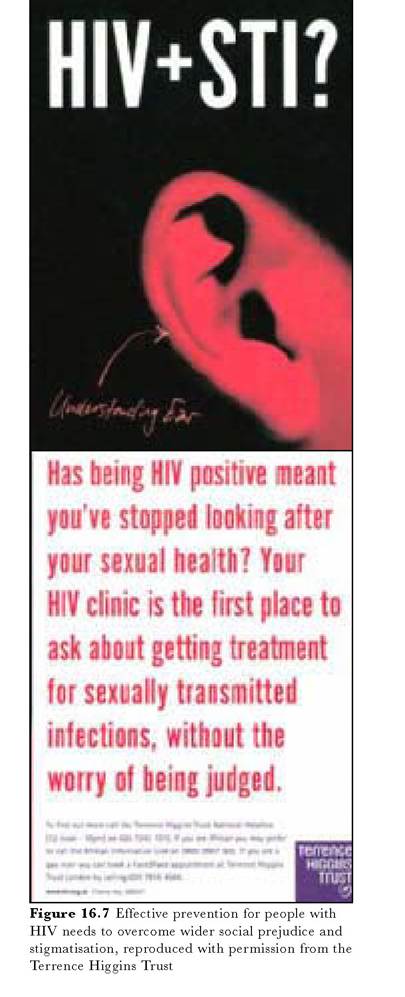
counselling and HIV testing is still an important component of any comprehensive HIV prevention strategy.
The testing scenario has much to offer with respect to individually focused prevention. The process of HIV testing offers an opportunity to use a client-centred counselling approach to undertake an individual risk assessment, discuss and develop individually tailored personal prevention strategies and consider the implications of a positive result.