Models for first-order logic
It will be useful, in order to motivate the definition of a more general concept of structure, to start with the historically important one of model for a first-order language.
A structure or relational system (or just a system) is a sequence 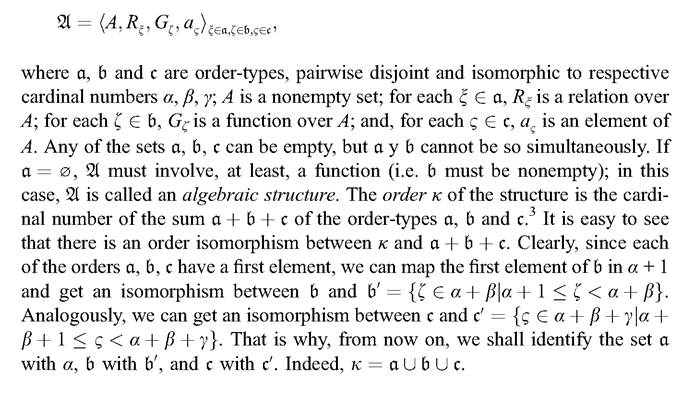
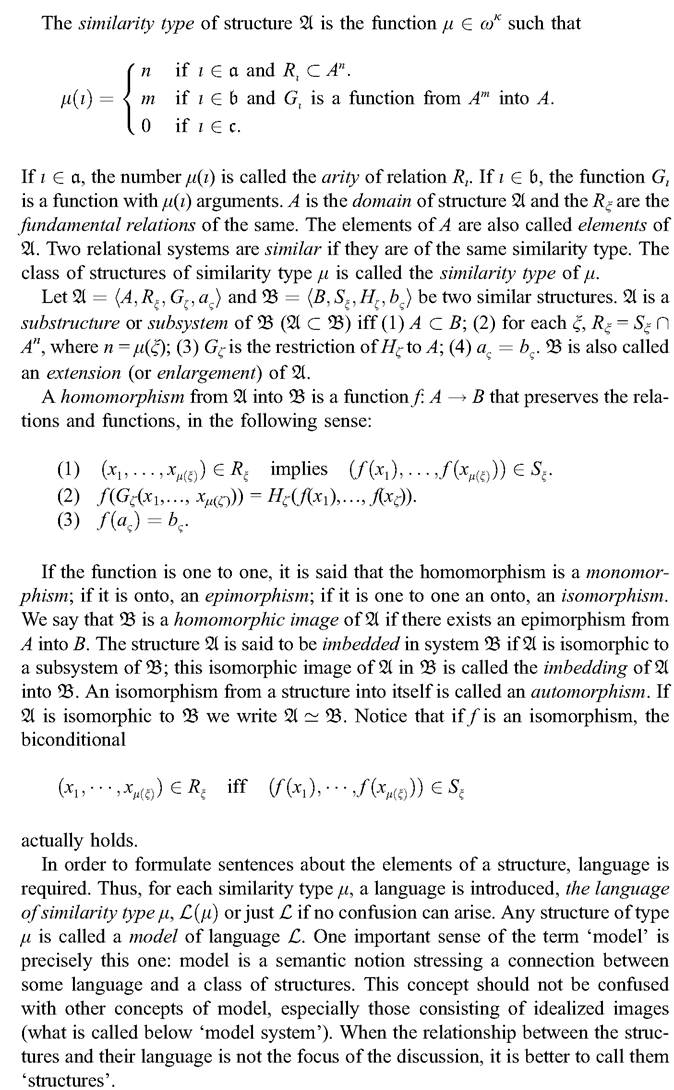
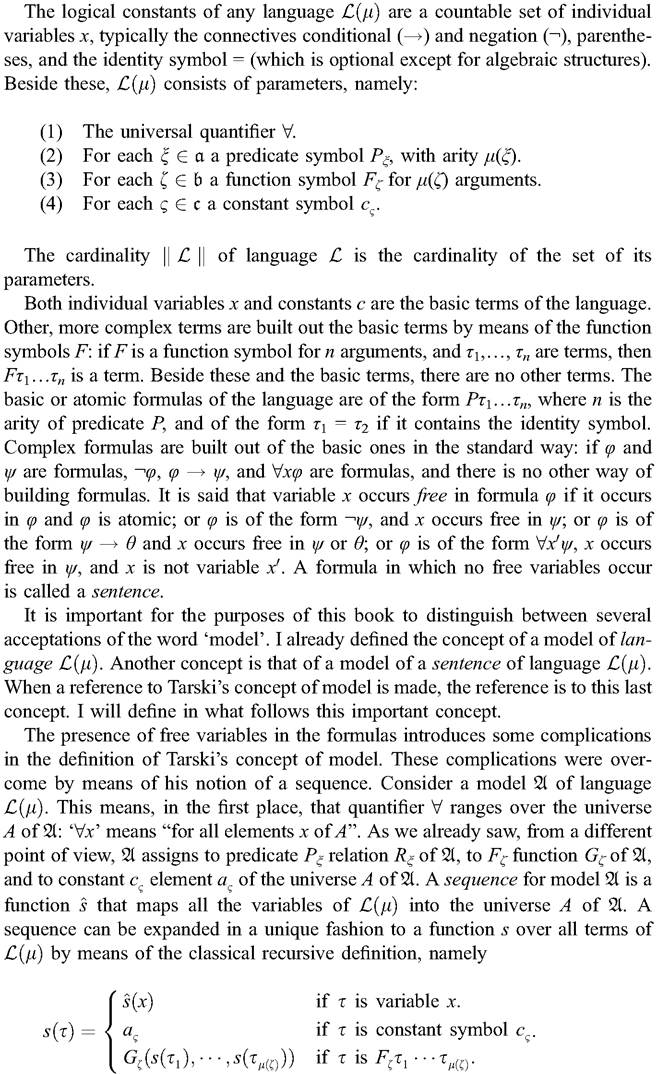
Now we are in position to define the famous notions of truth, satisfaction and
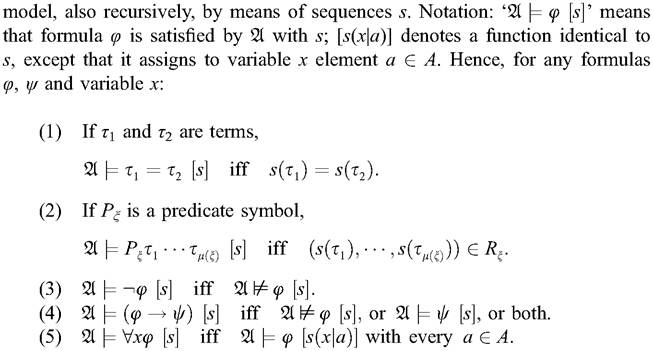
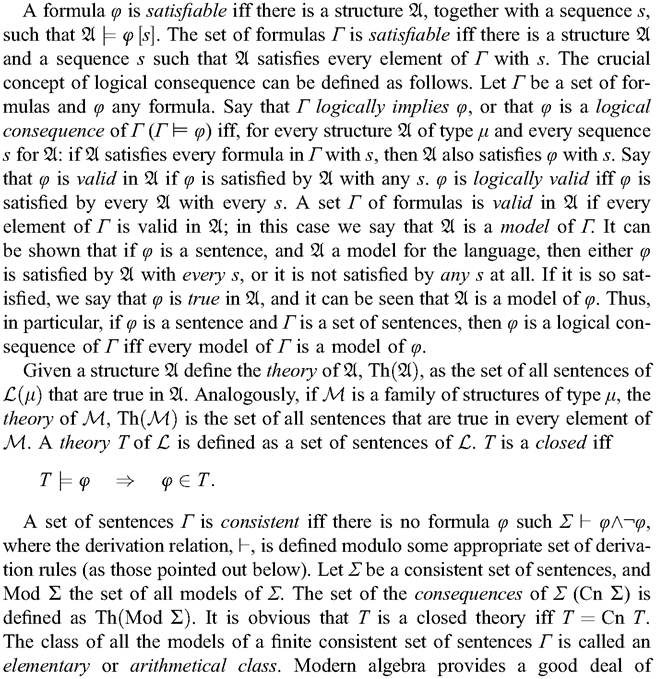
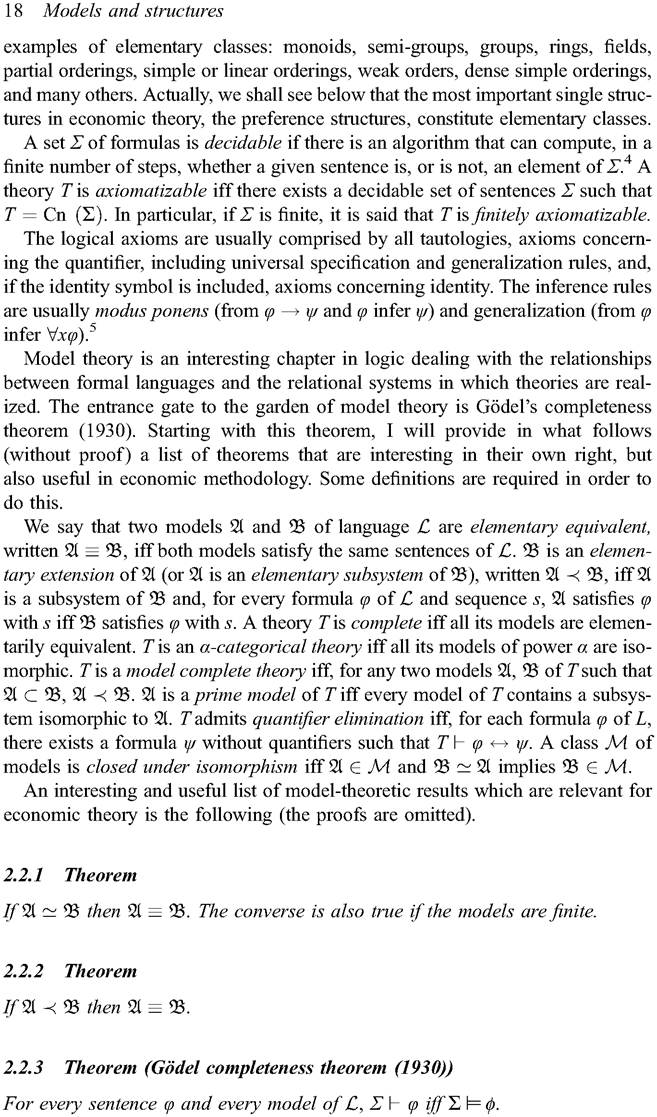
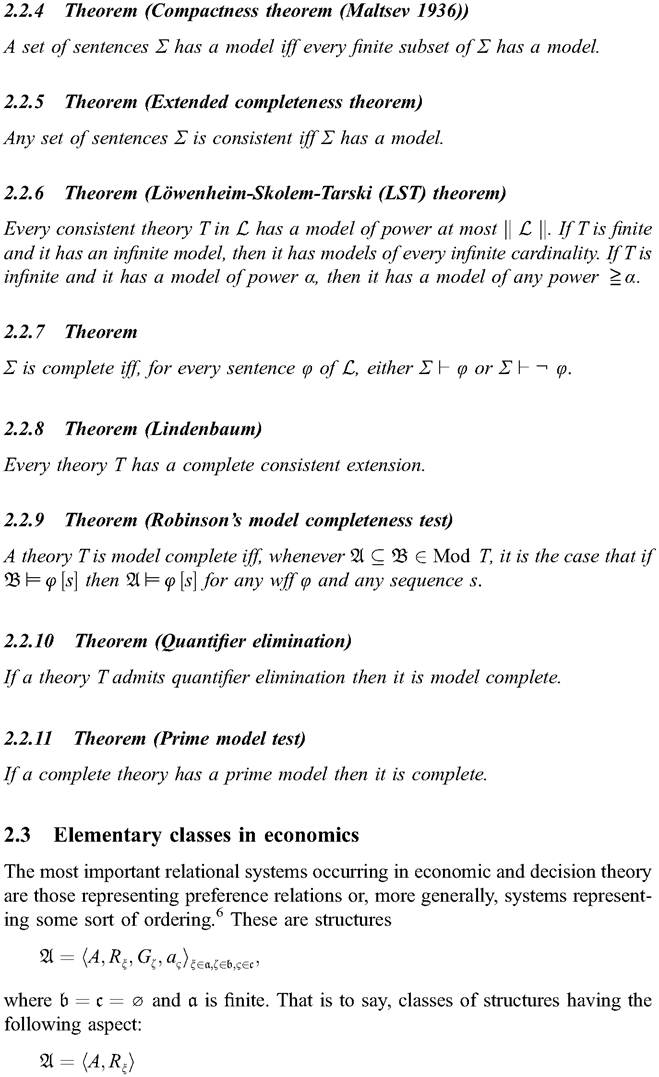
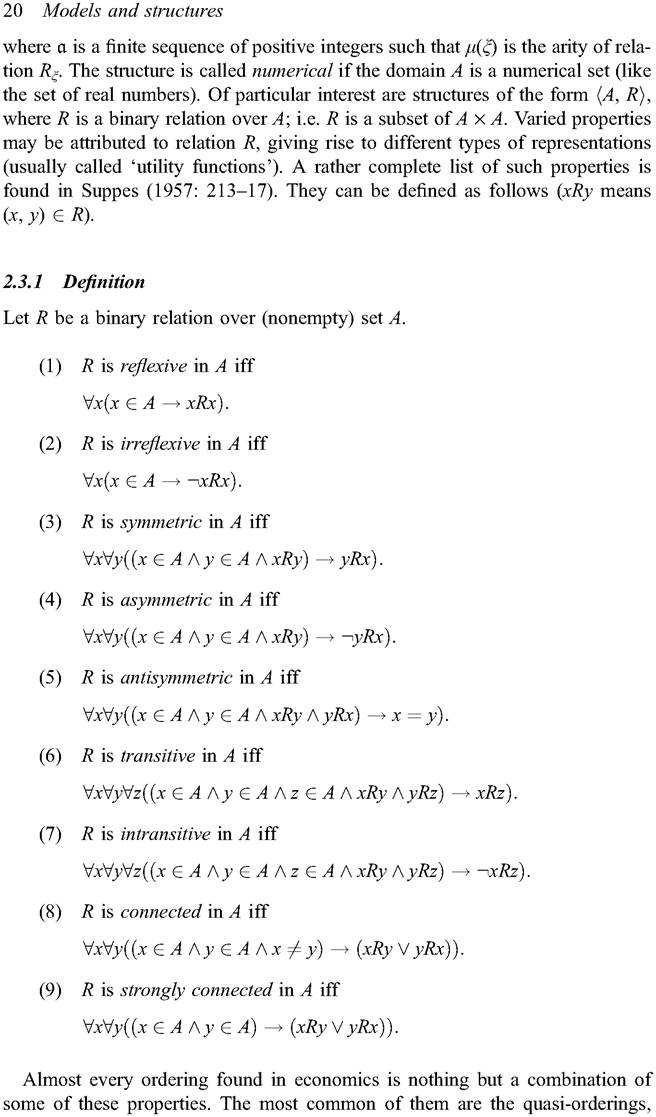
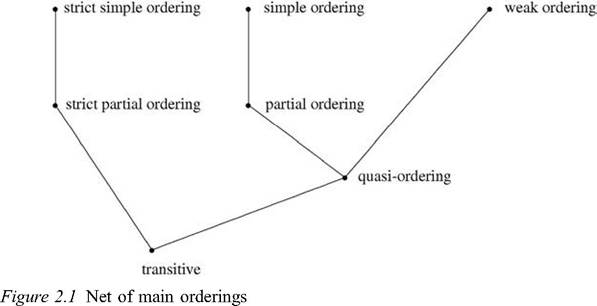
the partial, simple, strict partial, strict simple, and weak orderings.
These are easily defined as follows. R is a quasi-ordering of set A iff R is reflexive and transitive in A. R is a partial ordering of set A iff R is reflexive, antisymmetric, and transitive in A. R is a simple ordering of set A iff R is antisymmetric, transitive, and connected in A. R is a strict partial ordering of set A iff R is asymmetric and transitive in A. R is a strict simple ordering of set A iff R is asymmetric, transitive, and connected in A. R is a weak ordering of set A iff R is transitive and strongly connected in A. Figure 2.1 (taken from Suppes 1957: 223) displays the relationships between all these orderings. The structures consisting of the set A together with R bear the name of the ordering, but are called ‘orders’; for instance, the structure (A, R) is called a strict partial order if R is a strict partial ordering of A, and so on for the others.Perhaps the single most important ordering in economic theory is what is called a regular or ‘rational’ preference ordering, which is just a weak ordering. Notice that a weak order is precisely a model of the set Two consisting of the following axioms:
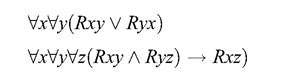
where R (more correctly written as R1) is now a predicate symbol of arity μ(1) = 2. Hence, the class of weak orders is an elementary or arithmetical class. Since Two is consistent, finite, and has an infinite model, it follows (by the LST theorem) that it has models of any infinite cardinality.
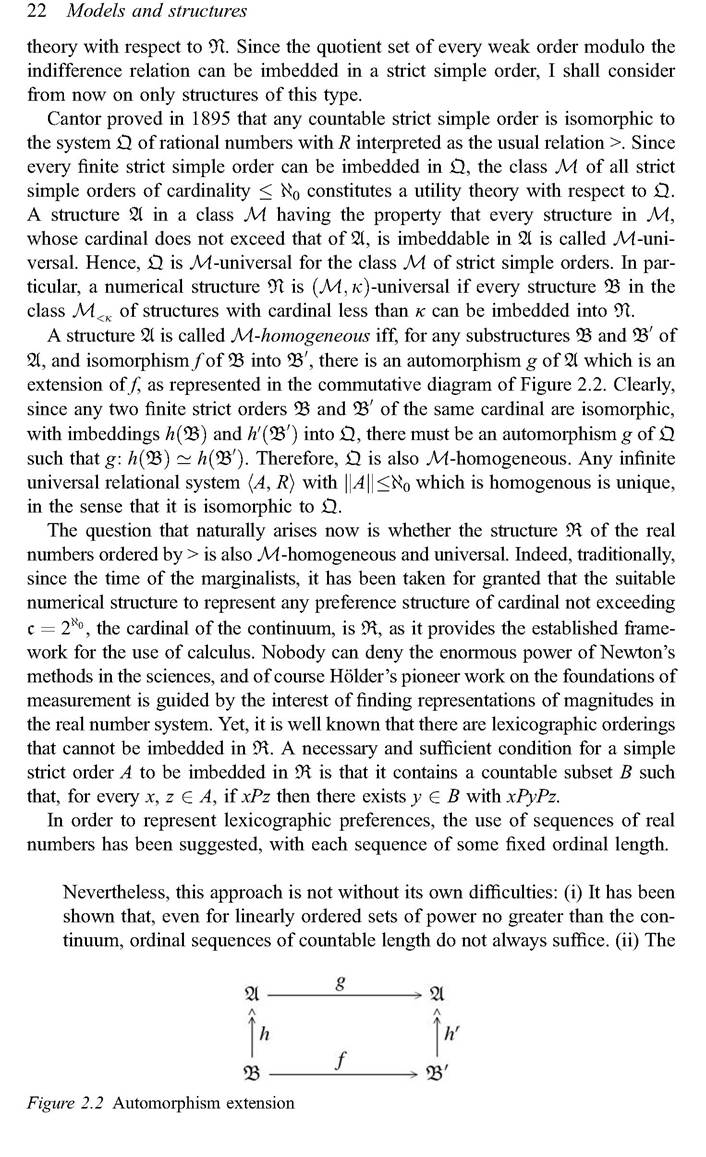
Scott and Suppes (1958: 115) defined a theory of measurement as a class M of relational systems of type a closed under isomorphism for which there exists a numerical structure N, also of type a, such that all structures in M are imbeddable in N. For the case of preference structures the theory of measurement may be called a utility theory, as it is done by Skala (1975: 10). If all structures in class M are imbeddable in the numerical system N, we say that M is a utility
techniques of classical analysis have not been extended in convenient fashion to sets of lexicographically ordered ordinal sequences.
(Richter 1971: 40)
This is not surprising, as Scott and Suppes (1958: 117) had pointed out that
among the morass of all possible numerical relational systems only a very few are of any computational value, indeed only those definable in terms of the ordinary arithmetical notions.
Hence, the problem of choosing an appropriate numerical system must be solved adopting only ‘natural’ systems, like the real number system, that have the desirable computational properties.
Marcel K. Richter (1971) solved this problem for preference structures of the same power as c by means of the introduction of nonstandard models of Th(R). A nonstandard model of Th(R) is an elementary extension *R of R that contains infinitesimal, nonzero numbers, as well as numbers larger than any positive real number. Actually, *R has more desirable computational properties than R and it is a utility theory for the class M of all simple strict orders of cardinal not exceeding c.It might be thought that this result is sufficient for economic theory, but it is sometimes necessary to consider preference relations over sets of cardinal greater than c. Actually, there are useful games in which the cardinal of the set of strategies is greater than c. For instance, McKinsey (1952: 356) describes a two-person game in which the common set F of pure strategies is a function space, the class of integrable functions defined over the closed interval [0, 1] C R. The problem with which McKinsey was concerned was that of defining the appropriate set of events for a probability space having F as sample space, in order to define the mixed strategies of the game. Our problem is to determine if there is a universal numerical system for the class M of simple strict orders containing spaces of cardinal greater than c. The solution of this problem is provided by the following theorem.
2.3.2 Theorem
The class M of all simple strict orderings contains a M-universal and M-homo- geneous relational system of power κ for every transfinite cardinal κ. This system is unique up to isomorphism.
PROOF: We beginning by observing that the class M of simple strictly ordered sets is an elementary class, since it is precisely the class of models of sentence σ0: 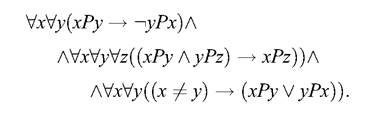
The remaining preference structures may receive analogous treatment. Yet, many properties of preferences, like continuity or nonsatiation, cannot be expressed by means of first-order formulas. Even less can most of the economic theories be expressed in first-order languages. That is why it is necessary to introduce a more general notion of structure, which is the purpose of the next two sections.
2.4