Theory of classes
Following Ackerman (1956), Frederick A. Muller (2001) has proposed a theory of classes that seems to be an adequate conceptual framework for contemporary mathematics, including category theory.
In this section I provide a modification of this theory fit for the methodology of empirical disciplines, since, in contradistinction to Muller’s version, it makes room for urelements. The variables of the language of Muller’s theory - labeled arc because it is a generalization of that of Ackerman (1956) which includes a choice axiom - take as values only classes, where these objects are implicitly defined by the axioms. What this means is that the domain of discourse of this language is a philosophical category that cannot be conceived as a class itself, let alone a set. Hence, the objects the theory deals with are entities that satisfy the English predicate ‘X is a class’, which expresses an intuitive notion with plenty of applications. Its meaning is further clarified by means of the given axioms.The methodology of any empirical science requires a theory of classes with variables taking as values also urelements. Roughly speaking, urelements are entities which are not classes, and so the English predicate ‘X is an urelement’ is roughly coextensive with what the Latin tradition called ens (being). Nevertheless, it is problematic to identify ‘X is an urelement’ with ‘Xis a being’ since for the Latin this last predicate excluded abstract entities (ens rationis). Thus, in order to avoid complications, the set of urelements must be specified in each application of the theory.
Hence, in the modified theory - which I shall call ARCU - individual variables can take as values classes or urelements. ARCU is exactly identical to ARC, but for a modification of the axiom of completeness and the addition of a couple of axioms that characterize the urelements and distinguish them from classes.
The original version of the completeness axiom expressed that every element of a set is a set; my version expresses that every element of a set is a set or an urelement. Thus the parameters or non-logical symbols of arcu are 2, V, and U, where V is the class of all sets and U the set of all urelements.A central notion of ARCU is that of a pure or safe predicate. Roughly speaking, φ(x1,..., xn) is a pure or safe predicate iff φ contains only terms for sets or urelements but V does not occur in φ. In order to be more precise, let us define a set term as the name of a set whose existence is derivable from the axioms. An ure- lement term is obviously a designator of an urelement, introduced as an individual constant. A pure or safe predicate is one in which all the terms occurring in it are set or urelement terms.
The first axiom of arcu is more a general version of the axiom of extensionality.
2.4.1 Axiom (ext)
Classes having the same elements are identical:

Notice that this axiom asserts a sufficient condition for the identity of individuals other than urelements. Nonetheless, it does not guarantee the existence of any class. Actually, since the theory deals both with classes and urelements, it is necessary to stipulate some axiom guaranteeing in an explicit manner that both U and V are classes and not urelements. The following two axioms serve this purpose.
2.4.2 Axiom (clex)
Both U and V have elements but none in common. As a matter of fact, no urele- ment is a set, and no set is an urelement:

The next axiom provides a necessary condition to be an urelement: to lack elements. The only class that lacks elements is the empty class, but then elements are characterized as individuals other than the empty class that have no elements.
2.4.3 Axiom (u)
Anything having elements is not an urelement:

The next axiom, the axiom of class separation, provides a powerful method to prove the existence of classes.
2.4.4 Axiom (clsep)
For any wff φ(x) and every class y there exists a class z containing exactly those elements of y that satisfy φ(x):

Class z is designated by the term ‘{x 2 y|0(x)}’, which is read thus: “the class of all x in y such that φ(x),∖
By virtue of axioms clex and U, we know that V is a class. Out of the existence of this class we can prove the existence of a very important one: the empty class.
2.4.5 Theorem
There is a class that has no elements
PROOF: Since V is a class and ‘x ¼ x, is a wff, a universally specified instance of CLSEP implies the following:

But this sentence asserts the existence of a class that has no elements. ?
2.4.6 Definition
We say that z is an empty class iff z is not an urelement and has no elements:

2.4.7 Theorem
There is only one empty class.
PROOF: Suppose that both x and y are empty classes. If x ¼ y, ext implies
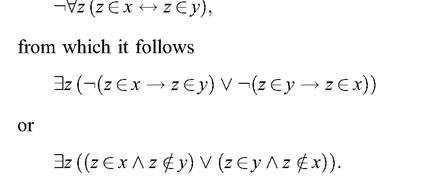
Hence, either x has an element or y has it. Since both x and y were by hypothesis empty, this shows that there can be no more than one empty class. ?
As usual, the empty class is designated by the symbol 0.
2.4.8 Definition
If y is a class, we say that x is a subclass of y, in symbols x C y, iff x is not an urelement and every element of x an element of y:

2.4.9 Theorem
The empty class is a subclass of every class:
Vx 0 C x.
28 Models and structures
PROOF: For any individual y it is the case that y = 0.
From here it tautologically follows that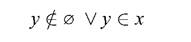
or, which is equivalent,

The completeness axiom asserts that subsets of sets are sets, and elements of sets other than urelements are also sets.
2.4.10 Axiom (compl)
The class V of all sets is complete; that is to say, every element of a set which is not an urelement is a set and every subclass of a set is a set:

2.4.11 Theorem
The empty class is a set:

PROOF: 0 is a subclass of every class, in particular of the classes that are sets. Hence, by COMPL, it is a set. ?
The following is the axiom schema of set existence. It allows the proof of the existence of sets by means of pure predicates.
2.4.12 Axiom (ackset)
For any pure predicate φ(x), if the only individuals that satisfy φ(x) are sets or urelements, then these individuals are grouped as a set:

Set y thus formed can be denoted by ‘{x|0(x)}’.
2.4.13 Theorem
For any sets or urelements x and y, there exists the set that contains precisely x and y: 
PROOF: Let x and y be arbitrary sets or urelements, and φ(u) the condition ‘u = xVw = y'. Clearly, φ(u) is a pure condition and the elements that satisfy it must be sets or urelements, so that (by ackset), the same form a set z. ?
Set z is known as “the disordered pair x and y” and is also denoted as ‘ {x, y}' or ‘ {y, x}'. If x = y, the set is written as {x} and is called the singleton of x.
2.4.14 Definition
For any set x we define the intersection of the elements of x, ∩x, as the class that contains as elements those individuals belonging to all the elements of x:

2.4.15 Theorem
For any set x, ∩ x exists and, moreover, it is a set.
PROOF: Let x be a set and let φ(y) be the condition ‘8z(z 2 x → y 2 z)'. Clearly, any individual y that satisfies it is element of a class that in turns belongs to a set. Hence, y has to be a set or an urelement and ACKSET is applicable. It follows that

But set u is none other than ∩x. ?
The next one is the axiom of regularity.
2.4.16 Axiom (reg)
Every nonempty set has an element that has no elements in common with itself:

An immediate consequence of this axiom is the following:
2.4.17 Theorem

2.4.18 Definition
Set x is a disjointed set, disy x, iff x is nonempty, the elements of x are sets, 0 2 x, and its elements are pairwise disjoint: 
This definition provides the tools for the introduction of the last axiom of arcu.
2.4.19 Axiom (c)
For every disjointed set x, there exists a nonempty choice set; i.e. a set containing exactly one element of each of the sets belonging to x:

As it has been shown in Garcia de la Sienra (2008), arcu, the theory of classes comprising axioms ext, clex, u, clsep, compl, ackset, reg, and C, implies zfc, Zermelo-FraenkeTs set theory with the axiom of choice. It is also shown thereby that it can be used to formulate the axioms of category theory, and so it proves to be an appropriate framework to formulate a general concept of structure, an endeavor to which we now turn.
2.5
More on the topic Theory of classes:
- Adolfo Garcia de la Sienra. A Structuralist Theory of Economics. New York, USA: Routledge,2019. — 235 p., 2019
- Towards the domestication of Rwandan genocide trials
- Contents
- FIVE COMPONENTS OF LEGAL COMPETENCIES
- BACKGROUND AND DEFINITIONS
- CASE 92: A Hunting Accident?
- 3 On a Legacy to the Jews of Antioch A Rescript of Caracalla
- CASE 208: The Gargilian Farm