The general concept of structure
Models of first-order logic quickly become insufficient and inadequate for mathematics and the empirical sciences. For instance, probability spaces cannot be seen as such models, since the universe of the structure must be the sample space, in order for the language to be able to talk about elementary events.
But then the field of definition of any relation must be a subset of some cartesian product of the set of elementary events. This precludes the set of events, which is a family of subsets of the sample space, and the probability measure, which is a function from the set of events into a numerical set (the interval [0, 1]), from being components of the structure.Hence, we need a more general and powerful concept of structure. One such concept was inspired by the Bourbaki group with its concept of structure, but was developed by Balzer, Moulines, and Sneed (1987), and Da Costa and Chuaqui (1988). I shall freely borrow from both sources, as I deem convenient.
Roughly speaking, a structure is a list of sets together with relations built over such sets. Hence, from an ontological point of view, a structure is just a point in the class V of all sets. For instance, a probability space is a list (S, F, P), where S is a nonempty set called sample space, F is a ring of sets over S, and P is a function from F into [0, 1]. In some sense, S is the principal set of the structure, but P cannot be characterized without the interval [0, 1] of real numbers. It is usual to call numerical sets used in the characterization of the principal sets ‘auxiliary sets’. They are distinguished from principal sets in that they are invariant under the canonical transformations (isomorphisms) of the structures. For instance, even though sample spaces can be wildly diverse, all probability measures of the (standard) probability spaces must have their values in [0, 1].
Sometimes, in the empirical sciences, the distinction between principal and auxiliary sets becomes intuitive: principal sets contain empirical objects or name the objects the theory deals with (even though these objects may be idealized), whereas auxiliary sets are invariant sets of numbers or other mathematical objects used to represent magnitudes of objects pertaining to the principal sets.
In order to specify the precise set-theoretical nature of the components of a structure, and to define precisely what a structure is, we need the rather abstract notion of a type of n species or n-type. This is defined recursively as follows.
2.5.1 Definition
Let the sequence 1,..., n of positive integers be given. The set of types of n species or n-types is given as follows.
(1) For each positive integer i < n, i is a n-type.
(2) If σ is a n-type then (σ, 0) is a n-type.
(3) If σ and τ are n-types then (σ, τ) is a n-type.
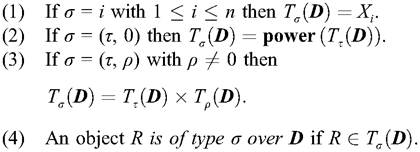
Notice that if (σ, τ) is a type, then σ = 0. A type of the form (σ, 0) is intended to represent the power set of objects of type σ, whereas one of the form (σ, τ) the Cartesian product of objects of types σ and τ. More precisely, we have the following definition.
2.5.2 Definition
Let D = (D1,..., Df be a sequence of sets and σ a type of n species. Define the set Ta(D) of objects of type σ over X1,., Xn by means of the following conditions:
2.5.3 Definition
A is a system or structure iff there exist D, R, σ, and nonnegative integers p, n, and m, such that
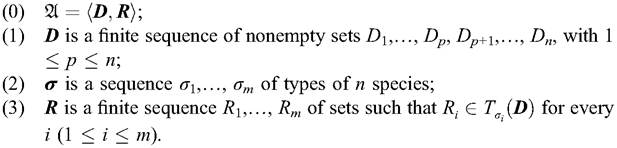
Some of the sets Di, those labeled Dp+1,..., Dn are auxiliary, but there may be no auxiliary sets at all (in which case p = n).
Clearly, a type of structure is completely determined by the length of the sequence D, the distinction between principal and auxiliary sets, and the types σ. Hence, and we are entitled to define the type of a structure as the triple (n, p, σ). Two structures A and B are similar iff they are of the same type and have the same number of auxiliary sets.It is possible to point out a minimum set to which all species belong. This can be done by means of the notion of universe of rank k over X. Let D = D1U ■ ■ ■ U Dn and define
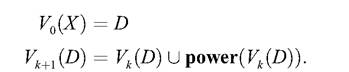
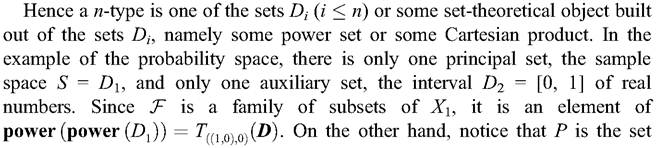
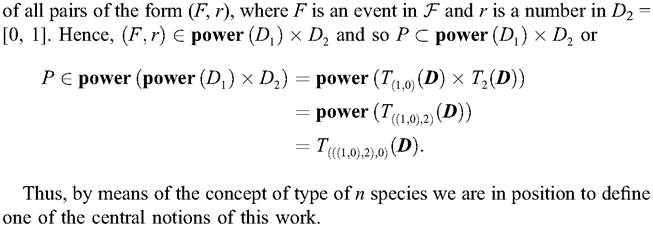
Vk(D) is the universe of sets of rank k over D. It is easy to see that Tσ(D) 2 Vk(D) from a certain k < ω on. Given a sequence σ = (σ1..., sm) of types of n species, it can be seen that there is a k such that Ts (D) 2 Vk (D) for every i = 1,., m, but Ts (D) 2 Vk (D) for some i. For instance, in order to define a certain probability space A = (S, F, P), we must take D as the union D1 U D2, with D1 = S and D2 = [0, 1]. Besides the points in V0(D), V1(D) contains all events F and [0, 1] itself. Besides V1(D), V2(D) contains all pairs (F, r) and so V3(D) contains all
subsets of such pairs, namely all subsets of F x [0,1]. Thus, S, F and P belong to V4(D) and the triple (S, F, P) belongs to V5(D). This means that A is a point in V5(D) and that the ‘constants’ S, F, P are elements of the universe B = V5(D) of the first-order structure B = (B, 2, S, F,P).
Nevertheless, it is more convenient and profitable to define the required type of structure as a point of V, in the language of ARCU, by means of characterizations; i.e. sentences of ARCU in informal language that specify the exact characteristics of the primitive terms.
For instance, instead of merely saying that the probability measure P is of type Tl^10 2) 0)(D), we may stipulate that P is function from F into [0, 1]. Obviously, such a characterization implies the corresponding typifica- tion but it has the advantage of being more specific and easy to read than the clumsier and more general typification. A characterization, as its name indicates, is just a declaration that specifies the nature of some set-theoretical object. Since the concept of characterization is so important, it is convenient to define it in a precise way.2.4.1 Definition
Let A = (D1,..., Dn, R1,..., Rm) be a structure of type (n, p, σ). A characterization is a formula φ in the language of arcu that contains, besides set-theoretical symbols and symbols for base sets, only symbols for precisely one of the relations R1,..., Rm.
A set-theoretical predicate is a formula of the form ‘A is a P’, of the language of arcu, asserting “A is a system of similarity type (n,p, σ) that satisfies Γ,, where Γ is a set of sentences of arcu. If A satisfies P, then A is called a P-struc- ture. Every class M of P-structures has associated with it a certain class of structures which we shall call ‘potential models with respect to M’. This is the class of all systems that satisfy all the characterization in Γ. Those formulas in Γ that are not characterizations will be called ‘theoretical systematizations’. Clearly, some of these will be properly nomological statements or laws.
In the case of our example, a probability space is a triple (S, F, P) (the auxiliary set [0, 1] is omitted) that satisfies the formulas in the set Γ consisting of the following sentences of arcu:
(1) S is a nonempty set;
(2) F is a σ-algebra over S;
(3) P is a function from F into [0, 1];
(4) For every A, B 2 F: if A ∩ B = 0 then P(A U B) = P(A) + P(B).
Sentences (1)-(3) are characterizations, while (4) is the fundamental law of probability theory. The class of all systems satisfying sentences (1)-(3) is the class of potential models of probability theory. Hence, probability spaces are those potential models that satisfy law (4): these are the models of probability theory.
Notes
1 The deficiencies of Peano’s logic were discussed by Van Heijenoort (1967: 83-5).
2 I take for granted here arcu, the theory of classes presented in Garcia de la Sienra (2008). Since ARCU implies zfc, as it is shown thereby, I will quote texts of authors exposing some aspect of the latter when that is convenient.
3 Cf. the definition of order-type and sum of order-types in Kamke (1950: 55-61).
4 Cf. Boolos, Burgess, and Jeffrey (2002: 71).
5 For a thorough exposition of these axioms and rules the reader is referred to Enderton (2001: 109-31).
6 Cf. Skala (1975: 2).
7 Cf. theorem 2.2.9 above, or Bell and Slomson (1969: 191-3).
8 Bell and Slomson (1969: 213).
9 Cf. Hausdorff (1914).
3