Motivation
The problem we are concerned with can be formulated thus: is it possible to find an (idealized) empirically meaningful property over a (cardinal) preference relation that enables a continuously differentiable utility representation of the same?
In order to discuss this question let us recall that, according to consumer theory, the satisfaction of a given agent at a certain consumption menu (i.e.
when the menu constitutes his current consumption) reaches a certain level. This level normally changes as he moves from that menu to another one (i.e. when he changes his consumption from the previous menu to a new one). If his preferences are continuous, to small changes in his consumption menu there correspond small changes in his satisfaction level. Hence, it makes sense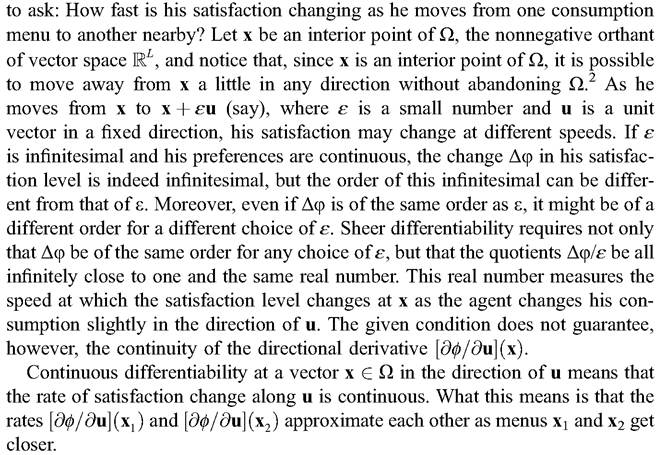
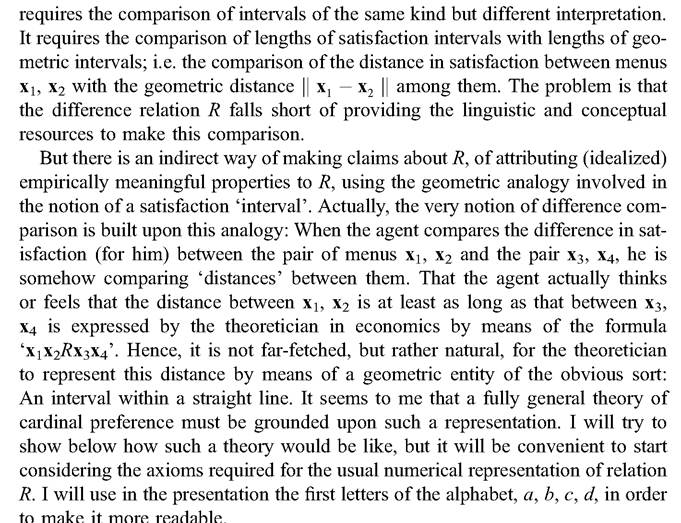
It is indeed impossible to formulate this condition within the conceptual apparatus of ordinal preference theory, or even within the usual apparatus of cardinal preference theory. This is due to the fact that the notion of differentiability
94 Preference and utility
7.4
More economic literature on Economics.Studio
More on the topic Motivation:
-
Distribution of productive forces -
Economic theory -
General economic issues -
History of economic scientists -
Macroeconomics -
World economy -
-
Conflictology -
Ecology -
Economy -
Finance -
History -
Law -
Medicine -
Philosophy -
Religious studies -