The algebraic theory of difference
There is no doubt that every consumer has an idea of the satisfaction differences between the consumption menus among which he has to make a choice. Hence, the comparison of these differences is only natural.
As we already indicated, it is usual to express this comparison by means of a difference relation R among pairs of consumption menus (represented by points in the nonnegative orthant Ω of Rl). The simplest such relation is defined as follows.7.4.1 Definition 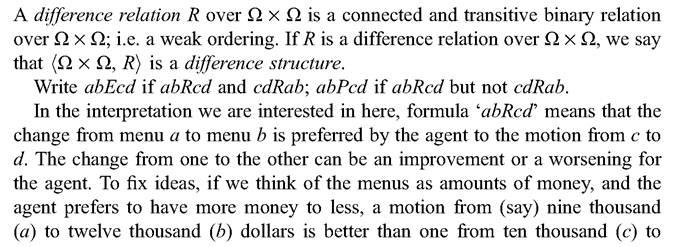
Preference and utility 95 eleven thousand (d). But, if the agent is to lose money, it is preferable for him to fall from eleven (d) to ten (c) than from twelve (b) to nine (a) thousand dollars. Thus, we shall assume (below) that

It will be necessary to introduce, also, the operation of composition of motions. For instance, we can compose the motion from nine thousand (a) to twelve thousand (b) with the motion from twelve thousand (b) to eight thousand (c). The result will be a motion from nine thousand (a) to eight thousand (c), a net loss of one thousand dollars. I will define below, in general terms, the required composition operation among intervals.
In order to formulate axiomatic conditions over R, say that interval ab 2 Ω2 is positive (ab 2 A+) iff abPcc for any c, which means that moving from a to b is an improvement for the agent. Interval ab is negative (ab 2 A ) iff ba is positive. ab is null (ab 2 A0) iff ab is neither positive nor negative. It is easy to show, out of the axioms that will be introduced below, that all null intervals are equivalent among themselves; i.e. abEcd for any null intervals ab, cd; it can be seen also that, if ab is null, then ba is also null.
We shall denote with symbol ? the operation of composition of motions. Its meaning depends upon several conditions that we can put together in six cases. In the first case, both ab and bc are positive, so that ab represents an improvement and bc another one. In this case, ab ? bc is ac, which is also positive. In the second case, we have that ab is positive and bc negative, but the distance between a and b is larger than that between b and c; thus, the net advance ab ? bc is positive and equal to ac. In the third case, ab is positive and bc again negative, but this time the loss represented by bc is greater than the win represented by ab; hence, ab ? bc = ac is negative. In the fourth case, ab is negative and bc positive, but distance ab is greater than distance bc, and so ab ? bc = ac is negative. In the fifth case, ab is negative and bc positive, but the distance between a and b is lesser than that between c and b, and so ab ? bc = ac is positive. Finally, in the last case, both ab and bc are negative, and so ab ? bc = ac is negative. Summing up, ab ? bc is always congruent with ac but this interval may be of any direction. Definition 7.4.2 provides a formal definition of operation ?.
7.4.2 Definition
Let R be a difference relation over Ω2. For any options a, b, c 2 Ω, operation ? over pairs of the form ab, bc is defined as follows: 

Notice that operation ? is not defined for all pairs of intervals, but only for those that have one option in common and have the indicated form.
A standard sequence of elements of Ω is a set {ak}k2κ, where K is an initial segment of the set Z+ of positive integers (or the whole set), such that ak+1akEba for all ak, ak+1 in the sequence, and it is not the case that baEaa. The sequence is strictly bounded if there exist a', a" 2 Ω such that a'a''PakaPa''a for all k 2 K.
I will assume that relation R satisfies the conditions specified in the following definition.
7.4.3 Definition 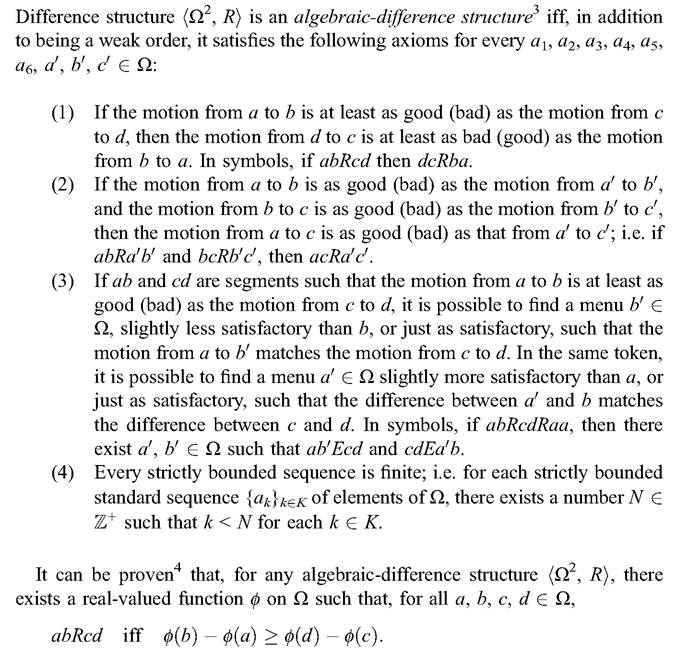
φ, which is a utility function, is unique up to a positive linear transformation; i.e. if φ' is another such utility function, then there are real constants α, β, α > 0, such that φ' = αu + β. This means that φ is, indeed, a cardinal utility function.
7.5