Some Generalizations on Random Terms, Heterogeneities, and Social Interaction
We can decompose the utility on the alternative a into the deterministic part Va and the random term eα, which then allows us to develop the utility function V to a more general U.6,7

6This part was firstly written in Japanese: Aruka (2004b, pp.
163-166).7See, for example, Durlauf (1997).
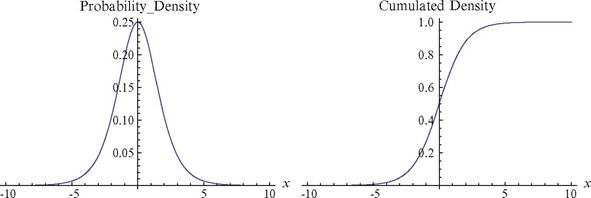
Fig. 2.1 PDF and CDF of a logistic distribution. Note: Here η is set as 1
In the choice set is C = {a, β}, the binary choice. This might, for example, mean an individual i choosing to be either a musician to guarantee the utility Va or a doctor to guarantee Vβ. However, this choice is likely to be affected by events; for example, attending a gig by a favorite band. Each alternative will be influenced by the random terms ea,eβ. The binary choice probability of a is then given by:

If we limit the binary choice, we can assume that the next choice set will be:

A particular choice will be realized by a probabilistic distribution of random shocks. We assume a logistic distribution within a particular z of the probability of the random shocks on a binary choice ei (—1) — ∈i(1) for individual i.

On the choice plane Xi for i, we distinguish the observable characteristics from the unobservable heterogeneity ηi. Here ηi = η(Xi) > 0.
The density function of the logistic distribution is symmetrically bell-shaped. As η becomes larger, the probability that the difference in utility falls within a certain value of z decreases (Fig. 2.1).Individual i has his own belief about the choices of the other members of the group I based on information received, F:

Individuals are inclined to either conform to or deviate from the choices of others in the group.[31] When all the members make the same choice, social utility for any one individual is zero. When they all deviate, according to the Ising model, the social utility for agent i is negative:

The weight of the interaction Jj (Xi) on the domain of observable characteristics Xi is denoted by Jij, relating the choice for i to that for j. (ωi — ωj)2 will then give the conformity effects. Social utility S is a subjectively expected value based on individual i's belief about the distribution of social interaction [Jj∙ (Xi)].
The decision process of individual i is therefore:

It is easy to derive the solution ωi by linearization of utility function U. We assume that:

hi and κi are such that:

Since the random shocks are assumed to be subject to the logistic distribution, the probability distribution of the choice of individual i, i.e., ωi, can be solved:

Thejoint probability distribution of the whole population of the choice of ω is then:
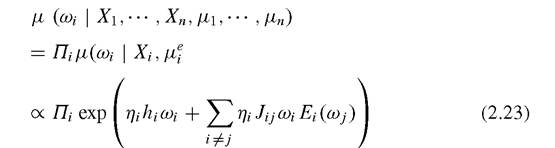
This solution is underpinned by certain limited assumptions including linearization of the utility function and a special form of the error distribution. By introducing
Fig. 2.2 The framing image of random preference.
Source: Aruka (2007, Fig. 2; 2011)
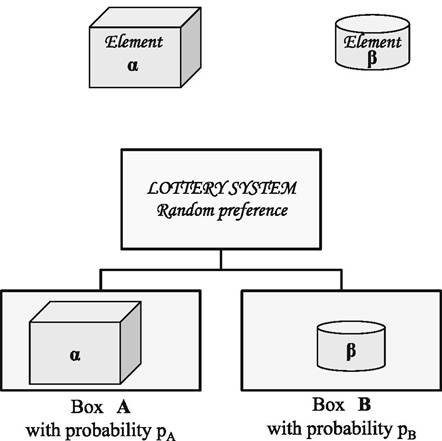
randomness, heterogeneity, and social interaction, however, it may be possible to predict a macroscopic motion to abandon individual subjectivism, moving away from a shortsighted focus on intrinsic preferences. In Fig. 2.2, we show the framing image of random preference. Intermediating by a “lottery system”, we may be taken into either parallel world.
2.1.4