Some Essential Differences Between Frames
If we focused on the introduction of uncertainty, we would touch on some essential differences.[32] We may formulate several possible frames of preferences under different conditions of uncertainty:
A.
State-dependent preference• A1: If it is hot, the individual prefers to drink milk.
• A2: If it is not hot, the individual prefers tea.
B. Random preferences
• B1: If it is hot, the individual is more likely to prefer milk.
• B2: If it is not hot, the individual is less likely to prefer tea. If it is cool, the individual is more likely to prefer tea.
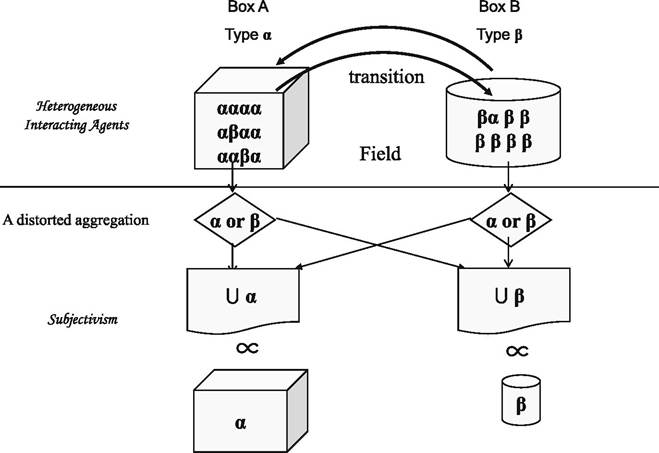
Fig. 2.3 A comparison between heterogeneous framing and random framing. Source: Aruka (2007, Fig. 4; 2011)
C. Socio-dynamic view
• C1 : If it is hot, many prefer milk but some prefer tea.
• C2 : If it is neither hot nor cool, many prefer tea and a few prefer milk.
Random preference, as in B1&2, is directly applied, because all the utilities in the model are deterministic and only externally subject to random shocks. Heterogeneous interaction in the context of the Ising model from physics is only introduced in terms of social utility. Heterogeneous interactions are extrapolated to individual utility. Private utility is not affected by social utility, and will never be reflected by heterogeneous interaction rather than by noise interference. Random preference, at first glance, indicates B1&2. The idea of a subjective agent is essential to both A and B, and is one who aims to optimize their subjective object. We may, however, create another interpretation by framing the case differently, as such an agent is not necessary in case C, moving us away from individual subjectivism. Figure 2.3 illustrates an essential difference between the two frames.
2.2
More on the topic Some Essential Differences Between Frames:
- Coordinated Management of Meaning
- Personal Skills Required to Be a Good Conflict Manager
- THE PROCESS OF CONFRONTING TERRORIST-RELATED CONFLICT
- PROBLEM SOLVING
- A Road Less Travelled: The Metaphor of the Constitutional Advice-Giver
- THEORETICAL BASIS OF MULTICULTURALISM
- The Nature of the Dispute
- HOW TO INTERVENE IN CONFLICT, CONTROL NEGATIVE EMOTIONS, AND FOSTER POSITIVE EMOTIONS
- A hegemonic discourse
- IMPLICATIONS FOR INTERVENTION IN INTRACTABLE CONFLICT