Coordinated Management of Meaning
CMM is both a practice and a theory that takes a communication perspective (Cronen & Pearce, 1981). CMM has a point of view and models that can be useful in supporting the framing and contextualizing of the conflict.
There are three principles in CMM, which are coordination, coherence, and mystery (Pearce, 2004). In interacting with others, we strive to coordinate our actions and communication, so that we foster mutual understanding. Coherence is our own sense making, in that our experiences fit with our expectations, and we understand what this means to us in our lives at that time. Dissonance is unsettling and may cause anxiety. The third principle, mystery, acknowledges the complexity of our world and relationships, and that situations and circumstances are not always what they appear to be. It is more comfortable and causes less anxiety if we view this complexity as something to be curious about rather than fearful of as we strive for coherence. Figure 30.2 depicts how coordination, coherence, and mystery are interconnected.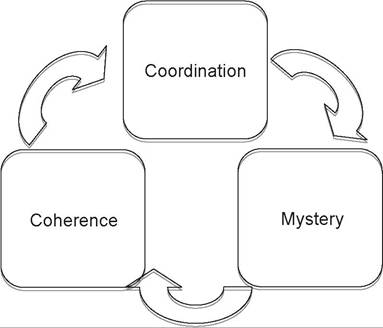
Figure 30.2 Interdependence Among Coordination, Coherence, and Mystery
Together these three principles interact and influence each other. For example, if our communication and interactions with another person are not smooth or clear, the confusion can cause us internal dissonance. We then seek understanding as we try to make sense of our surroundings, and we may accept an explanation that is not complete and perhaps not accurate, but it satisfies our need to know and feel secure. This premature rendering of an explanation will most probably be in alignment with our frames of reference or worldview and may not be considering fully the influence of our conversation partner’s worldview frames. We may be omitting important pieces of information that could inform us, but in our haste to squelch the dissonance of not knowing, we jump at the first explanation.
This issue of dissonance, and therefore seeking internal coherence, may deter us from managing paradoxes when dealing with inter- cultural communication and instead seek an absolute response. To foster better coordination with others across cultures, we need to find ways to be comfortable with the mystery that managing a paradox brings. The danger of acting on biased or uninformed explanations is that we usually do not realize they are ill formed or biased. The five paradoxes to understanding cultural dimensions in combination with CMM provide us with tools to use as a frame to enter into and more successfully manage intercultural interactions.
CMM uses a Hierarchy of Meaning Model (Fisher-Yoshida, 2012; Pearce, 2007) to highlight and differentiate the various contexts and draw attention to the varying levels of metacommunication present within and between these contexts. The meaning we extract from our communication is very much influenced by the context within which the actual words are spoken and actions taken. This specific example will illustrate the point.
Someone performs the speech act of moving to a different country and into an environment in which community involvement is core to the way of life. This and other speech acts can take place in the episode of the community coming together one Saturday a month to clean the local parks. If I interpret this act through the context of self, I may be trying to enjoy my day off from work and feel annoyed by what I consider an unfair imposition because this practice is not familiar. If I instead interpret this act through the context of being a member of the group because I now live in the same community, I may interpret this act as a good thing and join in the park cleaning. If I connect with the people calling on me Saturday morning to join their cleaning crew,
| Self | Relationship |
| Episode | Episode |
| Speech act | Speech act |
Figure 30.3 Context of Self and Relationship
I may be viewing it from the context of relationship, empathize, feel honored, and join them.
Figure 30.3 shows the different hierarchies of how self and relationship may be configured.The main point of talking through these different levels of context is to highlight that the contextual lens I am using to understand a behavior will directly influence the meaning I make of that behavior and the subsequent actions I take next in response to that speech act. Each context has filters that shape how I frame and understand the speech act because different elements in that context are heightened for me. Cultural influences play a significant role in creating some of those filters, and people involved may make different interpretations, resulting in conflict, which can be exacerbated when communicating across cultures.
Relationship as
Higher Order Context
There are many ways to name and frame contexts. If we name the context of relationship as the highest order from within which we act and make meaning, it will lend a particular frame to how we understand the communication. Inside the framing of relationship, we place the aspects of self and other because they are both part of the dynamic of the interaction that takes place in relationship. The context of relationship with self and other relates directly to the paradox of knowing; the better we know and understand self and other, the better chances we have of being in coordination. Figure 30.4 shows the context of relationship.
Our sense of s elf is created from our cultural norms, values, and beliefs. We may have more than one social identity depending on the role we play in any particular interaction. Am I a student, CEO, father, religious observer, chef, or another role I take on within any given day? One or more of these roles are privileged in each of our interactions because it is from that social identity that we engage in this encounter with another. The other person with whom we are engaging also has myriad social identities and elevates one or more of these roles as well.
We both may not be agreeing on which social identity role we are interacting with and that can cause serious miscommunication because we frame the communication with different lenses. You may call yourself a freedom fighter, and all your communication and behaviors are explained from that social identity. If I view you as a terrorist, then everything you do or say is going to come through that filter. I interpret, make meaning, and act from that interpretation.Relationship
Self and Other
Figure 30.4 Self and Other in Relationship
There are different ways of defining relationship and the parameters that are used to categorize the different types that exist. For the purposes of assigning relevance to relationship as a context within which we live and interact, we will assume that there is interdependence between the involved parties (Deutsch, 2006). This means that the success or failure of one party directly influences the success or failure of the other; we sink or swim together is a positive interdependence; you sink I swim or vice versa is a negative interdependence. In relationships where we have interdependence, we can choose to be cooperative (positive interdependence) or competitive (negative interdependence), and each orientation has its own set of behaviors, assumptions, and processes (Deutsch, 2006).
Three elements characteristic of interdependence are s ubstitutability, attitudes, and inducibility (Deutsch, 2006). Substitutability is a basic function of social life, and that is when we can substitute someone else’s actions to satisfy our intentions or needs. We have division of labor, and this is why we can perform some tasks and depend on others to fulfill other tasks, such as farming, building, teaching, and governing. The flip side of this is negative substitutability when we reject or actively try to thwart or counter these actions. Attitude refers to our predisposition toward another; are we favorably or unfavorably inclined as this influences how we interpret and understand this other person.
Inducibility refers to the level of readiness and openness we have in accepting someone else’s influence, and the flip side of this is negative inducibility when we actively reject another person’s influence.Substitutability and inducibility are complementary, in that we are more favorable to those who help us and thus more willing to reciprocate, and those who we perceive as harmful to us we will reject and not help (Deutsch, 2006). Our attitude influences how we view the substitutability-inducibility dynamic, and this dynamic also influences our attitudes. They are all interconnected within the context that we label as relationship. Differences may occur across cultures in how we recognize and respond to acts of substitutability and inducibility. We may look for certain behaviors to depict which people we find helpful, and in what ways and how we want to reciprocate. This reciprocation may or may not be recognized as such by someone viewing and interpreting these acts from different cultural lenses. So an act of “helping” may not be viewed as such and may in fact be viewed as the exact opposite.
We frame our understanding based on our attitude, the structure of the relationship, and the cultural and social lenses we bring. The history of our relationship also plays a key role in how we interpret subsequent conversations and interactions. In social interactions, especially conflict situations, we tend to get caught up in unwanted repetitive patterns (URPs), because we follow rules of communication that set certain dynamics in motion to elicit familiar behaviors and responses (Cronen, Pearce, & Snavely, 1979). These rules are culturally created and socially endorsed. To move beyond these URPs toward more productive patterns of communication, we need to shift our perspectives, and one way of doing this is by reframing the context. Instead of my story or your story, we envision and live into “our” story.
Pearce and Littlejohn (1997) refer to this type of communication as transcendent in that it highlights a metastory that overarches the individual stories of the groups involved in the conflict. This is impactful, because as humans we are social beings, who are linguistically connected and use stories as a means of developing our individual and collective identities. New stories can be cocreated that are inclusive of different cultural values and behaviors and use this inclusiveness to build on the context of relationship in managing effective communication across cultures. Conflict will most likely still occur, and it can be an opportunity for this transcendence as we consider ourselves as members of a larger expanded community (Briskin, Erickson, Ott, & Callanan, 2009). This concept of transcendence offers a different way of thinking about conflict, and the next section will discuss ways in which we can transform our communication to language of we in relationship.
More on the topic Coordinated Management of Meaning:
- Some Essential Differences Between Frames
- References
- Oetzel John, Ting-Toomey Stella. The SAGE Handbook of Conflict Communication: Integrating Theory, Research and Practice. SAGE Publications,2013. — 912 p., 2013
- Subject Index