The demise of child labor
Economically valuable and emotionally worthless to economically worthless and emotionally valuable. In 1896 the Southern Railroad Company of Georgia was sued for the wrongful death of a two-year-old boy.[148] The parents claimed that their son performed valuable services worth $2 per month, “going upon errands to neighbors...
watching and amusing... younger child”. The court’s judgement allowed just for minimum burial expenses to be recovered. The ruling stated that the youngster was “of such tender years as to be unable to have any earning capacity, and hence the defendant could not be held liable in damages”. The problem was that the boy was too young to do productive work. And the court attached no value to the pain and suffering connected with the loss of a child. An older child could earn money, but it was still a fraction of what an adult would get. For example, a ten-year-old in 1798 could earn the equivalent of $22 a year working as a farm laborer, as compared with $96 for an adult - Lebergott (1964, pp. 49-50).Now move forward in time to January 1979. The New York State Supreme Courtjury awarded $750,000 to the parents of three-year-old William Kennerly. He had been given a lethal dose of fluoride in a city dental clinic. The twentieth century has witnessed a profound transformation in the value of children. Along with the Second Industrial Revolution emerged the “economically worthless” and the “emotionally priceless” child. For in strict economic terms, today’s children are worthless to their parents. They are expensive. The direct cost to a two-parent median income family of raising a child born in 1995 through to the age of 17 was estimated to be $145,320.[149] And this does not include college costs, time costs, and foregone earnings. In return they provide no labor.
What caused this dramatic change in society’s valuation of children over such a relatively short period of time? And what accounts for the apparent paradox that the value in the twentieth century that society placed on an economically useless child far surpassed the one in the nineteenth century that society placed on an economically useful child? A case can be made that technological progress resulted in the liberation of children from work.
Increased mechanization of agriculture and manufacturing in the late nineteenth and early twentieth centuries resulted in a decline in the demand for unskilled labor and a rise in the demand for skilled labor. Thus, the return to skill rose. This created an incentive for parents both to educate their offspring more, and to have less of them; i.e., to substitute away from quantity toward quality of children. The death of child labor was natural.4.1. Theenvironment
The analysis here closely follows the setup of the previous section. Assume that an individual lives for three periods: the first as a child, and the second and third as an adult. In the first period of life a person undertakes no economic decisions; he simply accumulates the level of human capital dictated by his parents. He begins the second period of his life with a fixed number of children, η. In addition to being exogenous, childbearing is costless. Skilling a child, however, involves two costs. First, as before, there is the direct cost of educating the child. In particular, endowing a child with h' units of human capital involves a cost of φh' units of unskilled time. Second, there is the opportunity cost of sending the child to school; that is, by going to school a child forgoes some labor earnings. Specifically, suppose that a child is as productive in the labor market as ζ < 1 unskilled adults. Additionally, assume that in order for the child to acquire h' units of human capital he must go to school for h' units of time.
A young adult’s decision problem. The economic environment is pretty much the same as that in the previous section, with the above notable exceptions. Another distinction is that a parent now cares about the leisure that his children will enjoy, in addition to his own consumption and the quality of his children. The purpose is to break the link between the time spent schooling and the time spent working by children. The analogue to choice problem (20) is

where once again consumption when old, co/, has been substituted out using the Euler equation (19).
Inthis maximization problem, h denotes the human capital of the parent, h' the human capital of the child, l the leisure time for the child, w the unskilled wage rate, υ the skilled wage rate, and π is the flow of profits associated with the operation of firms in the agricultural and manufacturing sectors.The first-order condition for h' is

The right-hand side of this equation gives the value from extra human capital accumulation in children. It has the same form as (22). The left-hand side gives the cost of extra human capital accumulation. Observe that part of this cost is the forgone earnings wζ that a child would realize by working instead of going to school. Also, the cost of educating kids is an increasing function of the number of kids η. Hence, one would expect that as η falls h' should rise. Note that an equiproportionate increase in υ, υ', w, w' and cy will have no effect on h'. Consequently, along a balanced growth path h will be constant. Hence, in order to get some action it must transpire that v must rise relative to w, or equivalently that z must increase relative to x. Recall that this was exactly what was needed to account for the U.S. demographic transition in Section 3.
Finally, the first-order condition for leisure reads

The right-hand side of this equation gives the marginal benefit from providing an extra unit of leisure to each child while the left-hand side gives the marginal cost. Observe that for leisure, l, to increase, cy must rise relative to wη. This will happen if either v rises relative to w, or if the level of human capital h increases, ceteris paribus. Note that a fall in fertility, η, plays an important role in increasing l. When fertility declines, the marginal cost to the parent of providing more leisure to each of his children falls, hence leisure rises.
4.2. Analysis
Imagine that the economy is resting in a steady state where z and x are constant.13 Variables such as h, l, w∕cy and v∕cy will also be constant. Others such as the size of the young generation, ∙s∙y, will be changing at a constant rate dictated by the size of η. The market-clearing condition for skilled labor will again be described by (26). The one for unskilled labor will now appear as
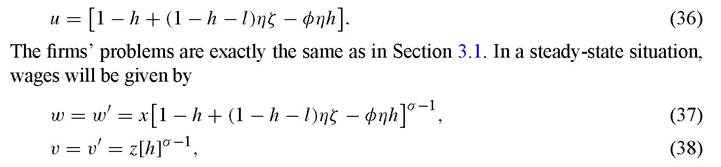
which follow from Equations (24), (25), (26) and (36).
In principle one can solve the first-order conditions (34) and (35), in conjunction with (37) and (38), to obtain a solution for h and l.14 General results are hard to obtain for
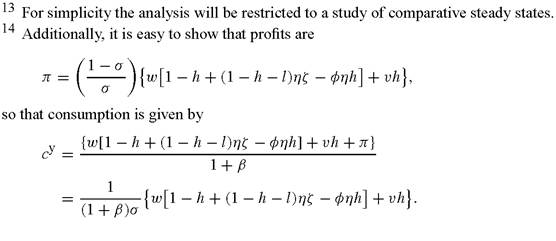
this economy, however, so a numerical example will be used to highlight the effect of changes in z/x and η on h.15 The goal of this example is to show that the above setup is capable of generating a large decline in child labor. Little attention has been paid to its realism.
EXAMPLE 4 (The natural death of child labor). Assume the parameter values listed below.
(i) Tastes: β = 0.9420, χ1 = 0.14, χ2 = 0.03, ψ = 1 — χ1 — χ2.
(ii) Technology: σ = 0.7.
(iii) Childcare: φ = 0.1.
(iv) Child productivity: ζ = 0.15.
Again, start off in 1800. Set η1800 = 3.5, since an average family gave birth to 7 children. Observe that in work a child has the productivity of 0.15 adults.16 Assume that z1800 = x1800 = 1. Then Equations (34) and (35) imply that h1800 = 0.025 and Z1800 = 0.16; i.e., about (1 — h1800 — Z1800) ? 100 = 81.5 percent of children are gainfully employed.
Now, move ahead to 1940. TFP in agriculture grew by a factor of 1.95 while TFP in manufacturing grew by a factor of 4.11. Consequently, (z∕x)1940 = (4.11/1.95) ? (z∕x)1800 = 2.1. Also, let η1940 = 1.1. Now, h1940 = 0.49 and Z1940 = 0.51 so that no child works in 1940!Child labor laws and compulsory schooling laws. Child labor laws are often cited as a reason for the decline in child labor. While the National Child Labor Committee was formed as early as 1904, it was not until 1938, when the Fair Labor Standards Act was passed, that children were freed from the bondage of dangerous work. The data suggests that the process of the withdrawal of children from the workforce had been completed before child labor laws were firmly in place. The conventional wisdom among economic historians is that these laws had little impact on teen attendance early in the twentieth century because the laws were imperfectly enforced [Landes and Solmon (1972) and Eisenberg (1988)]. More recent work by Margo and Finegan (1996) finds significant positive effects on school attendance when compulsory schooling laws were coupled with child labor laws. There is still the possibility that the enactment of these laws was a reaction to the greater demand for skilled labor, and the lower demand for unskilled labor, caused by industrialization. Nardinelli (1990) echoes this sentiment and provides evidence that those areas that industrialized first were also among the first to adopt these laws. Hence the enactment of these laws in more industrialized states is consistent with

the notion that technological progress increased the demand for skilled labor vis a vis unskilled labor and consequently reduced the demand for child labor.
The above example suggests that sector-specific technological progress alone can account for all of the decline in child labor. There are three effects at play.
First, the demand for skilled labor rises relative to unskilled labor. This increases the skill premium, and promotes investment in skill via a substitution effect. Second, technological advance makes parents wealthier. This income effect makes parents more likely to invest in the well-being of their children. Third, fertility drops also, which reduces the cost of educating a family. Consequently, h and l both rise. A more serious treatment of the issue of child labor would endogenize fertility and incorporate the quantity-quality trade-off that parents face. There is one aspect of the data that make a technology-based explanation appealing. The period from 1900 to 1930 saw a dramatic decline in child labor. These three decades saw an enormous increase in manufacturing productivity relative to agricultural productivity z/x. The United States experience accords well with this implication. Last, observe that the utility flow that a parent realizes from a child increases with technological progress. This transpires because both the child’s level of human capital (or quality) and leisure rise.5.