The U.S. demographic transition
At the start of the nineteenth century most adult males worked in the agricultural sector and children got very little in the way of a formal education. By the end of the twentieth century almost no adult worked in agriculture, at least relative to nonagriculture.
The average child received about 13 years of formal education. To address these facts, a two- sector version of the standard neoclassical growth model will be employed. One sector will represent agriculture, the other manufacturing. Agriculture hires unskilled workers while manufacturing employs skilled ones. In the framework developed, parents will decide upon both the number of children to have and the level of education for their offspring. The idea is that as manufacturing expands relative to agriculture, the demand for skilled labor rises. This entices parents to provide more education for their children. Since education is costly, they choose to have less kids too.3.1. Theenvironment
Take the setup of the previous section with two slight modifications.[146] First, assume that parents now care about the quality of their children in addition to the quantity of them. Second, suppose that there are two production sectors in the economy. One sector uses solely skilled labor, the other only unskilled workers. A unit of skilled labor earns the wage v, while a unit of unskilled labor gets w. A parent must choose the skill level to endow his offspring with (or the quality of his children).
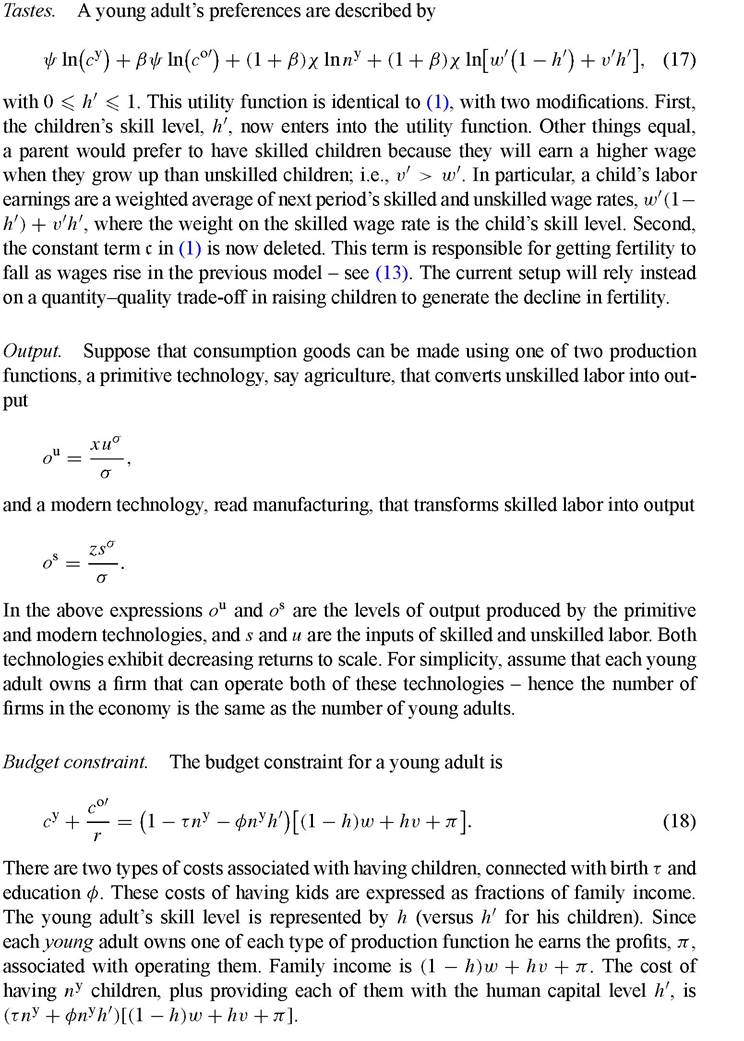
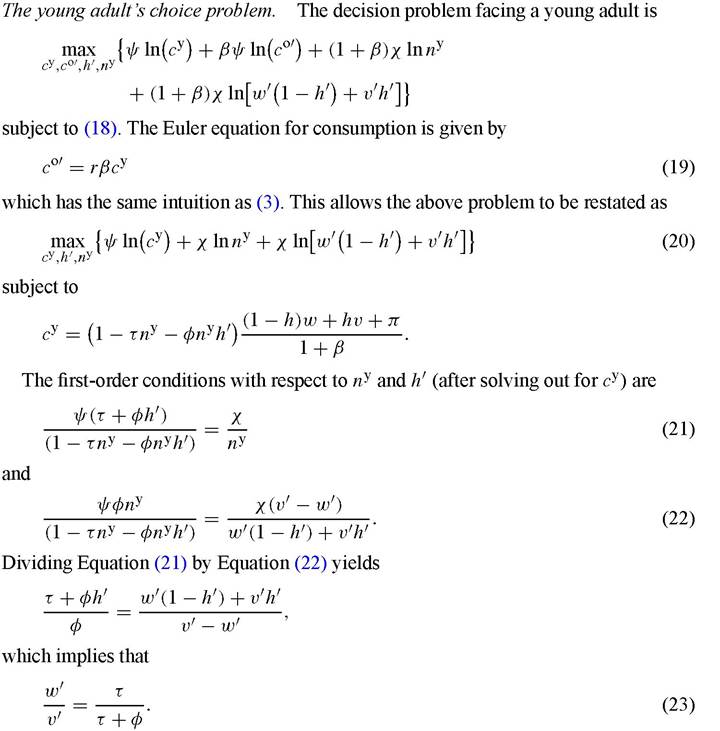
In other words, tomorrow’s skill premium is a constant, pinned down by the proportional costs for birth and education. Note that this follows directly from the assumption that quantity and quality have same weight χ in the utility function.
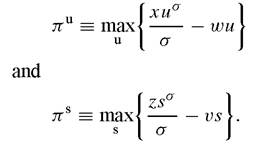
The firms' problems. The firms in the agricultural and manufacturing sectors will solve the problems
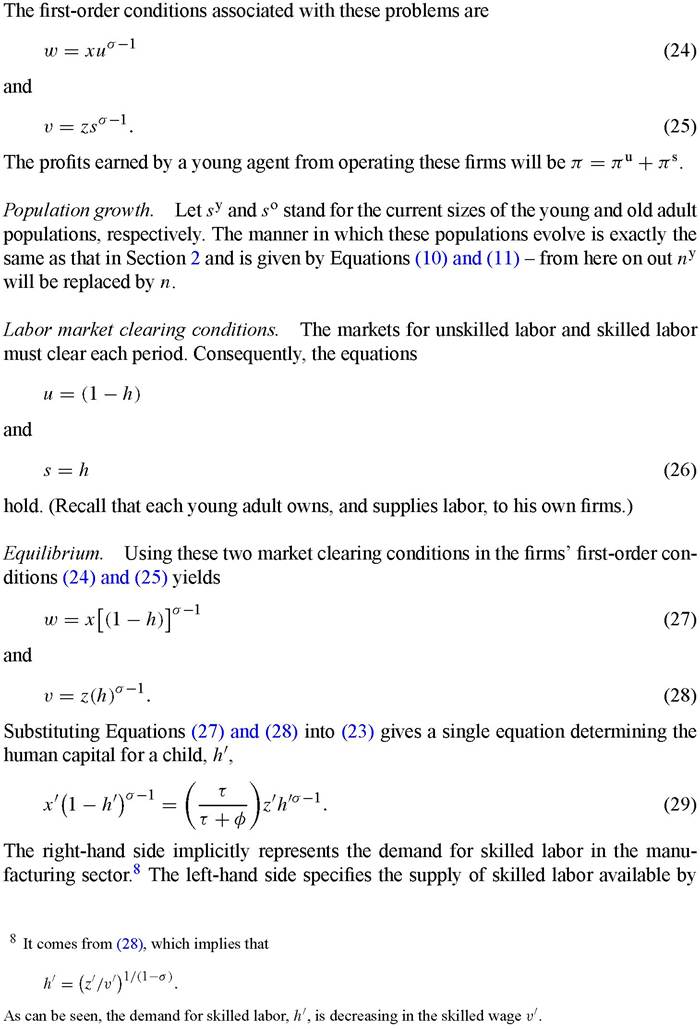
freeing up workers from agriculture.9 This equation can be solved to get a closed-form expression for the level of human capital that reads

3.2. Analysis
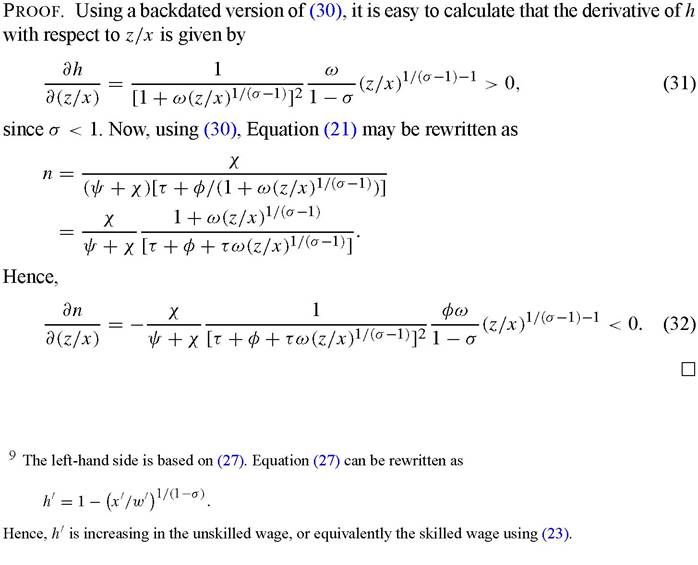
Now, imagine that the economy is resting in a steady state where z' and χ' are constant. It is then easy to see from (30) that h' will be constant. Notice that if Z and χ' were to increase at the same rate, h' would also remain unchanged. This result follows because identical increases in total factor productivity in both sectors leave unchanged the demand for each type of labor, given the constancy of the skill premium. This leaves unchanged the fraction of total labor allocated to each sector. So, when will human capital rise?
Lemma 2. As TFP in manufacturing, z, rises relative to agriculture x, human capital, h, increases and fertility, n, falls.
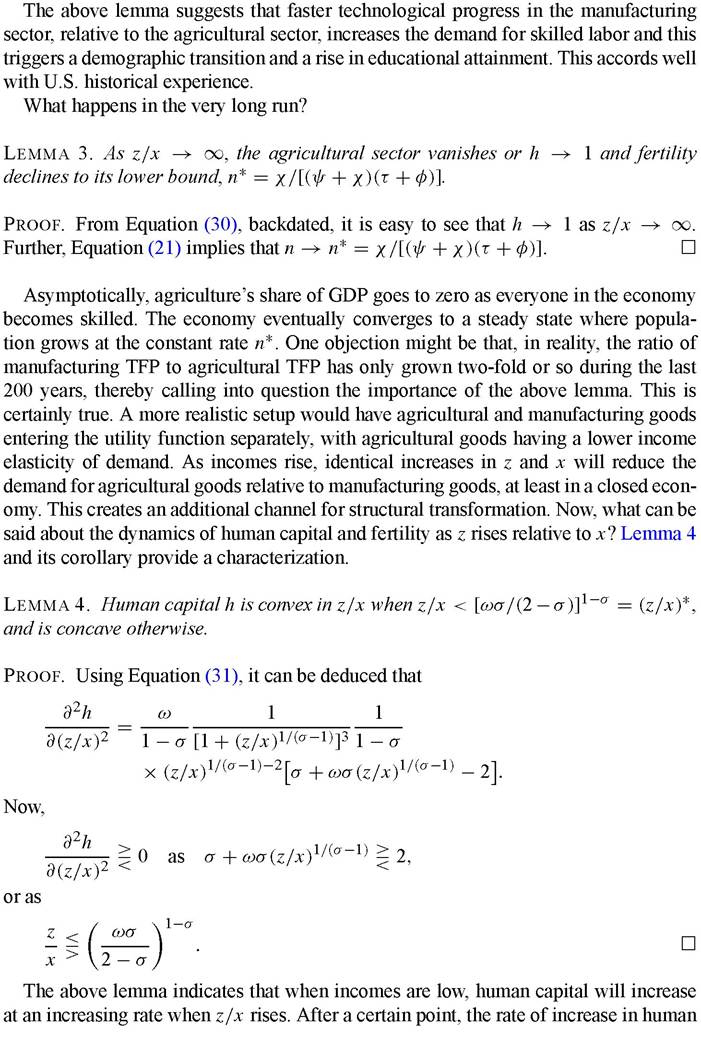
capital will slow down, and human capital will increase at a decreasing rate as z/x rises. Thus, the convergence of h from a society where every individual is unskilled (h = 0) to one in which every one is skilled (h = 1) will have an S shape that is characteristic of the diffusion of many innovations. Now, recall that fertility is inversely related to human capital. Consequently, fertility will initially fall at a increasing rate, and then will eventually decline at an decreasing rate as it converges to n*. The following corollary characterizes the dynamics of fertility.
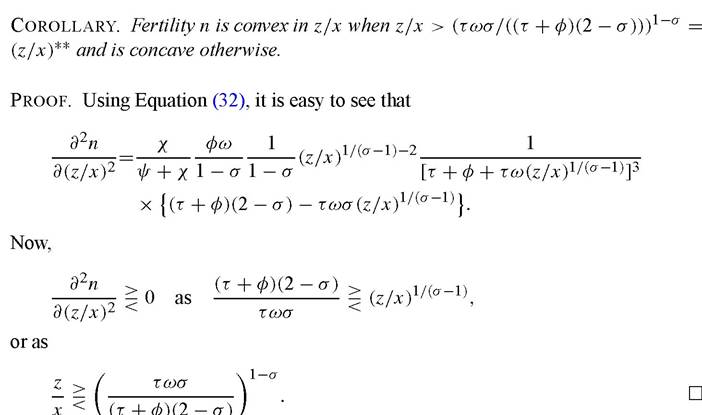
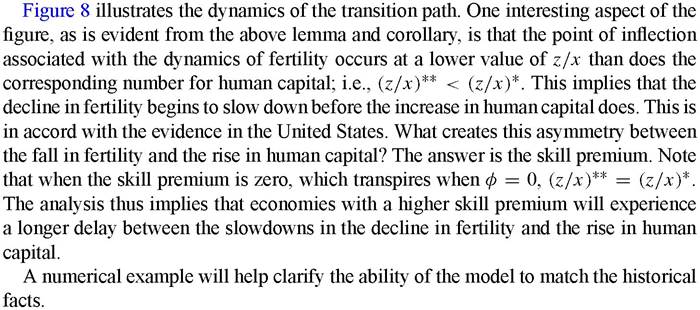

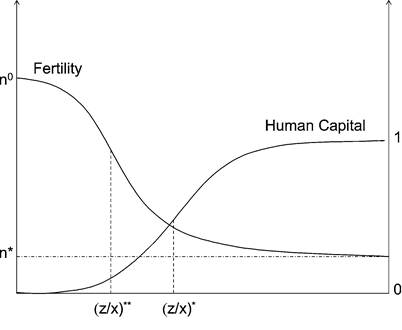
Figure 8. The dynamics of fertility and human capital.
(ii)Technology: σ = 0.8.
(iii) Child care: τ = 0.123, φ = 0.4.
The time is 1800. Assume that (z∕x) 18oo = 2.36. Then, Equation (30) implies that h1800 = 0.05; i.e., about 5 percent of the population are skilled. The rest of the population, 95 percent, live in the rural sector. Further, Equation (21) implies that n1800 = χ∕[(ψ + χ)(τ + φh 1800)] = 3.5, which is exactly the number of kids per adult (male plus female) in 1800. An average married couple in 1800 had 7 kids. Now, move ahead to 1940. TFP in agriculture grew by a factor of 1.95, while TFP in manufacturing grew by a factor of 4.11. Consequently, (z∕x)1940 = (4.11/1.95) ? (z∕x)1800 = 4.97. Now, Equation (30) implies that h1940 = 0.69, or that about 31 percent of the population live in the rural sector. Further, n1940 = χ∕[(ψ + χ)(τ + φh1940)] = 1.26, so that an average family has 2.52 children (as opposed to 2.23 in the data). Finally, the long-run value of fertility is n* = 0.96. In the long run an average family will give birth to 1.92 children.
Notice that even without employing any differences in curvature between manufacturing or agricultural goods, or differences in the skill intensities associated with the production of these goods, technological advance can account for most of the decline in fertility between 1800 and 1940.[147]
4.
More on the topic The U.S. demographic transition:
- Concluding remarks
- THEORETICAL APPROACHES TO WAGE DISPERSION AND THE ROLE OF INSTITUTIONS
- I Structure defined
- CONCLUSIONS
- IMPACTS ON COLONIZED PEOPLES AND TERRITORIES