CONCLUSIONS
This chapter has tried to describe and better understand how the idea of antipoverty policy emerged and has evolved over the last 200 years. It has been argued that we have transitioned from one view of poverty to another, radically different view of poverty.
In the first, there was little reason to think that poor people had the potential to be anything else than poor. Poverty would inevitably persist, and, indeed, it was deemed necessary for economic expansion, which required a large number of people eager for work; avoiding hunger was seen as the necessary incentive for poor people to do that work. Social policy had a role in ensuring social stability—most importantly, a generally docile working class willing to work for low wages—and successfully so it seems in the case of England’s Poor Laws. Promotional antipoverty policies would probably not have made much sense to those in power, although the need for protection from economic shocks would have been more evident and appears to have had reasonably broad support from the elites even when mass chronic poverty was taken for granted. However, beyond short-term palliatives to address shocks, there was little or no perceived scope for public efforts to permanently reduce poverty. And a world free of poverty was unimaginable— after all, who then would be available to farm the land, work the factories, and staff the armies?In the second, modern, view, poverty is not only seen as a social ill that can be avoided through public action, but such action is seen as perfectly consistent with a robust growing economy. Indeed, the right antipoverty policies are expected to contribute to development by removing material constraints on the freedom of individuals to pursue their own interests.
Granted, such a public commitment is not universal today in any country. Some observers still point to behaviors of poor people as causes of their poverty, while others point to constraints beyond their control.
Advocates against poverty are often frustrated by the setbacks. However, the progress that has been made in both the idea of antipoverty policy and its effective implementation is undeniable. Recognizing such a marked transition in mainstream thinking over 200 years makes one more optimistic that the idea of eliminating poverty can be more than a dream.Progress has been uneven over time. Two key historical steps in the transition can be identified, dubbed here as the First and Second Poverty Enlightenments. The First, taking place just before the turn of the nineteenth century, saw the emergence of a new respect for poor people as people—no longer the “shadows in a painting” or objects that served some purely instrumental role as means of production. Instead, the economy itself came to be seen as a means to promote human welfare, including that of poor people. The Second Poverty Enlightenment, in the latter part of the twentieth century, came with the strongest case yet for antipoverty policy, which saw poverty as a severe constraint on freedom and personal self-fulfillment. A consensus emerged that poverty was morally unacceptable, though with continuing debates on what to do about it.
Although the foundation for this change was laid in the First Poverty Enlightenment—notably in seeing all human beings as morally equal, with legitimate desires for freedom and self-fulfillment—it was really only by the time of the Second Poverty Enlightenment that it came to be understood that freedom and self-fulfillment required (among other things) that people were not constrained by poverty. The state was seen to have a role in ensuring that all individuals had access to the material conditions for their own personal fulfillment—arguably the most important requirement for equity, but also the key to breaking out ofpoverty traps. Antipoverty policy came to be seen as a matter of both promotion and protection. Along with rising real wages and (hence) savings by poor people, public education systems, sound health care systems, and reasonably well-functioning financial markets came to be seen as crucial elements for the next generation of poor families to escape poverty for good.
Once it started to be widely accepted that those born poor could in fact escape poverty, public action against poverty became more acceptable, and more people joined political coalitions or struggles toward that end. Once successful promotion policies had been initiated, the fiscal burden of providing relief to those who remained poor started to fall. This was probably reinforced by new political support for action and moral conviction about its need, stemming from the world’s (now much expanded) middle class. Beyond some point, a self-reinforcing cycle emerged in the successful countries to help ensure a sustained and (over time) more rapid escape from poverty. The cycle has been broken at times; the history of thinking and action on poverty gives ample illustration of the fragility of the progress we have seen. Each Poverty Enlightenment was followed by a backlash in thinking and policy making. But we have seen progress.
ACKNOWLEDGMENTS
This chapter’s title owes a debt to Gertrude Himmelfarb’s (1984) text, The Idea of Poverty: England in the Early Industrial Age. For comments the author thanks Robert Allen, Tony Atkinson, Pranab Bardhan, Francois Bourguignon, Denis Cogneau, Jean-Yves Duclos, Sam Fleischacker, Pedro Gete, Karla Hoff, Ravi Kanbur, Charles Kenny, Sylvie Lambert, Philipp Lepenies, Peter Lindert, Michael Lipton, Will Martin, Alice Mes- nard, Branko Milanovic, Johan Mistiaen, Berk Ozler, Thomas Pogge, Gilles Postel-Vinay, Henry Richardson, John Roemer, John Rust, Agnar Sandmo, Amartya Sen, Dominique van de Walle, and participants at presentations at the World Bank, the Midwest International Economic Development Conference at the University of Wisconsin-Madison, the Paris School of Economics, the Canadian Economics Association, the 12th Nordic Conference on Development Economics, Lancaster University, and the World Institute for Development Economics Research.
APPENDIX
This Appendix proves the claim made in Section 22.8 about the properties of the characterization of wealth dynamics in Section 22.2.
The claim in Section 22.8 referred to a situation in which the threshold is not binding, giving the Banerjee and Duflo (2003) model. The latter paper shows that higher initial wealth inequality lowers future growth in wealth. Here, we focus instead on the implications of high initial wealth poverty.Initial wealth, wt for date t, is distributed across individuals according to the cumulative distribution function, Ft(w), giving the population proportion with wealth lower than w, and let Ht = Ft(z) denote the headcount index of poverty (poverty rate) when the poverty line is z. (It will be analytically easier to work with the inverse of Ft(w), namely, the quantile function, wt(p).) Ifcredit is constrained (wt ≤ k*Z(λ +1)), then output at t + 1 is limited by the amount of capital available at time t, which is given by own-wealth plus maximum borrowing, yielding an output of h((λ + 1)wt). The recursion diagram for the credit-constrained individual then takes the form:
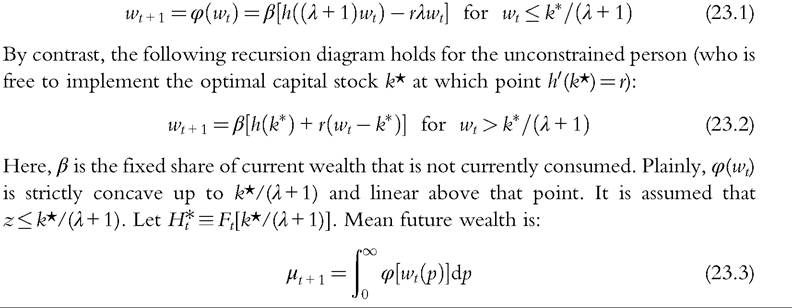
By standard properties of concave functions, we can readily verify that an inequalityincreasing spread in the wealth distribution in this economy will reduce mean future wealth at a given level of mean current wealth, that is, reduce the growth rate, as in Banerjee and Duflo (2003).
What about the impact on growth of higher initial poverty at a given initial mean? Using Equations (23.1) and (23.2), we can rewrite Equation (23.3) as:
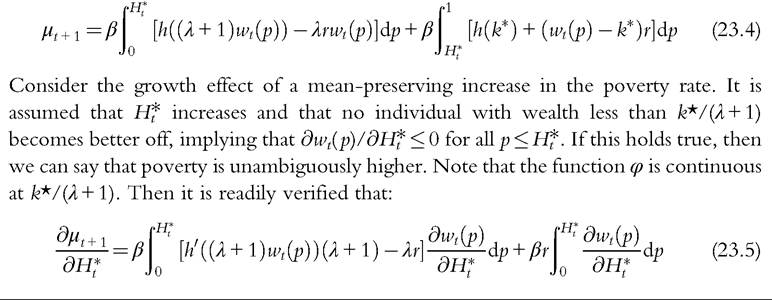
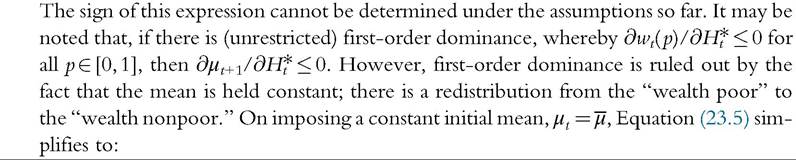

Thus, we find that an unambiguously higher initial headcount index of poverty holding the initial mean constant implies a lower growth rate, as claimed in Section 22.8.
REFERENCES
Abel-Smith, B., Townsend, P., 1966. The Poor and the Poorest, a New Analysis of the Ministry of Labour’s Family Expenditure Surveys of 1953—54 and 1960. Bell, London.
Acemoglu, D., Robinson, J., 2006. Economic Origins of Dictatorship and Democracy. Cambridge University Press, Cambridge, England.
Acemoglu, D., Zilibotti, F., 1997. Was Prometheus unbound by chance? J. Polit. Econ. 105 (4), 709-751.
Adelman, I., Morris, C.T., 1973. Economic Growth and Social Equity in Developing Countries. Stanford University Press, Stanford.
Agee, J., Evans, W., 1941. Let Us Now Praise Famous Men, the American Classic, in Words and Pictures, of Three Tenant Families in the Deep South, Houghton Mifflin edition, Boston, MA, 2000.
Aghion, P., Bolton, P., 1997. A theory of trickle-down growth and development. Rev. Econ. Stud. 64, 151-172.
Aghion, P., Caroli, E., Garcia-Penalosa, C., 1999a. Inequality and economic growth, the perspectives of the new growth theories. J. Econ. Lit. 37 (4), 1615-1660.
Aghion, P., Banerjee, A., Piketty, T., 1999b. Dualism and macroeconomic volatility. Quart. J. Econ. 114 (4), 1359-1397.
Ahluwalia, M.S., 1976. Inequality, poverty and development. J. Dev. Econ. 3, 307-342.
Ahluwalia, M.S., Carter, N.G., Chenery, H.B., 1979. Growth and poverty in developing countries. J. Dev. Econ. 6, 299-341.
Ahluwalia, M.S., Duloy, J., Pyatt, G., Srinivasan, T.N., 1980. Who benefits from economic development? Comment. Am. Econ. Rev. 70 (1), 242-245.
Akerlof, G., 1970. The market for lemons, quality uncertainty and the market mechanism. Quart. J. Econ. 84, 485-500.
Akresh, R.,de Walque, D., Kazianga, H.,2013. Cash Transfers and Child Schooling, Evidence from a Randomized Evaluation of the Role of Conditionality, Policy ResearchWorking Paper 6340, WorldBank.
Alatas, V., Banerjee, A., Hanna, R., Olken, B.A., Tobias, J., 2012. Targeting the poor, evidence from a field experiment in Indonesia. Am. Econ. Rev. 102 (4), 1206-1240.
Albelda, R., Folbre, N., The Center for Popular Economics, 1996. The War on the Poor. A Defense Manual. The New Press, New York.
Alderman, H., 2002. Do local officials know something we don’t? Decentralization of targeted transfers in Albania. J. Pub. Econ. 83, 375-404.
Alderman, H., Hoddinott, J., Kinsey, B., 2006. Long-term consequences of early childhood malnutrition. Oxf. Econ. Pap. 58 (3), 450-474.
Alesina, A., Rodrik, D., 1994. Distributive politics and economic growth. Quart. J. Econ. 108, 465-490.
Allen, R., 2007. Pessimism Preserved, Real Wages in the British Industrial Revolution, Oxford University Department of Economics Working Paper 314.
Allen, R., 2009. Engels’ pause technical change, capital accumulation, and inequality in the British industrial revolution. Explor. Econ. Hist. 46, 418-435.
Allen, R., 2013. Poverty Lines in History, Theory, and Current International Practice. Nuffield College, Oxford, Mimeo.
Anand, S., 1983. Inequality and Poverty in Malaysia. Oxford University Press, Oxford.
Anand, S., Kanbur, R., 1993. The Kuznets process and the inequality-development relationship. J. Dev. Econ. 40, 25-52.
Anand, S., Ravallion, M., 1993. Human development in poor countries, on the role of private incomes and public services. J. Econ. Perspect. 7 (Winter), 133-150.
Angelucci, M., Karlan, D., Zinman, J., 2013. Win Some Lose Some? Evidence from a Randomized Microcredit Program Placement Experiment by Compartamos Banco. mimeo.
Aristotle, 350BC, Politics Book 2 (B. Jowett, Trans.). http://classics.mit.edu/Aristotle/politics.2.two.html.
Arneson, R., 1989. Equality and equal opportunity for welfare. Philos. Stud. 56 (1), 77-93.
Arrow, K.J., 1951. Social Choice and Individual Values. John Wiley, New York.
Artz, F.B., 1934. Reaction and Revolution, 1814-1834. Harper and Row, New York.
Atkinson, A.B., 1970. On the measurement of inequality. J. Econ. Theory 2, 244-263.
Atkinson, A.B., 1987. On the measurement of poverty. Econometrica 55, 749-764.
Atkinson, A.B., 1991. Comparing poverty rates internationally, lessons from recent studies in developed countries. World Bank Econ. Rev. 5 (1), 3-21.
Atkinson, A.B., Bourguignon, F., 1982. The comparison of multi-dimensional distributions of economic status. Rev. Econ. Stud. 49, 183-201.
Atkinson, A.B., Sutherland, H., 1989. Analysis of a partial basic income scheme. In: Atkinson, A.B. (Ed.), Poverty and Social Security. Harvester Wheatsheaf, Hertfordshire.
Attanasio, O., Meghir, C., Santiago, A., 2004. Education Choices in Mexico, Using a Structural Model and a Randomized Experiment to Evaluate PROGRESA. Working Paper EWP04/04, Institute of Fiscal Studies, London.
Aykroyd, W.R., 1974. The Conquest of Famine. Chatto and Windus, London.
Azariadis, C., 1996. The economics of poverty traps. Part one: complete markets. J. Econ. Growth 1, 449-486.
Azariadis, C., 2006. The theory of poverty traps, what have we learned? In: Bowles, S., Durlauf, S., Hoff, K. (Eds.), Poverty Traps. Princeton University Press, Princeton.
Baird, S., McIntosh, C., Ozler, B., 2011. Cash or condition? evidence from a cash transfer experiment. Quart. J. Econ. 126 (4), 1709-1753.
Banerjee, A., Duflo, E., 2003. Inequality andgrowth, what can the data Say?J. Econ. Growth 8 (3), 267-299.
Banerjee, A., Duflo, E., 2007. The economic lives ofthe poor. J. Econ. Perspect. 21 (2), 141-167.
Banerjee, A., Iyer, L., 2005. History, institutions and economic performance, the legacy of colonial land tenure systems in India. Am. Econ. Rev. 95 (4), 1190-1213.
Banerjee, A., Newman, A., 1993. Occupational choice and the process of development. J. Polit. Econ. 101 (2), 274-298.
Banerjee, Abhijit, Duflo, Esther, Glennerster, Rachel, Kinnan, Cynthia, 2009. The Miracle of Microfinance? Evidence from a Randomized Evaluation, BREAD Working Paper No. 278, BREAD.
Banerjee, A., Banerji, R., Duflo, E., Glennerster, R., Khemani, S., 2010. Pitfalls of participatory programs, evidence from a randomized evaluation in education in India. Am. Econ. J. Econ. Policy 2 (1), 1-30.
Bardhan, P., 1984a. Land, Labor and Rural Poverty, Essays in Development Economics. Columbia University Press, New York.
Bardhan, P., 1984b. The Political Economy of Development in India. Basil Blackwell, Oxford.
Bardhan, P., 2011. Challenges for a minimum social democracy in India. Econ. Pol. Wkly. 46 (10), 39-43.
Bardhan, P., Bowles, S., Ginitis, H., 2000. Wealth inequality, wealth constraints and economic performance. In: Atkinson, A.B., Bourguignon, F. (Eds.), In: Handbook of Income Distribution, vol. 1. North- Holland, Amsterdam.
Barrett, C.B., Marenya, P.P., McPeak, J.G., Minten, B., Murithi, F.M., Oluoch-Kosura, W., Place, F., Randrianarisoa, J.C., Rasambainarivo, J., Wangila, J., 2006. Welfare dynamics in rural Kenya and Madagascar. J. Dev. Stud. 42 (2), 178-199.
Barro, R., 2000. Inequality and growth in a panel of countries. J. Econ. Growth 5 (1), 5-32.
Barro, R., Sala-i-Martin, X., 1992. Convergence. J. Polit. Econ. 100 (2), 223-251.
Basu, K., 1999. Child labor, cause, consequence and cure, with remarks on international labor standards. J. Econ. Lit. 37, 1083-1119.
Bator, F.M., 1958. The anatomy of market failure. Quart. J. Econ. 72 (3), 351-379.
Beaudoin, S., 2007. Poverty in World History. Routledge, New York.
Beaumarchais, P., 1778. La FolleJournee ou Le Mariage de Figaro. Nathan, Paris, 2007.
Beck, T., Levine, R., Loayza, N., 2000. Finance and the sources of growth. J. Financ. Econ. 58, 261-300.
Beck, T., Demirguc-Kunt, A., Levine, R., 2007. Finance, inequality and the poor. J. Econ. Growth 12, 27-49.
Benabou, R., 1996. Inequality and growth. In: Bernanke, B., Rotemberg, J. (Eds.), National Bureau of Economic Research Macroeconomics Annual. MIT Press, Cambridge.
Benton, D., 2010. The influence of dietary status on the cognitive performance of children. Mol. Nutr. Food Res. 54 (4), 457-470.
Berg, A., Ostry, J.D., Zettelmeyer, J., 2012. What makes growth sustained? J. Dev. Econ. 98, 149-166.
Besley, T., Burgess, R., 2003. The political economy of government responsiveness, theory and evidence from India. Quart. J. Econ. 117 (4), 1415-1451.
Bethlehem, J., 2009. The Rise of Survey Sampling, Statistics Netherlands Discussion Paper 09015, Amsterdam.
Beveridge, W., 1942. Social Insurance and Allied Services. His Majesty’s Stationary Office, London.
Birdsall, N., Londono, J.L., 1997. Asset inequality matters, an assessment ofthe world Bank’s approach to poverty reduction. Am. Econ. Rev. 87 (2), 32-37.
Birdsall, N., Ross, D., Sabot, R., 1995. Inequality and growth reconsidered, lessons from east Asia. World Bank Econ. Rev. 9 (3), 477-508.
Birdsall, N., Graham, C., Pettinato, S., 2000. Stuck in the Tunnel, Is Globalization Muddling the Middle Class? Center on Social and Economic Dynamics, Working Paper 14, Brookings Institution, Washington, DC.
Blaug, M., 1962. Economic Theory in Retrospect. Heinemann Books, London.
Blaug, M., 2001. No history of ideas, please, we’re economists. J. Econ. Perspect. 15 (1), 145-164.
Bliss, C., 1975. Capital Theory and the Distribution of Income. North-Holland, Amsterdam.
Bliss, C., Stern, N., 1982. Palanpur, The Economy of an Indian Village. Clarendon Press, Oxford.
Boo, K., 2012. Behind the Beautiful Forevers. Random House, New York.
Booth, C., 1903. Life and labour of the people of London. Second Series: Industry, vol. 5. Macmillan and Co., London.
Bourguignon, F., 2003. The growth elasticity of poverty reduction, explaining heterogeneity across countries and time periods. In: Eicher, T., Turnovsky, S. (Eds.), Inequality and Growth Theory and Policy Implications. MIT Press, Cambridge.
Bourguignon, F., Morrisson, C., 2002. Inequality among world citizens, 1820-1992. Am. Econ. Rev. 92 (4), 727-744.
Bowles, S., Gintis, H., 1976. Schooling in Capitalist America, Educational Reform and the Contradictions of Economic Life. Routledge and Kegan Paul, London.
Bowles, S., Durlauf, S., Hoff, K., 2006. Poverty Traps. Princeton University Press, Princeton.
Bowley, A.L., 1915. The Nature and Purpose of the Measurement of Social Phenomena. P.S. King and Sons, London.
Boyer, G., 2002. English poor laws. In: Whaples, R. (Ed.), EH.Net Encyclopedia.
Brinton, C., 1934. A Decade of Revolution 1789-1799. Harper and Row, New York.
Brooke, M.Z., 1998. Le Play Engineer and Social Scientist. Transaction Publishers, New Brunswick.
Bruno, M., Ravallion, M., Squire, L., 1998. Equity and growth in developing countries, Old and New perspectives on the policy issues. In: Tanzi, V., Chu, K.-y. (Eds.), Income Distribution and High-Quality Growth. MIT Press, Cambridge.
Bulow, J., Summers, L., 1986. A theory of dual labor markets with application to industrial policy, discrimination and Keynesian unemployment. J. Labor Econ. 4 (3), 376—414.
Burnett, J., 1969. A History ofthe Cost of Living. Penguin Books, Harmondsworth, England.
Cameron, L., 2002. Did Social Safety Net Scholarships Reduce Drop-Out Rates duringthe Indonesian Economic Crisis? Policy Research Working Paper 2800, World Bank.
Campbell, F., Conti, G., Heckman,J., Moon, S.H., Pinto, R., Pungello, E., Pan, Y.,2014. Early childhood investments substantially boost adult health. Science 343, 1478—1485.
Cantril, H., 1965. The Pattern of Human Concerns. Rutgers University Press, New Brunswick.
Cappelen, A., Mmstad, O., Tungodden, B., 2010. Demand for childhood vaccination-insights from behavioral economics. Forum Dev. Stud. 37 (3), 349—364.
Carter, M., Barrett, C., 2006. The economics of poverty traps and persistent poverty, an asset-based approach. J. Dev. Stud. 42 (2), 178-199.
Chen, S., Ravallion, M., 2010. The developing world is poorer than we thought, but no less successful in the fight against poverty. Quart. J. Econ. 125 (4), 1577-1625.
Chen, S., Ravallion, M., 2013. More relatively poor people in a less absolutely poor world. Rev. Income Wealth 59 (1), 1-28.
Chen, S., Ren, M., Ravallion, M., 2009. Are there lasting impacts of aid to poor areas? J. Pub. Econ. 93, 512-528.
Chenery, H., 1977. Forward to David Morawetz, Twenty-Five Years of Economic Development. World Bank, Washington, DC.
Chenery, H., Ahluwalia, M.S., Bell, C., Duloy, J., Jolly, R., 1974. Redistribution with Growth. Oxford University Press, Oxford.
Cinnirella, F., 2008. Optimists or Pessimists? A Reconsideration of Nutritional Status in Britain, 1740-1865. Eur. Rev. Econ. Hist. 12, 325-354.
Clark, G., 2005. The condition of the working class in England 1209-2004. J. Polit. Econ. 113, 1307-1340. Clarke, G.R.G., 1995. More evidence on income distribution and growth. J. Dev. Econ. 47, 403-428.
Cogneau, D., 2012. The Political Dimension ofinequality during Economic Development. Region et Developpement 35, 11-36.
Cohen, G., 1989a. On the currency of egalitarian justice. Ethics 99 (4), 906-944.
Cohen, J., 1989b. Democratic equality. Ethics 99 (4), 727-751.
Cornia, Giovanni, Stewart, Frances, 1995. Two errors of targeting. In: van de Walle, Dominique, Nead, Kimberly (Eds.), Public Spending and the Poor. Johns Hopkins University Press for the World Bank, Baltimore.
Cunha, F., Heckman, J., 2007. The technology of skill formation. Am. Econ. Rev. 97 (2), 31-47.
Cunningham, H., 1990. The employment and unemployment of children in England c.1680-1851. Past Present 126, 115-150.
Currie, J., 2001. Early childhood development programs. J. Econ. Perspect. 15 (2), 213-238.
Currie, J., 2011. Inequality at birth, some causes and consequences. Am. Econ. Rev. 101 (3), 1-22.
Currie, J., 2012. Antipoverty programs for poor children and families. In: Jefferson, P.N. (Ed.), The Oxford Handbook of the Economics of Poverty. Oxford University Press, Oxford.
Dandekar, V.M., Rath, N., 1971. Poverty in India. Indian School of Political Economy, Pune.
Daniels, W., 1898. The bearing of the doctrine of selection upon the social problem. Inter. J. Ethics 8 (2), 203-214 (now called Ethics).
Das, J., Do, Q.-T., Ozler, B., 2005. A welfare analysis of conditional cash transfer schemes. World Bank Res. Obs. 20 (1), 57-80.
Dasgupta, P., 1993. An Inquiry into Well-Being and Destitution. Oxford University Press, Oxford.
Dasgupta, P., 1997. Poverty traps. In: Kreps, D.M., Wallis, K.F. (Eds.), Advances in Economics and Econometrics, Theory and Applications. Cambridge University Press, Cambridge.
Dasgupta, P., 2011. Personal Histories and Poverty Traps. In: Annual World Bank Conference on Development Economics. World Bank, Washington, DC.
Dasgupta, P., Ray, D., 1986. Inequality as a determinant of malnutrition and unemployment. Econ. J. 96, 1011-1034.
Datt, G., Ravallion, M., 1998. Farm productivity and rural poverty in India. J. Dev. Stud. 34 (4), 62-85.
Day, R.H., 1992. Complex economic dynamics, obvious in history, generic in theory, elusive in data. J. Appl. Econ. 7, S9-S23.
De Donder, P., Hindriks, J., 1998. The political economy of targeting. Public Choice 95, 177-200.
DeJanvry, A., Sadoulet, E., 2006. Making conditional cash transfer programs more efficient, designing for maximum effect of the conditonality. World Bank Econ. Rev. 20 (1), 1-29.
De Mandeville, B., 1732. An essay on charity and charity schools. In: The Fable of the Bees, Or, Private Vices, Publick Benefits, sixth ed. Oxford University Press, London, Oxford, 1957 (reprint).
de Montesquieu, C., 1748. The SpiritofLaws (T. Nugent, Trans.). G. Belland Sons, London (1914 edition).
De Tocqueville, A., 1835. Memoir on Pauperism, Does Public Charity Produce and Idle and Dependent Class of Society? Cosimo Classics edition, NewYork, 2005.
de Waal, F., 2009. The Age of Empathy. Nature’s Lessons for a Kinder Society. Three Rivers Press, New York.
Dearden, L., Emmerson, C., Frayne, C., Meghir, C., 2009. Conditional cash transfers and school dropout rates. J. Hum. Res. 44 (4), 827-857.
Deaton, A., 1997. The Analysis of Household Surveys: A Microeconometric Approach to Development Policy. World Bank, Washington, DC.
Deaton, A., 2006. The great escape, a review of Robert Fogel’s the escape from hunger and premature death, 1700-2100. J. Econ. Lit. 44, 106-114.
Deininger, K., Olinto, P., 2000. Asset Distribution, Inequality and Growth, Policy Research Working Paper 2375, World Bank.
Deininger, K., Squire, L., 1996. A New data set measuring income inequality. World Bank Econ. Rev. 10, 565-591.
Deininger, K., Squire, L., 1998. New ways of looking at old issues, inequality and growth. J. Dev. Econ. 57 (2), 259-287.
Dercon, S., Outes, I., 2013. The Roadto Perdition, Rainfall Shocks, Poverty Traps and Destitution in Semi- Arid India. Oxford University, mimeo.
Dickens, C., 1838. Oliver Twist. Richard Bently, London, Penguin edition, 2003.
Do, Q.-T., Levchenko, A., Ravallion, M., 2013. Copyingwith food price volatility, trade insulation as social protection. In: Chavas, J.-P., Hummels, D., Wright, B. (Eds.), The Economics of Food Price Volatility. University of Chicago Press, forthcoming.
Doepke, M., Zilibotti, F., 2005. Social class and the spirit of capitalism. J. Eur. Econ. Assoc. 3 (2-3), 516-524.
Doeringer, P., Piore, M., 1971. Internal Labor Markets and Manpower Analysis. Sharpe, New York.
Dollar, D., Kraay, A., 2002. Growth is good for the poor. J. Econ. Growth 7 (3), 195-225.
Dollar, D., Kraay, A., 2004. Trade, growth and poverty. Econ. J. 114 (493), F22-F49.
Doron, A., 1990. Definition and measurement ofpoverty—the unsolved issue. In: Social Security,Journal of Welfare and Social Security Studies, 2, pp. 27-50, Special English Edition.
Dreze, J., 1990a. Famine prevention in India. In: Dreze, Sen (Eds.), In: The PoliticalEconomy of Hunger, vol. 2. Oxford University Press, Oxford.
Dreze, J., 1990b. Famine prevention in Africa, some experiences and lessons. In: Dreze, J., Sen, A. (Eds.), The Political Economy of Hunger. vol. 2. Oxford University Press, Oxford.
Dreze, J., Sen, A., 1989. Hunger and Public Action. Oxford University Press, Oxford.
Duncan, O., Featherman, D., Duncan, B., 1972. Socioeconomic Background and Achievement. Seminar Press, New York.
Dutta, P., Murgai, R., Ravallion, M., van de Walle, D., 2012. Does India’s employment guarantee scheme guarantee employment? Econ. Pol. Wkly. 48 (April 21), 55-64.
Dutta, P., Murgai, R., Ravallion, M., van de Walle, D., 2013. Right-to-Work? Assessing India’s Employment Guarantee Scheme in Bihar. World Bank, Washington, DC.
Easterly, W., 2001. The middle class consensus and economic development. J. Econ. Growth 6 (4), 317-335.
Easterly, W., 2009. How the millennium development goals are unfair to Africa. World Dev. 37 (1), 26-35. Eastwood, R., Lipton, M., 1999. The impact of changes in human fertility on poverty. J. Dev. Stud. 36 (1), 1-30.
Eastwood, R., Lipton, M., 2001. Demographic transition and poverty, effects via economic growth, distribution and conversion. In: Birdsall, N., Kelley, A., Sinding, S. (Eds.), PopulationMatters. Oxford University Press, Oxford.
Eden, FrederickMorton, 1797. The State ofthe Poor. J. Davis, London.
Elbers, C., Lanjouw, J., Lanjouw, P., 2003. Micro-level estimation ofpoverty and inequality. Econometrica 71 (1), 355-364.
Ellwood, D., Summers, L., 1986. Poverty in america, is welfare the answer or the problem? In: Danziger, S., Weinberg, D. (Eds.), Fighting Poverty, What Works and What Doesn’t. Harvard University Press, Cambridge.
Engel, E., 1857. Die Productions- und Consumtionsverhaltnisse des Konigreichs Sachsen. Zeitschrift des statistischen Bureaus des Koniglich Sachsischen Ministerium des Inneren 8-9, 28-29.
Engels, F., 1845. The Condition ofthe Working Class in England. Oxford University Press, Oxford, 1993 edition.
Engerman, S.L., Sokoloff, K., 2006. Colonialism, inequality and long-Run paths of development. In: Banerjee, A., Benabou, R., Mookherjee, D. (Eds.), Understanding Poverty. Oxford University Press, Oxford, pp. 37-62.
Eurostat, 2005. Income poverty and social exclusion in the EU25, Statistics in Focus 03/2005, Office of Official Publications of the European Communities, Luxembourg.
Ferreira, F.H.G.,Ravallion, M.,2009. Povertyandinequality, the globalcontext. In: Salverda, W., Nolan, B., Smeeding, T. (Eds.), The Oxford Handbook of Economic Inequality. Oxford University Press, Oxford.
Fields, G.S., 1977. Who benefits from economic development? a reexamination of Brazilian growth in the 196O’s. Am. Econ. Rev. 67 (4), 570-582.
Fields, G.S., 1980. Poverty Inequality and Development. Cambridge University Press, Cambridge.
Fields, G.S., 2001. Distribution and Development. Russell Sage Foundation, New York.
Fifield, A., 2013. Starved of healthy options. Financ. Times, 9, June 14.
Filmer, D., 2007. If You build It, will they come? school availability and school enrolment in 21 poor countries. J. Dev. Stud. 43 (5), 901-928.
Fishlow, A., 1972. Brazilian size distribution of income. Am. Econ. Rev. 62, 391-402.
Fishlow, A., Gwin, C., 1994. Overview, Lessons from the East Asian Experience. In: Fishlow, A., Gwin, C., Haggard, S., Rodrik, D., Wade, R. (Eds.), Miracle or Design? Lessons from the East Asian Experience. Overseas Development Council, Washington, DC.
Fiszbein, A., Schady, N., 2010. Conditional Cash Transfers for Attacking Present and Future Poverty. World Bank, Washington, DC.
Fleischacker, S., 2004. A Short History of Distributive Justice. Harvard University Press, Cambridge, MA.
Fleurbaey, M., 2008. Fairness Responsibility and Welfare. Oxford University Press, Oxford.
Fogel, R.W., 2004. The Escape from Hunger and Premature Death, 1700-2100. Cambridge University Press, Cambridge.
Fogel, R.W., Engerman, S., Floud, R., Friedman, G., Mango, R., Sokoloff, K., Steckel, R., Trussell, J., Villaflor, G., Watchter, K., 1983. Secular change in American and British stature and nutrition. In: Rotberg, R., Rabb, T. (Eds.), Hunger in History. Cambridge University Press, Cambridge.
Forbes, K.J., 2000. A reassessment of the relationship between inequality and growth. Am. Econ. Rev. 90 (4), 869-887.
Foster, J., 1998. Absolute versus relative poverty. Am. Econ. Rev. 88 (2), 335-341.
Foster, J., Greer, J., Thorbecke, E., 1984. A class of decomposable poverty measures. Econometrica 52, 761-765.
Friedman, M., 1962. Capital and Freedom. University of Chicago Press, Chicago.
Fuchs, V., 1967. Redefining poverty and redistributing income. Public Interest 8, 88-95.
Furniss, E., 1920. The Position of the Laborer in a System of Nationalism. A Study in the Labor Theories of the Later English Mercantilists. Houghton Mifflin, Boston and New York.
Gaiha, R., 1997. Rural public works and the poor, the case of the employment guarantee scheme in India. In: Polachek, S. (Ed.), Research in Labour Economics. JAI Press, Connecticut.
Galasso, E., Ravallion, M., 2005. Decentralized targeting of an antipoverty program. J. Pub. Econ. 89, 705-727.
Galasso, E., Ravallion, M., Salvia, A., 2004. Assisting the transition from workfare to work: Argentina’s Proempleo Experiment. Ind. Labor Relat. Rev. 57 (5), 128—142.
Galbraith, J.K., 1958. The Affluent Society. Mariner Books, Boston.
Galor, O., Zeira, J., 1993. Income distribution and macroeconomics. Rev. Econ. Stud. 60 (1), 35—52.
Gans, H., 1995. The War Against the Poor. Basic Books, New York.
Garces, E., Thomas, D., Currie, J., 2002. Longer term effects of head start. Am. Econ. Rev. 92 (4), 999-1012.
Gelbach, J., Pritchett, L., 2000. Indicator targeting in a political economy, leakier can be better. J. Policy Reform 4, 113-145.
Geremek, B., 1994. Poverty. A History. Blackwell, Oxford.
Ghatak, M., Jiang, N.N.-H., 2002. A simple model of inequality, occupational choice, and development. J. Dev. Econ. 69 (1), 205-226.
Gillie, A., 1996. The origin of the poverty line. Econ. Hist. Rev. 49 (4), 715-730.
Goldin, C., Katz, L.F., 2008. The Race Between Education and Technology. Harvard University Press, Cambridge.
Gordon, R., Li, W., 2009. Tax structures in developing countries, many puzzles and a possible explanation. J. Pub. Econ. 93 (7-8), 855-866.
Grosh, M., Glewwe, P., 2000. Designing Household Survey Questionnaires for Developing Countries. Lessons from 15 Years of the Living Standards Measurement Study, 3 vols. World Bank, Washington, DC.
Grosh, M., del Ninno, C., Tesliuc, E., Ouerghi, A., 2008. For Protection and Promotion, the Design and Implementation of Effective Safety Nets. World Bank, Washington, DC.
Gutierrez, C., Tanaka, R., 2009. Inequality and education decisions in developing countries. J. Econ. Inequal. 7, 55-81.
Hansen, M.H., Hurvitz, W.N., 1943. On the theory of sampling from a finite population. Ann. Math. Stat. 14, 333-362.
Harrington, M., 1962. The Other America, Poverty in the United States. Macmillan, New York.
Harrison, A., Rodriguez-Clare, A., 2010. Trade, foreign investment, and industrial policy for developing countries. In: Handbook of Development Economics. vol. 5. North Holland, Amsterdam.
Harsanyi,J., 1975. Can the maximin principle serve as a basis for morality? A critique ofjohn Rawls’s theory. Am. Polit. Sci. Rev. 69 (2), 594-606.
Hartmann, B., 1987. Reproductive Rights and Wrongs, the Global Politics of Population Control and Contraceptive Choice. Harper and Row, New York.
Hauk, W.R., Wacziarg, R., 2009. A Monte Carlo study of growth regressions. J. Econ. Growth 14 (2), 103-147.
Hazan, M., Berdugo, B., 2002. Child labour, fertility, and economic growth. Econ. J. 112 (482), 810-828.
Heckman, J., 2006. Skill formation and the economics of investing in disadvantaged children. Science 30, 1900-1902.
Heclo, H., 1986. The political foundations of antipoverty policy. In: Danziger, S., Weinberg, D. (Eds.), Fighting Poverty, What Works and What Doesn’t. Harvard University Press, Cambridge.
Hemerijck, A., 2014. The reform capacities ofEuropeanwelfare states. In: Cantillon, B., Vandenbroucke, F. (Eds.), Reconciling Work and Poverty Reduction. How Successful are European Welfare States? Oxford University Press, Oxford.
Hertel-Fernandez, A., Wenger, J.B., 2013. Taking Up Social Benefits, A Cautionary Tale from an Unemployment Insurance Survey Experiment, Available at SSRN, http://ssrn.com/abstract=2341885 or http://dx.doi.org/10.2139/ssrn.2341885.
Herzer, D., Vollmer, S., 2012. Inequality and growth, evidence from panel cointegration. J. Econ. Inequal. 10, 489-503.
Hill, C., 1972. The World Turned Upside Down, Radical Ideas During the English Revolution. Maurice Temple Smith, London.
Himmelfarb, G., 1984a. The Idea of Poverty, England in the Early Industrial Age. Faber and Faber, London.
Himmelfarb, G., 1984b. The idea of poverty. Hist. Today 34 (4). http://www.historytoday.com/gertrude- himmelfarb/idea-poverty.
Hindle, S., 2004. On the Parish? The Micro-Politics of Poor Reliefin Rural England 1550-1750. Oxford University Press, Oxford.
Hoff, K., 1996. Market failures and the distribution of wealth, a perspective from the economics of information. Polit. Soc. 24 (4), 411-432.
Hossain, M., 1988. Credit for Alleviation of Rural Poverty, the Grameen Bank in Bangladesh: IFPRI Research Report 65. International Food Policy Research Institute, Washington, DC.
Howe, I., 1993. Introduction to Michael Harrington’s, the OtherAmerica. 1993 Reprinting, Touchstone, New York.
Hoynes, H., 1997. Does welfare play any role in female headship decisions? J. Publ. Econ. 65, 89-117. Hunter, R., 1904. Poverty. MacMillan Company, London.
Imbert, C., Papp, J., 2011. Estimating leakages in India’s employment guarantee. In: Khera, R. (Ed.), The Battle for Employment Guarantee. Oxford University Press, New Delhi, pp. 269-278.
Jalan, J., Ravallion, M., 1998. Are there dynamic gains from a poor-area development program? J. Pub. Econ. 67 (1), 65-86.
Jalan, J., Ravallion, M., 2002. Geographic poverty traps? A micro model of consumption growth in rural China. J. Appl. Econ. 17 (4), 329-346.
Jalan, J., Ravallion, M., 2004. Household income dynamics in rural china. In: Dercon, S. (Ed.), Insurance Against Poverty. Oxford University Press, New York, pp. 107-123.
Jha, R., Gaiha, R., Pandey, M.K., 2012. Net transfer benefits under India’s rural employment guarantee scheme. J. Policy Model 34 (2), 296-311.
Johnson, D., Smeeding, T., 2012. A Consumer’s Guide to InterpretingVarious U.S. Poverty Measures, Fast Focus No. 14, Institute for Research on Poverty, University of Wisconsin.
Jones, G.S., 2004. An End to Poverty? A Historical Debate. Columbia University Press, New York.
Just, D., Michelson, H., 2007. Wealth as welfare, Are wealth thresholds behind persistent poverty? Appl. Econ. Perspect. Policy 29 (3), 419-426.
Kahl, S., 2005. The religious roots of modern poverty policy, catholic, Lutheran, and reformed protestant traditions compared. Eur. J. Sociol. 46, 91-126.
Kakwani, N., 1980. Income Inequality andPoverty, Methods ofEstimationandPolicyApplications. Oxford University Press, Oxford.
Kaldor, N., 1955. Alternative theories of distribution. Rev. Econ. Stud. 23 (2), 94-100.
Kalecki, M., 1942. A theory of profits. Econ. J. 52, 258-267.
Kanbur, R., 1987. Measurement and alleviation of poverty. IMF Staff. Pap. 36, 60-85.
Kanbur, R., Tuomala, M., 2011. Charitable conservatism, poverty radicalism and inequality aversion. J. Econ. Inequal. 9, 417-431.
Kanbur, R., Keen, M., Tuomala, M., 1994. Labor supply and targeting in poverty alleviation programs. World Bank Econ. Rev. 8 (2), 191-211.
Kant, I., 1785. Fundamental Principles ofthe Metaphysic of Morals. In: KingsmillAbbott, T. (Ed.), 10 ed, Project Gutenberg.
Katz, M.B., 1987. The Undeserving Poor, From the War on Poverty to the War on Welfare. Pantheon Books, New York.
Keefer, P., Khemani, S., 2005. Democracy, Public Expenditures, and the Poor, Understanding Political Incentives for Providing Public Services. World Bank Res. Obs. 20 (1), 1-28.
Kelley, A., Schmidt, R., 1995. Aggregate population and economic growth correlations, the role of the components of demographic change. Demography 32 (4), 543-555.
Kelley, A., Schmidt, R., 2001. Economic and demographic change, a synthesis of models, findings and perspectives. In: Birdsall, N., Kelley, A., Sinding, S. (Eds.), Population Matters. Oxford University Press, Oxford.
Kelly, M., Cormac, O.G., 2010. Living Standards and Mortality since the Middle Ages, Working Paper 201026, School Of Economics, University College Dublin.
Keynes, J.M., 1936. The General Theory of Employment, Interest and Money. Macmillan Press, London.
Keysers, C., 2011. Empathic Brain. How the Discovery of Mirror Neurons Changes our Understanding of Human. Social Brain Press, Nature.
Khandker, S., Samad, H., 2014. Dynamic Effects of Microcredit in Bangladesh. Policy Research Working Paper 6821, World Bank, Washington, DC.
Kinsey, B., 2013. The excluded generations, questioning a leading poverty indicator. In: Paper presented at the UNU-WIDER conference “Inclusive Growth in Africa, Measurement, Causes, and Consequences.
Klebaner, B.J., 1964. Poverty and its relief in American thought, 1815-61. Soc. Serv. Rev. 38 (4), 382-399.
Knowles, S., 2005. Inequality and economic growth, the empirical relationship reconsidered in the light of comparable data. J. Dev. Stud. 41 (1), 135-159.
Kolm, S.-C., 1976. Unequal inequalities. I. J. Econ. Theory 12 (3), 416-442.
Korpe, P., Petri, W., 2012. Environmental enteropathy, critical implications of a poorly understood condition. Trends Mol. Med. 18 (6), 328-336.
Kraay, A., 2006. When is growth Pro-poor? Evidence from a panel of countries. J. Dev. Econ. 80, 198-227. Kuznets, S., 1955. Economic growth and income inequality. Am. Econ. Rev. 45, 1-28.
Landauer, C., 1959. European Socialism, a History of Ideas and Movements from the Industrial Revolution to Hitler’s Seizure of Power. University of California Press, Berkeley.
Lanjouw, P., Stern, N., 1998. Economic Development in Palanpur over Five Decades. Clarendon Press, Oxford.
Lepenies, P.H., 2014. Ofgoats and dogs, Joseph Townsend and the idealisation of markets—a decisive episode in the history of economics. Camb. J. Econ. 38, 447-457.
Levine, R., Renelt, D., 1992. A sensitivity analysis of cross-country growth regressions. Am. Econ. Rev. 82, 942-963.
Lewis, A., 1954. Economic development with unlimited supplies of labor. Manchester Sch. Econ. Soc. Stud. 22, 139-191.
Li, H., Zou, H.-f., 1998. Income inequality is not harmful to growth, theory and evidence. Rev. Dev. Econ. 2 (3), 318-334.
Lin, J.Y., 2012. New Structural Economics, a Framework for Rethinking Development and Policy. World Bank, Washington, DC.
Lindert, P.H., 2004. Growing Public: The Story, Social Spending and Economic Growth since the Eighteenth Century, vol. 1. Cambridge University Press, Cambridge.
Lindert, P.H., 2013. Private welfare and the welfare state. In: Neal, L., Williamson, J. (Eds.), The Cambridge History of Capitalism. Cambridge University Press, Cambridge.
Lipton, M., 1968. Urban bias and rural planning, strategy for agriculture. In: Streeten, P., Lipton, M. (Eds.), The Crisis in Indian Planning. Oxford University Press, Oxford.
Lipton, M., 1977. Why Poor People Stay Poor, Urban Bias and World Development. Temple Smith, London.
Lokshin, M., Ravallion, M., 2004. Household income dynamics in two transition economies. Stud. Nonlinear Dyn. Econom. 8 (3), 1-33.
Lopez, H., Serven, L., 2006. A Normal Relationship? Poverty, Growth and Inequality, Policy Research Working Paper 3814, World Bank.
Lopez, H., Serveen, L., 2009. Too Poor to Grow, Policy Research Working Paper 5012, World Bank. Loury, G., 1981. Intergenerational transfers and the distribution of earnings. Econometrica 49, 843-867. Ludwig, J., Phillips, D.A., 2007. The Benefits and Costs of Head Start, NBER Working Paper 12973. Lundberg, M., Squire, L., 2003. The simultaneous evolution of growth and inequality. Econ. J.
113, 326-344.
Macours, K., Schady, N., Vakis, R., 2008. Cash Transfers, Behavioral Changes and Cognitive Development in Early Childhood. Policy Research Working Paper 4759, World Bank, Washington, DC.
Mahalanobis, P.C., 1953. Some observations on the process of growth. Sankhya 12, 307-312.
Malthus, T.R., 1806. An Essay on the Principle of Population, 1890 ed. Ward, Lock and Co., London.
Mani, A., Mullainathan, S., Shafir, E., Zhao, J., 2013. Poverty impedes cognitive function. Science 341, 976-980.
Mansuri, G., Rao, V., 2012. Localizing Development, Does Participation Work? World Bank, Washington, DC. Marshall, A., 1890. Principles of Economics. Macmillan, London (8th ed., 1920).
Marshall, A., 1907. Some possibilities of economic chivalry. Econ. J. 17 (65), 7-29.
Martin, W., Anderson, K., 2012. Export restrictions and price insulation during commodity price booms. Am. J. Agr. Econ. 94 (2), 422-427.
Marx, K., Engels, F., 1848. Manifesto ofthe Communist Party, London.
Mayhew, H., 2008. London Labour and the London Poor. Wordsworth Classics, London (reprinting a selection of newspaper articles from the 1840s).
McKenzie, D., Woodruff, C., 2006. Do entry costs provide an empirical basis for poverty traps? Evidence from Mexican microenterprises. Econ. Dev. Cult. Change 55 (1), 3-42.
McNamara, R., 1973. Address to the Board ofGovernors at the 1973 Annual General Meeting. World Bank, Washington DC.
Meade, J., 1972. Poverty in the welfare state. Oxf. Econ. Pap. 24, 289-326.
Mencher, S., 1967. Poor Law to Poverty Program, Economic Security Policy in Britain and the United States. University of Pittsburgh Press, Pittsburgh.
Mesnard, A., Ravallion, M., 2006. The wealth effect on new business startups in a developing economy. Economica 73, 367-392.
Meyer, B.D., Sullivan, J., 2012. Consumption and income poverty in the United States. In: Jefferson, P.N. (Ed.), The Oxford Handbook ofthe Economics of Poverty. Oxford University Press, Oxford.
Michel, J.-B., Shen, Y.K., Aiden, A.P., Veres, A., Gray, M.K., The Google Books Team, Pickett, J.P., Hoiberg, D., Clancy, D., Norvig, P., Orwant, J., Pinker, S., Nowak, M.A., Aiden, E.L., 2010. Quantitative analysis of culture using millions of digitized books. Science, 16 December.
Milanovic, B., 2005. Can we discern the effect of globalization on income distribution? World Bank Econ. Rev. 19 (1), 21-44.
Milanovic, B., 2008. Qat expenditures in Yemen and Djibouti, an empirical analysis. J. Afr. Econ. 17 (5), 661-687.
Mill, J.S., 1848. Principles of Political Economy, 1965 ed. A.M. Kelly, New York.
Mill, J.S., 1859. On Liberty, Dover Thrift Edition, Toronto2002.
Mirrlees, J., 1971. An exploration in the theory of optimum income taxation. Rev. Econ. Stud. 38, 175-208. Moehling, C.M., 1999. State child labor laws and the decline of child labor. Explor. Econ. Hist. 36 (1), 72-106.
Montagu, A., 1971. Forward, in the 1971 reprint of Townsend (1786).
Morduch, J., 1999. The role of subsidies in microfinance, evidence from the Grameen Bank. J. Dev. Econ. 60, 229-248.
Muller, J.Z., 1993. Adam Smith in his Time and Ours, Designing a Decent Society. Princeton University Press, Princeton.
Murgai, R., Ravallion, M., 2005. Is a Guaranteed Living Wage a Good Antipoverty Policy? Policy Research Working Paper 3460, World Bank.
Murgai, R., Ravallion, M., van de Walle, D., 2013. Is Workfare Cost-Effective against Poverty in a Poor Labor-Surplus Economy? Policy Research Working Paper, World Bank.
Murphy, K., Schleifer, A., Vishny, R., 1989. Industrialization and the big push. J. Polit. Econ. 97 (5), 1003-1026.
Murray, C.A., 1984. Losing ground: American Social Policy 1950-1980. Basic Books, New York.
Musgrave, R., 1985. A brief history of fiscal doctrine. In: Auerbach, A.J., Feldstein, M. (Eds.), In: Handbook of Public Economics, vol. 1. North-Holland, Amsterdam.
Nath, S.K., 1969. A Reappraisal of Welfare Economics. Routledge and Kegan Paul, London.
Nozick, R., 1974. Anarchy, State and Utopia. Basic Books, New York.
O’Connor, A., 2002. Poverty Knowledge, Social Science, Social Policy, and the Poor in TwentiethCentury U.S. HistoryPrinceton University Press, Princeton.
O’Rourke, K., Williamson, J., 1997. Globalization and History, the Evolution of the Nineteenth Century Atlantic Economy. MIT Press, Cambridge, MA.
Orshansky, M., 1963. Children of the poor. Soc. Secur. Bull. 26, 3-29.
Pack, H., Saggi, K., 2006. The Case for Industrial Policy, a Critical Survey. Policy Research Working Paper 3839World Bank, Washington, DC.
Paine, T., 1797. Agrarian Justice, 2004 edition published with Common Sense by Penguin.
Pandey, P., Goyal, S., Sundararaman, V., 2009. Communityparticipation inpublic schools, impacts of information campaigns in three indian states. Educ. Econ. 13 (3), 355—375.
Perotti, R., 1996. Growth, income distribution and democracy, what the data say. J. Econ. Growth 1 (2), 149-187.
Persson, T., Tabellini, G., 1994. Is inequality harmful for growth? Am. Econ. Rev. 84, 600-621.
Pigou, A., 1920. The Economics of Welfare, Fourth ed. Macmillan, London, 1971.
Pitt, M., Khandker, S., 1998. The impact of group-based creditprograms onpoor households in Bangladesh, does the gender of participants matter? J. Polit. Econ. 106, 958-996.
Pitt, M., Khandker, S., 2012. Replicating Replication Due Diligence in Roodman andMorduch’s Replication of Pitt and Khandker (1998). Policy Research Working Paper 6273, World Bank, Washington, DC.
Pogge, T.W., 1989. Realizing Rawls. Cornell University Press, Ithaca.
Pollak, R., Wales, T., 1979. Welfare comparison and equivalence scale. Am. Econ. Rev. 69, 216-221.
Pradhan, M., Ravallion, M., 2000. Measuring poverty using qualitative perceptions of consumption adequacy. Rev. Econ. Stat. 82 (3), 462-471.
Probe Team, 1999. Public Report on Basic Education in India. Oxford University Press, New Delhi. Proceedings of the OldBailey., 2012. London, 1760-1815. Web Site, London.
Rajan, R., 2009a. Rent preservation and the persistence of underdevelopment. Am. Econ. J. Macroecon. 1 (1), 178-218.
Rajan, R., 2009b. Savinggrowthfromunequalinfluence. In: Levy, S., Walton, M. (Eds.), No Growthwith- out Equity? Inequality, Interests and Competition in Mexico. World Bank, Washington, DC.
Rao, V., 2001. Poverty and public celebrations in rural India. Ann. Am. Acad. Pol. Soc. Sci. 573 (1), 85-104.
Ravallion, M., 1987. Trade and stabilization: another look at British India’s controversial foodgrain exports. Explor. Econ. Hist. 24, 354-370.
Ravallion, M., 1994. Measuring social welfare with and without poverty lines. Am. Econ. Rev. 84 (2), 359-365.
Ravallion, M., 1995. Growth and poverty, evidence for developing countries in the 1980s. Econ. Lett. 48, 411-417.
Ravallion, M., 1997a. Can high inequality developing countries escape absolute poverty? Econ. Lett. 56, 51-57.
Ravallion, M., 1997b. Famines and economics. J. Econ. Lit. 35 (3), 1205-1242.
Ravallion, M., 1998. Does aggregation hide the harmful effects of inequality on growth? Econ. Lett. 61 (1), 73-77.
Ravallion, M., 2001. Growth, inequality and poverty, looking beyond averages. World Dev. 29 (11), 1803-1815.
Ravallion, M., 2003. Inequality convergence. Econ. Lett. 80, 351-356.
Ravallion, M., 2005. Externalities in rural development, evidence for China. In: Kanbur, R., Venables, T. (Eds.), Spatial Inequality and Development. Oxford University Press, pp. 137-162.
Ravallion, M., 2006. Looking beyond averages in the trade and poverty Debate. World Dev. 34 (8), 1374-1392.
Ravallion, M., 2007. Inequality is bad for the poor. In: Micklewright, J., Jenkins, S. (Eds.), Inequality and Poverty Re-Examined. Oxford University Press, Oxford.
Ravallion, M., 2009. Are there lessons for Africa from China’s success against poverty? World Dev. 37 (2), 303-313.
Ravallion, M., 2011. The two poverty enlightenments, historical insights from digitized books spanning three centuries. Poverty Public Policy 3 (2), 1-45.
Ravallion, M., 2012a. Poverty lines across the world. In: Jefferson, P.N. (Ed.), The Oxford Handbook of the Economics of Poverty. Oxford University Press, Oxford, pp. 75-104.
Ravallion, M., 2012b. Why don’t we see poverty convergence? Am. Econ. Rev. 102 (1), 504-523.
Ravallion, M., 2013. How long will it take to lift one billion people out of poverty? World Bank Res. Obs. 28 (2), 139-158.
Ravallion, M., 2014. Poor, or just feeling poor. In: Clark, A., Senik, C. (Eds.), Subjective Wellbeing in Developing Countries. Oxford University Press, Oxford, pp. 140-174.
Ravallion, M., 2015. The Economics of Poverty: History, Measurement and Policy. Oxford University Press, New York.
Ravallion, M., Chen, S., 2007. China’s (uneven) progress against poverty. J. Dev. Econ. 82 (1), 1—42.
Ravallion, M., Chen, S., 2011. Weakly relative poverty. Rev. Econ. Stat. 93 (4), 1251-1261.
Ravallion, M., Chen, S., 2013. A proposal for truly global poverty measures. Glob. Policy 4 (3), 258-265.
Ravallion, M., Datt, G., 1995. Is targeting through a work requirement efficient? Some evidence for rural India. In: de Walle, D., Nead, K. (Eds.), Public Spending and the Poor: Theory and Evidence. Johns Hopkins University Press, Baltimore.
Ravallion, M., Datt, G., 2002. Why has economic growth been more pro-poor in some states of india than others? J. Dev. Econ. 68, 381-400.
Ravallion, M., Wodon, Q., 2000a. Does child labor displace schooling? Evidence on behavioral responses to an enrolment subsidy. Econ. J. 110, 158-176.
Ravallion, M., Wodon, Q., 2000b. Banking on the poor? Branch location and non-farm rural development in Bangladesh. Rev. Dev. Econ. 4 (2), 121-139.
Ravallion, M., Datt, G., van de Walle, D., 1991. Quantifying absolute poverty in the developing world. Rev. Income Wealth 37, 345-361.
Ravallion, M., Chen, S., Sangraula, P., 2007. New evidence on the urbanization of global poverty. Popul. Dev. Rev. 33 (4), 667-702.
Ravallion, M., Chen, S., Sangraula, P., 2009. Dollar a day revisited. World Bank Econ. Rev. 23 (2), 163-184.
Ravallion, M., van de Walle, D., Dutta, P., Murgai, R., 2013. Try Telling People their Rights? On Making India’s LargestAntipoverty Program work in India’s Poorest State. Department of Economics, Georgetown University, Washington, DC.
Raventos, D., 2007. Basic Income, the Material Conditions of Freedom. Pluto Press, London.
Rawls, J., 1967. Distributive justice. In: Laslett, P., Runciman, W.G. (Eds.), Philosophy, Politics and Soci- ety.In: Series III,London.
Rawls, J., 1971. A Theory of Justice. Harvard University Press, Cambridge, MA.
Ray, D., 1998. Development Economics. Princeton University Press, Princeton, New Jersey.
Reinikka, R., Svensson, J., 2005. Fighting corruption to improve schooling, evidence from a newspaper campaign in Uganda. J. Eur. Econ. Assoc. 3 (2-3), 259-267, Papers and Proceedings of the Nineteenth Annual Congress of the European Economic Association.
Rhys-Williams, J., 1943. Something to Look Forward To. MacDonald, London.
Ricardo, D., 1817. Principles of Political Economy and Taxation, Everyman Edition, London, 1911.
Robbins, L., 1935. An Essay on the Nature and Significance of Economic Science, London.
Robinson, S., 1976. A note on the U-hypothesis relating income inequality and economic development. Am. Econ. Rev. 66, 437-440.
Roche, D., 1987. The People of Paris, an Essay in Popular Culture in the Eighteenth Century. University of California Press, Berkeley.
Rodriguez, F., Rodrik, D., 2001. Trade Policy and Economic Growth, A Sceptic’s Guide to the CrossNational Evidence. NBER Macroeconomic Annual 2000MIT Press, Cambridge, pp. 261-324.
Rodrik, D., 1994. King Kong meets Godzilla, The World Bank and The East Asian Miracle. In: Fishlow, A., Gwin, C., Haggard, S., Rodrik, D., Wade, R. (Eds.), Miracle or Design? Lessons from the East Asian Experience. Overseas Development Council, Washington, DC.
Rodrik, D., 2004. Industrial Policy for the Twenty-First Century, Kennedy School of Government Working Paper RWP04-047, Harvard University.
Roemer, J., 1996. Theories of Distributive Justice. Harvard University Press, Cambridge.
Roemer, J., 1998. Equality of Opportunity. Harvard University Press, Cambridge, MA.
Roemer, J., 2013. Economic Development as Opportunity Equalization, Policy Research Working Paper 6530, World Bank.
Roodman, D., Morduch, J., 2009. The Impact of Microcredit on the Poor in Bangladesh, Revisiting the Evidence, Working Paper 174, Center for Global Development.
Rothschild, E., 2001. Economic Sentiments, Adam Smith, Condorcet, and the Enlightenment. Harvard University Press, Cambridge, MA.
Rothschild, M., Stiglitz, J., 1976. Equilibrium in competitive insurance markets, an essay on the economics of imperfect information. Quart. J. Econ. 90 (4), 629—650.
Rousseau,J.-J., 1754. Discourse on the Origin ofInequality, a Discourse on a Subject Proposedby the Academy ofDijon, What is the Origin ofInequality AmongMen, and is it Authorised by Natural Law. Translated by G. D. H. Cole.
Rowntree, B.S., 1902. Poverty, a Study of Town Life. Macmillan, London.
Runciman, W.G., 1966. Relative Deprivation and SocialJustice, a Study ofAttitudes to Social Inequality in Twentieth Century England. Routledge and Kegan Paul.
Sachs, J., 2005a. Investing in Development, A Practical Plan to Achieve the Millennium Development Goals. United Nations Millennium Project, vol. 1, New York.
Sachs, J., 2005b. The End of Poverty. Economic Possibilities for Our Time. Penguin Books, New York.
Sadoulet, E., de Janvry, A., 1995. Quantitative Development Policy Analysis. The Johns Hopkins University Press, Baltimore.
Saez, E., 2006. Redistribution toward low incomes in rich countries. In: Banerjee, A., Benabou, R., Mookherjee, D. (Eds.), Understanding Poverty. Oxford University Press, Oxford.
Saint-Paul, G., 2011. The Tyranny of Utility. Behavioral Social Science and the Rise of Paternalism. Princeton University Press, Princeton.
Sala-I-Martin, X., Doppelhofer, G., Miller, R., 2004. Determinants of long-term growth, a Bayesian averaging of classical estimates (BACE) approach. Am. Econ. Rev. 94 (4), 813—836.
Sandmo, A., 2015. Income distribution in the history of economic thought. Handbook of Income Distribution, vol. 2A (Atkinson, A.B., Bourguignon, F. Eds.). Elsevier Science, Amsterdam (Chapter 1).
Sen, A.K., 1970a. Collective Choice and Social Welfare. Holden Day, San Francisco.
Sen, A.K., 1970b. Interpersonal aggregation and partial comparability. Econometrica 38 (3), 393—409.
Sen, A.K., 1973. On Economic Inequality. Clarendon Press, Oxford.
Sen, A.K., 1976. Poverty, an ordinal approach to measurement. Econometrica 46, 437—446.
Sen, A.K., 1980. Equality of what? In: McMurrin, S. (Ed.), TannerLectures on HumanValues. Cambridge University Press, Cambridge.
Sen, A.K., 1981a. Poverty and Famines. Oxford University Press, Oxford.
Sen, A.K., 1981b. Public action and the quality of life in developing countries. Oxf. Bull. Econ. Stat. 43 (4), 287-319.
Sen, A.K., 1983. Poor, relatively speaking. Oxf. Econ. Papers 35 (2), 153-169.
Sen, A.K., 1985. Commodities and Capabilities, North-Holland, Amsterdam.
Sen, A.K., 1999. Development as Freedom. Alfred Knopf, New York.
Sen, A.K., 2000. Social Justice and the distribution of income. In: Atkinson, A.B., Bourguignon, F. (Eds.), Handbook of Income Distribution. In: vol. 1. Elsevier Science, Amsterdam.
Shapiro, C., Stiglitz, J., 1984. Involuntary unemployment as a worker discipline device. Am. Econ. Rev. 74 (3), 433-444.
Shipler, D., 2005. The Working Poor. Invisible in America. Vintage, New York.
Slesnick, D., 2001. Consumption and Social Welfare. Cambridge University Press, Cambridge.
Small, M.L., Harding, D.J., Lamont, M., 2010. Reconsidering culture and poverty. Ann. Am. Acad. Pol. Soc. Sci. 629, 6-29.
Smith, A., 1759. The Theory of Moral Sentiments. A. Millar, London.
Smith, A., 1776. An Inquiry into the Nature and Causes of the Wealth of Nations. Electronic Classic Edition, Pennsylvania State University, Pittsburgh.
Smith, R.M., 2011. Social security as a development institution? The relative efficacy ofpoor reliefprovisions under the english old poor law. In: Bayly, C.A., Woolcock, M., Szreter, S., Rao, V. (Eds.), History, Historians and Development Policy, A Necessary Dialogue. Manchester University Press, Manchester.
Solar, P.M., 1995. Poor relief and english economic development before the industrial revolution. Econ. Hist. Rev. 48, 1-22.
Solow, R., 1956. A contribution to the theory of economic growth. Quart. J. Econ. 70 (1), 65-94.
Sridharan, E., 2004. The growth and sectoral composition of India’s middle class, its impact on the politics of economic liberalization. India Rev. 3 (4), 405-428.
Steinberg, Stephen, 2011. Poor Reason, Culture Still Doesn’t Explain Poverty, Boston Review January 13. Stephens, W.B., 1998. Education in Britain 1750-1914. Macmillan, London.
Stiglitz, J.E., 1969. Distribution of income and wealth among individuals. Econometrica 37 (3), 382-397. Stiglitz, J.E., 1974. Incentives and risk sharing in sharecropping. Rev. Econ. Stud. 41, 219-255.
Stiglitz, J.E., 2012. The Price of Inequality. W.W. Norton & Co., New York.
Strauss, J., Thomas, D., 1998. Health, nutrition and economic development. J. Econ. Lit. 36 (2), 766-817. Stromberg, D., 2004. Radio’s impact on new deal spending. Quart. J. Econ. 119 (1), 189-221. Subramanian, S., Deaton, A., 1996. The demand for food and calories. J. Polit. Econ. 104 (1), 133-162. Sundquist, J.L., 1968. Politics and Power, the Eisenhower, Kennedy and Johnson Years. Brookings, Washington, DC.
Swamy, A., 1997. A simple test ofthe nutrition-based efficiency wage model. J. Dev. Econ. 53, 85-98.
Swartz, J., Braxton, D., Viera, A.J., 2011. Calorie menu labeling on quick-service restaurant menus, an updated systematic review of the literature. Int. J. Behav. Nutr. Phys. Act. 8, 135.
Thane, P., 2000. Old Age in English History. Oxford University Press, Oxford.
Thorner, D., 1967. Social and economic studies of Dr Mann. Econ. Pol. Wkly. 2 (13), 612-645. Tinbergen, J., 1975. Income Distribution, Analyses and Policies, Amsterdam, North-Holland.
Todd, P., Wolpin, K., 2002. Using a Social Experiment to Validate a Dynamic Behavioral Model of Child Schooling and Fertility, Assessing the Impact of a School Subsidy Program in Mexico, Penn Institute for Economic Research Working Paper 03-022, Department of Economics, University of Pennsylvania.
Townsend, Joseph, 1786. A Dissertation on the Poor Laws by a Well-Wisher to Mankind, Reprint: University of California Press, Berkeley and Los Angeles, 1971.
Townsend, P., 1979. Poverty in the United Kingdom, a Survey of Household Resources and Standards of Living. Penguin Books, Harmonsworth.
Tucker, R.S., 1975. Real wages of artisans in London, 1729-1935. In: Taylor, A.J. (Ed.), The Standard of Living in the Industrial Revolution. Methuen, London.
United Nations Development Programme, 1990. Human Development Report. Oxford University Press for the UNDP, New York.
Vakil, C.N., Brahmanand, 1956. Planning for an Expanding Economy. Vora and Company, Bombay. van de Walle, D., 1998. Targeting revisited. World Bank Res. Obs. 13 (2), 231-248.
Van Horn Melton, James, 1988. Absolutism and the Eighteenth Century Origins of Compulsory Schooling in Prussia and Austria. Cambridge University Press, Cambridge.
Van Praag, B., 1968. Individual Welfare Functions and Consumer Behavior, Amsterdam, North-Holland. Vinovskis, M., 1992. Schooling and poor children in 19th-century America. Am. Behav. Sci. 35 (3), 313-331.
Voitchovsky, S., 2005. Does the profile of income inequality matter for economic growth? J. Econ. Growth 10, 273-296.
Voitchovsky, S., 2009. Inequality and economic growth. In: Salverda, W., Nolan, B., Smeeding, T. (Eds.), The Oxford Handbook of Economic Inequality. Oxford University Press, Oxford.
Walker, T.S., Ryan, J.G., 1990. Village and Household Economies in India’s Semi-Arid Tropics. Johns Hopkins University Press, Baltimore.
Watts, H.W., 1968. An economic definition of poverty. In: Moynihan, D.P. (Ed.), On Understanding Poverty. Basic Books, New York.
Webb, R.K., 1974. Modern England from the 18th Century to the Present. Dodd, Mead and Company, New York.
Weiner, M., 1991. The Child and the State in India. Princeton University Press, Princeton.
Wicksell, K., 1901. Lectures on Political Economy. Routledge and Kegan Paul, London, 1934 English Edition.
Williamson, J., 1985. Did British Capitalism Breed Inequality? Routledge, London.
Williamson, J., 1998. Globalization and the labor market, using history to inform policy. In: Aghion, P., Williamson, J. (Eds.), Growth, Inequality and Globalization. Cambridge University Press, Cambridge.
Williamson, J., 2001. Demographic change, economic growth and inequality. In: Birdsall, N., Kelley, A., Sinding, S. (Eds.), Population Matters. Oxford University Press, Oxford.
Wilson, W.J., 1987. The truly disadvantaged, the inner city, the underclass and the truly disadvantaged. Chicago University Press, Chicago.
Wim, V.O., Halman, L., 2000. Blame or fate, individual or social? An international comparison of popular explanations of poverty. Eur. Soc. 2 (1), 1—28.
Winters, L.A., McCulloch, N., McKay, A., 2004. Trade liberalization and poverty, the evidence so far. J. Econ. Lit. 42 (March), 72-115.
Woodham-Smith, C., 1962. The Great Hunger, Ireland 1845-9. Hamilton, London.
World Bank, 1980. World Development Report, Poverty and Human Development. Oxford University Press, New York.
World Bank, 1986. Poverty and Hunger, Issues and Options for Food Security in Developing Countries. World Bank, Washington, DC.
World Bank, 1990. World Development Report, Poverty. Oxford University Press, New York.
World Bank, 1993. The East Asian Miracle, Economic Growth and Public Policy. Oxford University Press, New York.
World Bank, 1997. India, Achievements and Challenges in Reducing Poverty: Report No. 16483-IN. World Bank, Washington, DC.
World Bank, 2000. World Development Report, Attacking Poverty. Oxford University Press, New York.
World Bank, 2004. World Development Report, Making Services work for the Poor. Oxford University Press, New York.
World Bank, 2006. World Development Report, Equity and Development. Oxford University Press, New York.
World Bank, 2014. Conditional Cash Transfers. http://web.worldbank.org/WBSITE/EXTERNAL/ TOPICS/EXTSOCIALPROTECTION/EXTSAFETYNETSANDTRANSFERS/0,contentMDK: 20615138~menuPK:282766~pagePK:148956~piPK:216618~theSitePK:282761,00.html
More on the topic CONCLUSIONS:
- Conclusions
- CONCLUSIONS
- Conclusion
- Conclusion
- Conclusion
- Conclusion
- Conclusion
- Conclusion
- Conclusion
- Conclusion