The effect of economic growth on social structures: Theoretical considerations
Does economic growth tend to affect people’s income and welfare in the same way? Alternatively, does economic growth tend to favor the expansion of some particular socio-economic groups with respect to others? Of course, these two types of changes in social structures are related to each other.
It is because economic growth favors urban workers over rural workers that the latter tend to migrate to the cities and the size of the agricultural population declines. Likewise, it may be because, in some circumstances, growth favors skilled work that parents have an incentive to send their children to school for longer periods and the literacy rate in the labor force tends to rise. In line with the plea for a ‘structural approach’ to these questions in the preceding section, this section reviews various theoretical models meant to describe the ‘distributional’ consequences of growth.It is well known, since the pioneering work by Chenery and Syrquin (1975) on the structural aspects of growth, that growth favors some specific sectors and therefore specific social groups, mostly those who work in them or consume their products. Thus, when growth occurs, changes take place in the weight of these sectors in the economy and in the weight of these groups in the population. However, it is not necessarily the case that those changes also produce permanent modifications in relative incomes. Indirect mechanisms might partially or completely compensate for these direct effects by spreading them to the rest of the society. Competition in the labor market may spread sectoral effects to the whole economy, for instance, or migration may be a natural response to urban-oriented growth leaving urban-rural income differentials unchanged. Evaluating this chain of effects may require fairly elaborate models, however. Evaluating the effect of growth on social structures thus is more or less straightforward depending on what aspect of social structures is being studied.
Given the considerable interest it provoked in the literature over the past 30 years or so, this review concentrates on the issue of income inequality, while considering at the same time related dimensions of social differentiation.The relationship between economic growth and the inequality of the distribution of income and economic resources in general has attracted the interest of economists ever since the classical age of the discipline. More recently, very much interest arose with Kuznets’ (1955) observation that, historically, inequality tended to increase in a first stage and then to decrease at a later stage of development. Cross-country analysis un- dertakeninthe early 1970s by Paukert (1973) and Ahluwalia (1976a) seemed to confirm that there was indeed an inverted-U shape relationship between inequality and the level of development, as measured by the GDP per capita.
As can be seen in at the bottom of Table 1, the cross-country data available circa 1970 seemed indeed in full agreement with Kuznets’ hypothesis. Data that became available later did not confirm that feature of the 1970 sample, however, whereas estimations based on panel data suggested that, in many countries, the evolution of inequality did not fit Kuznets’ patterns. In Table 1, the coefficient of GDP per capita (y) and its square (y2) show an inverted-U curve in 1970s, a significant U-shaped curve when these data are pooled together with more recent data, and a nonsignificant relationship when controlling for fixed effects.
Interestingly enough, the debate about the Kuznets hypothesis gave rise to a renewal of the theoretical literature on the general effects of growth on inequality. That literature also provides a representation of the channels through which economic growth may affect social structures in general. This literature is briefly reviewed in what follows.
The literature on the effect of growth on inequality emphasizes two fundamental channels: sectoral shifts, on the one hand, and factor markets on the other.
Both channels have been represented with different types of modeling and have been subject to continuous scrutiny and analytical elaboration. They remain the cornerstones of any analytical approach to the social consequences of growth.2.1. The sectoral shift view
The explanation that Kuznets himself gave to the inverted-U curve hypothesis was based on the sectoral shifts away from traditional agriculture that characterizes long-run economic growth. In effect, the model he had in mind was very much along the lines of the classical surplus labor model as formulated in the modern literature by Lewis (1954) and later by Fei and Ranis (1965). There are two sectors in the economy with fixed relative prices and fixed relative incomes. The development process consists of shifting some proportion of the population from one sector to the other. An obvious formalization of this model is as follows. Let yi be the fixed income level in sector i, and ni the share of the population in that sector. Let sector 2 be traditional agriculture and suppose that income in that sector is smaller than in the ‘modern’ sector, labeled 1 - i.e. y1 > y2. Long-run growth in that model is then essentially described by the increase in the proportion of the population employed in the modern sector, n1, for fixed income levels y1 and y2. Such a process may for instance be explained by some capital accumulation taking place in sector 1 and some labor-market imperfection preventing labor remuneration to equalize in the two sectors.
This simple representation of the process of economic growth has obvious implications for social structures in general. Everything depends on the interpretation given to the two sectors 1 and 2. If sector 2 is indeed identified with traditional agriculture, then the drop in n2, and the consequent increase in n1, implies altogether an increase in urbanization and all social transformations that may possibly accompany it, like lower fertility, higher school enrollment, higher crime rate, etc.
But the dichotomy between sectors 1 and 2 may also represent manufacturing versus services, formal versus informal or high versus low technology. In each case, growth comes with a more or less rapid modification in the structure of society in a particular dimension.This framework may be easily extended so as to represent the evolution of income inequality within society. Following Robinson (1976), let income inequality be measured by the variance of the logarithm of income.7 Thus, denote as Vi the variance in sector i and assume that this variance is constant. Total income inequality in the economy is then given by

7 Knight (1976) and Fields (1979) use the same framework but different income inequality measures. Anand and Kanbur (1993) present a more general version of this model where the analysis is conducted in terms of the full distribution of income in both sectors and in the whole economy rather than on a specific summary inequality measure.
where use is made of the fact that n1 + n2 = 1. As before, the development level of the economy is fully described by the proportion of people in sector 1, n1. If it is assumed that V1 > V2, then total inequality in (1) is a parabolic function of n1. Under some plausible conditions on the values of V1, V2, y1 and y2, total inequality may thus go up and then down as observed by Kuznets on some historical data.
Yet, this result on inequality, and more generally the fact that this model represents the social consequences of growth through a single parameter, n1, must be taken with very much care. First, as n1 is bounded, it may well be the case that inequality will be increasing or decreasing monotonically throughout the development process. Depending on the various parameters of the model, the time profile of inequality may be extremely flat or, on the contrary, have a sizable slope.
Second, representing growth through a mere sectoral shift of the population may seem overly simplistic and restrictive. Assuming that income in the two sectors of the economy does not change along with growth is equivalent to assuming that markets are imperfectly competitive or that compensating phenomena are at work. Practically, more people in sector 1 could lower the relative price of that sector’s output. This might reduce the initial level of inequality between the two groups of workers and may be enough to prevent inequality among individuals to go up in the first stage of the process just described. Likewise, it is restrictive to assume that migration from one sector to the other is distribution-neutral. A change in n1 is likely to modify both V1 and V2. The direction of that change will depend on whether migration concerns the least well-off people in sector 2 or people in the middle of the income scale.In short, representing economic growth through a simple sectoral shift parameter appears unsatisfactory to account for the effect of growth on social structures, except maybe in very particular cases where inequality across socio-economic groups may indeed be considered as constant. In general, however, the implicit fixed price assumption in the sectoral shift model seems unduly restrictive.
Several authors have proposed extensions of the preceding model for the analysis of the evolution of inequality among individual incomes. In some cases, the conclusion of an inverted-U shape relationship between growth and inequality was reinforced, as in Rauch (1993), for instance, while in other cases, the inverted-U shape conclusion was undermined - see for instance the demand-based models by Bacha and Taylor (1978), de Janvry and Sadoulet (1983) or Bourguignon (1990).
It is not clear that the inverted-U-shaped relationship between inequality and the level of development is an important issue by itself. It may have been important in the debate of the early 1970s on whether development efforts had to concentrate solely on growth as opposed to growth and distribution.[436] What seems more important today is the recognition that at all stages of the development process economic growth has indeed the capacity of modifying social structures, and in particular the hierarchy of relative incomes among individuals or socio-economic groups, through its natural sectoral bias.
The way in which this bias is actually translated into more or less inequality is likely to be country-specific, but this strand of the literature suggests that it is not justified a priori to start from the postulate that economic growth is neutral in the sense that it affects everybody’s living standard in the same proportion.It is interesting that this emphasis on the sectoral bias of growth as the source of social changes is still present in the recent literature on inequality. Indeed, several authors see the appearance of a new branch in the Kuznets curve in the surge of wage and income inequality observed in the US economy in the late 1970s and in the 1980s - see for instance List and Gallet (1999). This evolution is often interpreted as the consequence of technical progress and/or international trade. A new sectoral specialization is appearing and social structures are affected by a progressive transition of the whole labor force towards the most modern sectors of the economy, in a process reminiscent of the industrialization process behind Kuznets’ original argument.[437]
2.2. General equilibrium models of the distributional effects of growth
The sectoral shift view of the distributional consequences of growth refers to a ‘fixprice’ view of economic development where population movements across sectors or socio-economic groups respond to some disequilibrium. This disequilibrium may itself be caused by economic growth, but that relationship and the growth process itself are not explicitly considered. An alternative approach to the distributional effects of economic growth consists of considering changes in factor prices that may take place along the growth path, together with the factor accumulation behavior that is causing growth. Such an analysis is equivalent to linking the micro-economic analysis of distribution with standard macro-economic theories of growth and the functional distribution of national income. Sectoral differences and disequilibria which were prominent in the preceding approach are now ignored because it is now implicitly assumed that factor and good markets are permanently in equilibrium. The theoretical framework thus is that of dynamic general equilibrium rather than that of temporary fix-price partial equilibrium.
Numerous dynamic general equilibrium models have been proposed to analyze the relationship between economic growth and inequality, many of them inspired by the recent revival of the growth literature. No attempt will be made here to give an exhaustive summary of that literature, which in effect tends to concentrate on the way inequality affects economic growth rather than the opposite.[438] Instead, this section looks at the other face of the coin, namely what is to be learned from this literature about the distributional consequences of growth.
Following the pioneering paper by Stiglitz (1969), assume that the income, yi, of agent i comes on the one hand from labor and on the other hand from the return on his/her wealth, ki. To simplify, assume that all agents have the same labor productivity and supply one unit of labor. Thus their labor income is uniform and equal to the wage rate w. These assumptions are more general than they look at first sight if ki incorporates both physical (or financial) and human capital. The uniformity of labor income thus is an assumption that tries to represent the fact that (raw) labor income is in general more equally distributed than physical or human capital. Generalizing the following argument to the case of some exogenous distribution of labor productivities does not raise major difficulty. Denoting the rate of return to capital by r leads to the following definition of individual income
yi = w + rki. (2)
Expression (2) shows a first way through which growth may affect the distribution of income among individuals. By modifying the relative rewards of labor and capital, growth modifies relative individual incomes. For a given distribution of wealth, the distribution becomes more equal when the relative reward of labor rises.
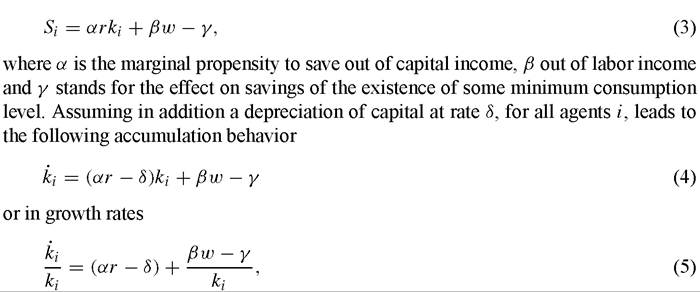
As growth proceeds through the accumulation of individual wealth, there is a second way by which it may modify the distribution of income and wealth. A simple general assumption is that saving or investment by agent i, Si, is a linear function of the various sources of income
where the notation “ ' ” refers to infinitesimal time change.
It may appear that the preceding specification only allows for the representation of the evolution of the distribution of income and assets among individuals and does not permit analyzing social structures as described by the composition and relative income of socio-economic groups. This is not the case, however. It is sufficient to define socio-economic groups by some particular endowments of assets for (1) to describe the evolution of the relative incomes between, for instance, unskilled workers and skilled workers, or between workers and ‘capitalists’. In effect, what matters here is the return to the various types of assets that are used to define socio-economic groups. The evolution of these rates of return defines the evolution of between group inequality. Likewise, Equations (4)-(5) implicitly define the dynamics of group composition. For instance, some unskilled workers - with k initially equal to zero - acquire some positive human capital (k) and become skilled workers, whereas some skilled workers may become ‘capitalists’. Thus, it should be clear that all that follows applies as well to a description of the effects of growth on inequality among individuals as well among socio-economic groups on social structures.
An obvious implication of the linearity of (4) is that the distribution of wealth and income does not affect the aggregate growth path of the economy and therefore the evolution of the factor prices, w and r, that comes with it. Yet, it can be seen in (5) that another implication of that saving function is that growth generally induces a change in wealth or income inequality. In the general case, inequality decreases or increases with growth depending on whether savings out of wages, βw, cover the dissaving due to minimum consumption γ, or not.[439] Since the wage rate is expected to increase with growth, inequality may increase with growth in a poor economy but this evolution may reverse itself when the economy has reached a certain level of affluence, in a process that is consistent with the Kuznets hypothesis.
This is an extremely simplified model. At the same time, it incorporates enough flexibility to analyze several interesting issues. To do so, it is helpful to derive from the preceding equation the time behavior of relative incomes. It is easily shown that the evolution of the relative income of two agents i and j is given by

This expression shows that distributional changes along a growth path have various sources. The first term in the curly bracket on the right-hand side corresponds to the changes in factor prices resulting from growth, whereas the last two terms correspond to capital and noncapital sources of savings, respectively. Sources for distributional changes are thus richer than with the sectoral shift approach. As mentioned above, the accumulation component may be compared, to some extent, to population shifts in the sectoral model. Differential accumulation behavior in the present representation of growth is equivalent to individuals moving from one socio-economic group to another. But, of course, it also corresponds to possible changes in ‘within-sector’ inequality parameters (Vi). The factor price effect corresponds to a change in the income differential across groups, that is the ratio y1 /y2 in the sectoral shift model.
Expression (6) readily shows what evolution in factor prices and what kind of saving behavior may be responsible for increasing or decreasing income disparities among individuals or socio-economic groups along the growth path. According to the factor price effect, any increase in the reward to capital, relative to labor, increases inequality by lowering the relative income of ‘pure’ workers. The same is true of a high propensity to save out of capital income. On the contrary, a high propensity to save out of labor
incomes contributes to more equality in the economy, at least after a wage threshold has been passed.
Of course, accumulation behavior and factor price changes cannot be considered as independent of each other. In this respect, it is interesting to consider some particular cases of the preceding general model. A first simple case is when agents save only out of their capital income (β = 0) and there is no minimum consumption requirement (γ = 0). It is well known that such a saving behavior can be obtained as the implication of a simple life cycle consumption allocation model.[440] As can be seen in (5), the rate of growth of individual wealth is then the same for all agents with positive initial wealth, which implies that the distribution of wealth remains constant over time, maintaining the features inherited from history. Note that this does not necessarily mean that the distribution of income will remain constant since relative factor prices and factor shares in individual incomes may change along the growth path. Yet, in the standard neoclassical framework with unit elasticity of substitution between capital and labor, it is easily shown that the distribution of relative incomes remains constant over time, precisely because the factor shares of total and individual incomes are constant.[441]
A related particular case, very much emphasized in the recent literature, arises when β = γ = 0, the rate of return to capital is constant and the wage rate grows at the same rate as individual and aggregate wealth. This would correspond to an economy where output is proportional to capital and is divided in constant proportion between labor and capital. The implicit growth model behind this description could be a version of the Harrod model or the ‘aK’ endogenous growth model proposed by Frankel (1962), extended later by Romer (1986) and others. The implications of these two particular cases are worth to be stressed. They indeed provide an interesting benchmark where economic growth is essentially distribution neutral, even after taking into account both the process of wealth accumulation and its effects on good and factor markets. However, it can be seen that this result is not so much due to the assumptions made on the production side of the economy - i.e. constant or declining returns to scale - as to the assumption that savings arise only out of capital income.
Another interesting particular case is the one originally explored by Stiglitz (1969). Assume that α = β and that factor prices are determined by the marginal products of an increasing and concave aggregate production function. Then, the aggregate economy behaves as in the well-known Solow model (1956), with the distribution of income following a Kuznets curve if the wage rate is initially low enough. More interestingly, and somewhat paradoxically, it can be shown that the distribution of income and wealth tends asymptotically towards full equality if the steady-state wage/profit rate ratio is large enough.[442] This result is considerably weakened if labor productivity and labor incomes are assumed to be heterogeneous across individuals. The distribution of both wealth and total income may then be shown to converge asymptotically to the distribution of labor productivities.
2.3. Nonlinearsavingsbehavior
The preceding results are all based on the assumption that the wealth accumulation process underlying growth is linear with respect to individual wealth. This assumption is debatable. There are various reasons why savings may be thought to be a nonlinear function of income or wealth, even when saving behavior is strictly assumed to result from inter-temporal optimization. Liquidity constraints and/or credit market imperfections are the most obvious factors that may explain such nonlinearities. For instance, credit rationing may imply that zero is a lower bound for the savings of somebody with zero wealth. Combining this feature and the preceding linear model leads to savings being defined by

In effect, this apparently small modification is sufficient to drastically alter the conclusions obtained previously. First, aggregating individual accumulation behavior leads to a change in aggregate wealth that depends on the distribution of wealth. Thus, the distribution of wealth affects the aggregate growth path of the economy, which was not the case before. Second, some of the conclusions obtained previously on the evolution of the distribution of income and wealth do not hold anymore. In particular, the result that the distribution of income tends towards equality in the Solow-Stiglitz model is not anymore granted. Depending on the initial distribution of wealth, inequality may well be nondecreasing throughout the whole growth path of the economy. Analogous conclusions may be obtained with more general nonlinear specifications of the saving function.[443]
A way ofjustifying nonlinear saving functions is to account for the fact that the rate of return to capital in the original (linear) model above may be heterogeneous across agents with different levels of wealth or income. Credit market imperfections associated with the existence of some indivisible investment project with an exogenous rate of return are sufficient to generate such a result. For moral hazard or adverse selection reasons those individuals who have to borrow to undertake this project face a borrowing rate of interest above rates served on conventional savings - and possibly decreasing with the amount borrowed, or equivalently their wealth.
Under the preceding assumptions, the original individual accumulation equation writes then

where r(∙) is a function of ki that has the shape of an inverted U - poor people are credit rationed and only people in some intermediate wealth range are borrowers facing an implicitly higher rate of return on their wealth.
A significant proportion of the recent literature on the effects of the wealth distribution on economic growth is implicitly based on credit market imperfections and an accumulation equation of type (7). This is true in particular of the seminal papers by Galor and Zeira (1993), Banerjee and Newman (1993), Aghion and Bolton (1996) and Piketty (1997). These models also have implications for the distributional consequences of growth. As the rest of the literature, however, they suggest that all types of evolution are possible, from continuously increasing or decreasing inequality to Kuznets-curve- like movements.
2.4. Theroleoftechnicalprogress
The preceding is based on a view of economic growth being essentially driven by factor accumulation. Growth modifies the distribution of income and wealth among individuals or across socio-economic groups essentially because individuals or groups do not accumulate at the same rate and because factor accumulation may cause changes in the remuneration of the productive factors owned by individuals. But, of course, another engine of growth is technical progress, which may itself modify both the relative remunerations of productive factors and factor accumulation behavior.
If technical progress is neutral, affecting the remuneration of all factors in the same way, then nothing has to be changed in the preceding argument. An issue arises when technical progress is ‘biased’ in the sense that it favors one factor more than others. A case that has received very much attention in the recent literature is that of the ‘skill- biased’ technical change, which is a shift in technology that increases the demand for skilled labor.[444]
From a theoretical point of view, one may analyze the effect of skill-biased technical change on social structures as resulting simply from a change in the return to the human capital component of individual wealth in the preceding framework. The increased demand for skilled labor increases the return to skill and, other things being equal, increases the income differential between skilled and unskilled workers. Of course, an increase in the return to skill is likely to cause an acceleration in the human capital accumulation, reducing progressively the differential between skilled and unskilled workers and, at the same time, shifting workers towards high skill socio-economic groups. The effect of this ‘race’ between technical change and education or training was first analyzed by Tinbergen (1975). Since then, it received very much attention.[445] In effect, the implications of this race for inequality are a priori ambiguous since it depends on the speed at which the demand for skilled labor increases following some technological innovation and the speed at which skill accumulation responds on the supply side of the labor market. If growth is seen as successive waves of skill-biased technical innovations, it may thus be accompanied by long-run fluctuations in earning differentials across skill groups of workers. These fluctuations may also be influenced by the fact that the bias of technical change may itself be affected by the skill differential and the relative availability of skilled workers, as in Acemoglu (2002).
The dynamics of the earning differential are not necessarily as simple as the preceding supply-demand argument would imply. For instance, Aghion, Caroli and Garcia- Penalosa (1999) and Aghion (2002) develop an original model of the diffusion of an innovation in General Purpose Technology where skill-biased technical change contributes to a continuous increase in the skill wage differential, after a preliminary period where the differential remains constant. The skill gap starts increasing when all skilled workers have been absorbed by firms which have adopted the new technology and the gap keeps increasing as long as other firms seek to adopt the new technology too. All firms eventually adopt the new technology and all workers acquire the new skill. In effect, this process combines both a sectoral shift of the type analyzed above and a general equilibrium price effect.
Although most of the effect of skill-biased technical change is expected to take place between skill groups, some authors insist that it may also affect inequality within groups. Any innovation requires adaptation of the first workers who are confronting it, and this adaptation is easier for workers with some specific ability on top of the skill required to perform the new task. The increased remuneration of that specific ability contributes to increasing the degree of inequality among workers, an inequality that may persist over time if the adaptation to the new technology has created a new type of human capital among the workers who were first exposed to the technical innovation [see Violante (1997), Rubinstein and Tsiddon (1998), Aghion, Howitt and Violante (2002)].
2.3. Conclusion
To conclude this section on the theoretical mechanisms through which growth affects social structures, it must be emphasized that, as mentioned in the case of technical progress, sectoral shift and general equilibrium mechanisms are not necessarily mutually exclusive. It was already seen above how the individual asset accumulation Equations (4)-(5) could actually represent the shift of individuals across socio-economic groups defined by their factor endowments. More explicitly, however, recent theoretical models built on the imperfect credit market mechanism actually combine the factor market and the sectoral shift approach. An interesting aspect of the model proposed by Banerjee and Newman (1993), for instance, is that the distribution of wealth in the economy practically determines economic agents’ kind of occupation and the sector where they operate. People with little wealth are pure wage workers, employed either in the formal or the informal sectors. People with a higher initial level of wealth engage in small businesses and determine the size of the ‘informal’ sector, whereas richer people are the owners, managers and top employees in the formal sector. The change in the wealth distribution that takes place, together with growth, over time thus has the effect of changing the distribution of occupations in the economy and the relative size of the formal and informal sectors. To some extent, this particular dynamic general equilibrium model provides a kind of formalization of the intersectoral shifts emphasized in the Kuznets tradition of the analysis of the effects of growth on inequality.
Overall, the short preceding review shows that considerable effort has been devoted to identifying and understanding the mechanisms through which growth affects social structures and inequality. As far as social structures are concerned, the analysis points to the evolution of the employment structure of the population away from lowest- productivity sectors and occupations. An obvious social consequence of growth thus is to reduce the share of the population living in traditional agriculture in a first stage, in informal nonagricultural activities in a second stage, in ‘low-tech’ manufacturing activities in a third stage, etc. At the same time, the accumulation of human capital implies that growth comes with a continuous reduction in the share of the population with no or low education.[446] On the other hand, the economic analysis of growth is largely inconclusive concerning other aspects of social structures and the distribution of wealth or income.
In this respect, three sources of ambiguity must be stressed. First, theory is necessarily silent on aspects of social structures that do not appear as central in economic growth mechanisms. That the population shifts sector and occupation in a well-defined direction is one thing. Whether this movement is uniform across population subgroups defined by gender or ethnicity is another thing - about which economic growth theory has little to say. This is essentially because factor endowments put forward by growth theory do not incorporate this dimension of social differentiation. Second, whether the shift of the population from one sector or socio-economic group to another is accompanied by an increase in income differentials among those sectors or groups is unclear. For instance, the share of educated people in the population is increasing with growth, but that evolution is in theory consistent with constant, increasing or decreasing income differentials between educational levels. Third, if economic theory permits us to identify the various channels through which growth may affect inequality among individuals, the sum total of these effects is ambiguous: no change, equalizing or unequalizing evolution throughout the whole growth process, or the inverted-U shape put forward by Kuznets. This conclusion holds whatever the analytical framework being used, whether theoretical models belong to the sectoral shift fix-price or to dynamic general equilibrium modeling tradition.
3.
More on the topic The effect of economic growth on social structures: Theoretical considerations:
- Conclusion
- THE EVOLUTION OF NETWORK SCIENCE
- Direct and indirect influences
- The social sciences have a long history as a source of law
- CONCLUSION
- Intellectual property rights and incentives
- Conclusion
- CONCLUSION
- Industrial relations
- CONCLUSION