THE EVOLUTION OF NETWORK SCIENCE
Even though the term network science was used only sporadically and colloquially before the 1990s, network thinking can be traced back to developments in the eighteenth century (Freeman, 2004).
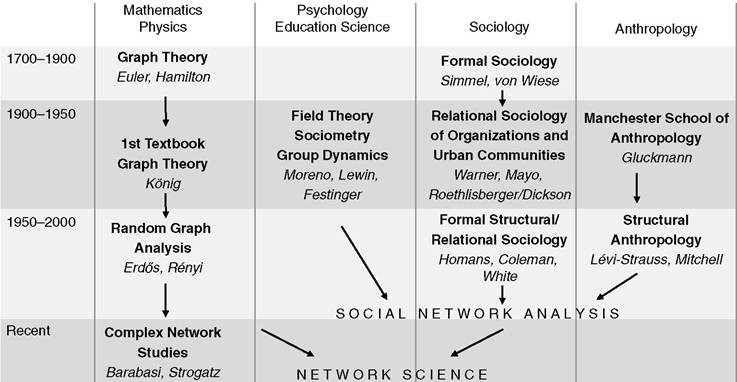
Which scientists and philosophers ought to be treated as forerunners of network research depends on how its core ideas are defined. If the use of terms such as ‘connections’ and ‘relationships’ already qualifies for a precursor role, then social scientists such as Montesquieu, Marx, and Comte need to be included (Emirbayer, 1997; Freeman, 2004). The first mathematical conceptualizations of relational configurations can be found in the work of Leonhard Euler, solving the famous ‘Konigsberg Bridges Problem’ (Wilson, 2004), and Francis Galton developing stochastic kinship mathematics (Freeman, 2004).The school of network studies becomes more exclusive if systematic concept development and an explication of research methods are seen as the relevant threshold. The first steps in method-based network analysis began with Leopold von Wiese and Jacob Moreno, who developed simple statistical methods to describe relations, albeit without advanced mathematical foundations. Similar developments happened in social anthropology and industrial sociology (Scott, 1991; Freeman, 2004). Kurt Lewin’s application of physical and mathematical concepts to interpersonal psychological relations can be considered a next step (Lewin, 1936). This also supported the development of modern graph theory, which contributed to a kind of ‘breakthrough’ (Raab, 2010) in social network
Sources: Scott (1991); Freeman (2004); Wilson (2004).
Figure 4.1 The development of network science and network research
research at Harvard and MIT with a range of new methods and techniques during the 1970s (Scott, 1991; Freeman, 2004).
Completely independent of social network analysis were the advances in mathematical graph theory at the end of the 1950s, spurred by the development of random graph models for global network structures that were developed by Paul Erdos and Alfred Reny in the 1950s and 1960s (Harary, 1969). The proliferation of computational methods and models based on these concepts and algorithms facilitated the emergence of the current version of ‘network science’ (Barabasi and Frangos, 2002; Jungnickel, 2005). In parallel, under the notion of ‘social network analysis’, network approaches have been booming in the social sciences since the 1970s and 1980s (Wasserman and Faust, 1994; Borgatti et al., 2009; Hennig et al., 2012). Figure 4.1 outlines the main lines of development of network science and network research.In network science, roads, rivers, communications circuits and social relations are no longer described as systems, as was popular during the 1960s and 1970s, but as networks in which ‘systemness’ is emerging from a network of relations. Notions such as the ‘web of life’ (Capra, 1996) or the ‘network society’ (Castells, 1996) have become widely used descriptors of ecological and social reality. Although the concepts of ‘system’ and ‘network’ have similar meanings - at least in a mathematical sense, as interrelated components within a boundary separating them from their environment - the network concept does not imply equilibrium orientation, and involves much lower integration. Rather, it emphasizes precariousness and vulnerability of social and biological configurations. Complexity and complex interdependence are important related concepts. Networked reality is non-linear, with only a few one-to-one relations and multiple and multiplex dependencies in most cases (Capra, 1996). In such systems, small local incidences may have global ramifications.
Although many studies in network science are related to the Internet, network science is much broader than Internet science or web science (Dorogovtsev and Mendes, 2003; Pastor-Satorras and Vespignani, 2004; Wright, 2011; Shadbolt et al., 2013; Tiropanis et al., 2015).
Network scientists try to find similar network characteristics in all natural and social phenomena - networks of proteins, people, words, or websites. Their ultimate goal is to find general patterns and laws that are effective in networks of any kind. From this perspective, network science is rather a subfield of mathematics that uses graph theory to model network topologies and analyzes empirical network data to explore the phenomenon of ‘networkness’. This can be done in many physical, biological and social networks that are unrelated to the Internet. From this broad research program, network science has developed powerful tools and methods to analyze networks and their implications for outcomes, aptly summarized by Newman (2012) in his comprehensive textbook on streams and directions of network science.Networked complexity suggests distributed control. In a political sense network configurations are new institutional arrangements that disperse power and control. In contrast to hierarchical control, networks are based on autonomous interaction of components. This idea of non-hierarchical but all-embracing connectedness became a technical reality through the World Wide Web, in which not only states and organizations, but also people and increasingly ‘things’ became globally interconnected. The provision of universally open technical network infrastructures created new forms of social interaction, new media and public spheres, new forms of scientific cooperation, new electronic economic sectors and new forms of governmental organization (e-government and e-democracy) and public services. The penetration of the Internet into almost all spheres of life created a new academic industry studying these socio-technical processes of adoption, diffusion and their actual and future impact. Network science offers a unique set of methods to model and understand these relations and their effects.
During the past decade Internet science and web science have emerged as fields that are related to but not identical with network science.
Moreover, these areas connect with the much broader domain of Internet studies, which predominantly employs social science approaches to examine a wide array of issues related to the Internet, its effects, and governance (Dutton, 2013). Tiropanis et al. (2015) examine the relations between network science, web science and Internet science in detail and identify multiple overlaps but also areas of differentiation. Of the three approaches, network science has the broadest scope as it analyzes networks beyond the Internet. Thus it provides a broader canvas to examine the economic consequences of the pervasive adoption of the Internet. At the same time, because of its reliance on network science approaches it is methodologically more narrowly construed than Internet science or web science. Both Internet science and web science focus on the specific domain of the Internet, with many overlaps between them and with network science (in as far as the latter focuses on the Internet). Within the recently formed Internet science community, many contributions approach the Internet as a socio- technical system with an emphasis on the infrastructural layer of the web and the implications of different protocols and designs for the openness and dynamics of the Internet.Web science is a hybrid of the two research paradigms embedded in physics and computer science. It seeks scientifically to understand the macroscopic laws operating in the web while also synthetically designing systems in ways that are compatible with fundamental human values such as privacy and freedom of speech. In the words of Berners- Lee et al. (2006a), ‘Web science, therefore, must be inherently interdisciplinary; its goal is to both understand the growth of the web and to create approaches allowing new powerful and more beneficial patterns to occur’. Thus, ‘Web science is about more than modeling the current web. It is about engineering new infrastructure protocols and about understanding the human society that uses them and creates the Web, and it is about the creation of beneficial new systems’ (Berners-Lee et al., 2006a, p. 771; see also Berners-Lee et al., 2006b; Hendler et al., 2008; Wright, 2011; Shadbolt et al., 2013). It remains to be seen whether these fields will continue to cross-fertilize and coalesce around a shared interest in the Internet or whether the differences in methods and primary interests will lead to segmentation into separate communities.
4.3