In the previous chapters we have focused on the effects of aggregate volatility and aggregate productivity or trade shocks on long-run growth, taking volatility as being largely exogenous.
In this and the following chapters we show how volatility can emerge endogenously, in a world where credit constraints sometimes bind.
Until recently, the dominant paradigm to explain persistent macroeconomic volatility in market economies has been the so- called Real Business Cycles model pioneered by Kydland and Prescott (1982) and by Long and Plosser (1987).
In its simplest version, the model is based on three elements. First, the dynamics of productivity, of the form:
where εt is a random noise (independently and identically distributed over time) whose variance measures the magnitude of the productivity shocks and ρ is a parameter that measures the persistence of the shocks over time. Second, the production technology
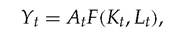
where F exhibits constant returns to scale with respect to capital (Kt) and labor (Lt). The first two equations describe the demand side of the labor market. The supply side is pinned down by a third element, namely the representative individual's utility for consumption and leisure

where η measures the elasticity of labor supply.
This model provides a very simple explanation for why even small productivity shocks can induce large and persistent output fluctuations: suppose the occurrence of a positive productivity
shock. This will increase the relative attractiveness of work relative to leisure, and all the more so when the elasticity of labor supply η is sufficiently close to 1. This in turn will amplify the positive effect of the productivity shock on the equilibrium output Yt.
There are several problems with this approach. First, for small technological shocks to generate large and persistent fluctuations in aggregate GDP and employment, one needs to assume very large values for the variance of εt and a persistence parameter ρ very close to 1.[VII] Second, to account for the fact that large fluctuations in employment occur in practice with little change in real wage, one needs to assume a labor supply elasticity parameter η also very close to 1. But then, how can we explain that volatility has been so much higher in Asia or Latin America over the past three decades when the elasticity of labor supply is higher in the United States? Table 3.1 gives estimates of the income-compensated wage elasticities of labor supply for several Asian countries, Peru, and the United States. The elasticity is highest in the United States, with a value of 0.11. Third, there seem to be many more recessions than large negative shocks that could explain them: There is the example of the negative trade shock that occurred in Finland upon the collapse of the Soviet Union in 1991, but it is hard to find large negative productivity shocks after 1975 in LatinAmerica or in Asia. For all of these reasons, the literature on explaining
Table 3.1 Income-compensated wage elasticity of labour supply
| Taiwan | -0.12 |
| Malaysia | -0.07 |
| Korea(South) | 0 |
| Thailand | 0.08 |
| Peru | 0.1 |
| US Average | 0.11 |
macroeconomic volatility have come to the conclusion that credit constraints probably do have a role to play in this story.
The basic intuition for why credit constraints may contribute to volatility is laid out in an important paper by Bernanke-Gertler (1989), henceforth BG, and Bernanke et al.
(1998). These papers explore the effects of the so-called “financial accelerator" whereby the existence of credit constraints limits firms' investment to a finite multiple of their current cash flow (as in our model earlier). This financial accelerator in turns amplifies the effects of real and nominal shocks. In particular, small changes in real interest rates induced by monetary policy, or small changes in the cost structure of firms resulting from a productivity shock, can have large real effects as they affect firms' investment capacity. This in turn will have a negative impact on cash flows in subsequent periods, thereby propagating and amplifying the initial shock over time. To show evidence of a financial accelerator, Bernanke et al. use the Quarterly Financial Report for Manufacturing, Mining, and Trade Corporations published by the US Department of Commerce, which contains quarterly time-series information for small and large US firms. They show that small manufacturing firms (which are typically more credit constrained than large firms[VIII]) experience more procyclical variations in sales, inventories, and short-term debt than larger firms, which they take as evidence of the existence of a financial accelerator. The BG model is a partial equilibrium model, where interest rates changes are exogenous. Moreover, what credit constraints do in their model is to amplify shocks: There is not yet a theory of persistent business cycles.Kiyotaki and Moore (1997), henceforth KM, show a way of extending the BG insight into a theory of persistent business cycles. In their model, a positive shock to profits raises investment which, in turn, increases the price of collateral. This in turn relaxes borrowing constraints on investors and therefore improves their investment capacity. This in turn amplifies the positive shock on profits. Hence, the possibility of positive serial correlation in aggregate output over time. KM also show that this general equilibrium effect via the price of collateral can generate persistent fluctuations, that is negative serial correlation in aggregate output, in an extended version of their models with lags in the response of investment to changes in borrowing constraints.
However, they offer no simple intuition for why the positive serial correlation underlying their basic amplification mechanism suddenly turns into a negative serial correlation and relatedly, the model does not give us much insight into the conditions under which endogenous cycles are most likely to occur. Finally, neither BG nor KM lay out the long-run growth implications of the amplification or endogenous volatility phenomena described in these papers.In this and the next chapter, we develop an elementary theoretical framework which generates endogenous and persistent volatility in a growing economy with credit constraints. The basic mechanism is the interaction of credit constraints and endogenous changes in market prices. We begin with a version that is relevant for a closed economy, where the important market price is the interest rate. In the next chapter, we present an alternative version built around a small open economy, and argue that a similar mechanism operates there, even though the interest rate is fixed by the world capital markets. This is because there are endogenous movements in the real exchange rate. We argue that the model can account for a number of observed facts about lending booms and crises in emerging market economies. It also provides additional arguments in favor of countercyclical budgetary policies in less financially developed economies. The remaining part of this chapter is organized as follows. Section 3.1 outlines a simple AK growth model with credit constraints and pecuniary externalities among investors. Section 3.2 defines booms and slumps in the context of the model, and Section 3.3 analyzes the dynamics of the model. Section 3.4 derives sufficient conditions for the existence of a limit cycle and considers the long-run effects of exogenous shocks. Section 3.5 discusses the empirical relevance of the model. Section 3.6 turns the attention to policy analysis and the effects of countercyclical budgetary policies.
3.1