A theory of relative efficiencies
The Hansen and Prescott (2002) theory of economic development reviewed in Section 2 is not a theory of the evolution of international income levels. It does not address the issue of why modern economic growth started at different dates in different countries.
India, for example, began modern economic growth nearly 200 years later than did the United Kingdom. As a result, India's income level relative to the leader fell from 50 percent in 1770 to only 5 percent in 1970. Neither does the theory address the issue of why some countries that have been experiencing modern economic growth for a century or more have failed to narrow the income gap with the industrial leader. In Latin American countries, for example, income levels have remained at roughly 25 percent the U.S. income level since the end of the nineteenth century when modern economic growth began there. The theory does not address the issue of why some countries in the 1950-2000 period have been able to substantially narrow the income gap with the industrial leader. These countries include Italy, Spain, Japan, Korea, and Taiwan, the latter three all of which experienced a growth miracle. Some factor that differs across countries must be added to the Hansen and Prescott theory to make it a theory of the evolution of international income levels.One might be led to introduce differences in TFP associated with the modern production function to the model, because the Hansen and Prescott theory of development predicts that per capita income in a country starts to increase once TFP in the modern sector reaches a critical level. Moreover, there is ample evidence that countries (at least those experiencing modern economic growth) differ along this dimension.[260] Although it would be easy to introduce such differences into the Hansen and Prescott theory, it would not be useful, as long as country-specific TFP differences are treated exogenously.
Absent a theory of country-specific TFP, the theory of the evolution of international income levels is sterile because it offers no policy guidance. What is needed is a policy-based theory of why TFP differs across countries at a point in time.Parente and Prescott (2000) develop a theory of TFP that attributes differences in TFP to country-specific policies that both directly and indirectly constrain the choice of production units. Their theory of TFP is more appropriately called a theory of relative efficiencies. This is because Parente and Prescott (2000) decompose a country’s TFP into the product of two components. The first component is a pure knowledge or technology component, denoted by A. The second is an efficiency component, denoted by E. In the context of the Hansen and Prescott model, the modern growth production function is

The technology component of TFP, ASt, is common across countries. It is the same across countries because the stock of productive knowledge that is available for a country to use does not differ across countries.[261] The efficiency component differs across countries as the result of differences in economic policies and institutions. Here we consider the case in which a country’s economic policies and institutions do not change over time, so Es is not subscripted by t. The efficiency component is a number in the (0, 1] interval. An efficiency level less than one implies that a country operates inside the production possibilities frontier, whereas an efficiency level equal to one implies that a country operates on the production possibilities frontier. Differences in efficiency, therefore, imply differences in TFP.
Relative efficiencies at a point in time, and not absolute efficiencies, can be determined using the production function and the data on quantities of the inputs and the output. Thus, it is not possible to determine if any country has an efficiency level equal to one, although we tend to doubt that this is the case.
Changes in relative efficiencies of a given country can also be determined conditional on an assumption on the behavior of the technology component of TFP such as that it grows at some constant rate.We now present the Parente and Prescott (2000) theory of relative efficiencies. To keep the analysis manageable, we present the theory of relative efficiencies in the context of an economy in which only the modern production function is available. The theory constitutes a theory of the aggregate production function when there are constraints at the production unit level.
In light of this, we first review the theory underlying the aggregate production function. We then show how policy constraints give rise to an aggregate production function with a different efficiency level. We follow this by providing estimates of cross-country relative efficiencies associated with the modern production function using the mapping from policy to aggregate efficiency derived in this section with estimates of the costs imposed by a country-specific policy. Finally, we conclude this section with a discussion of why constraints on the behavior of the production units exist.
3.1. The aggregate production function
Before developing the mapping from policy to aggregate efficiency, we briefly review the theory of the aggregate production function associated with modern growth. The theory underlying the aggregate production function is as follows. In each period, there is a set of plant technologies B. A plant technology b ∈ B is a triplet that gives the plant’s output yb and its capital and labor inputs, kb and nb. A plan {λb} specifies the measure of every type of plant operated. The aggregate production function, that is, the maximum Y that can be produced given aggregate inputs K and N is
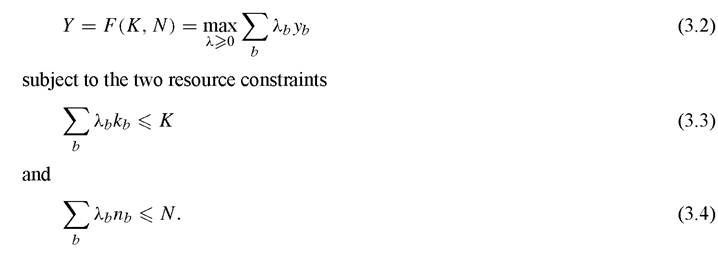
Assuming that this program has a solution, which it will under reasonable economic conditions, the aggregate production function will be weakly increasing, weakly concave, homogeneous of degree one, and continuous.
Empirically, the Cobb-Douglas aggregate production function is the one consistent with the post-1900 modern economic growth era. The question then is: What set of technologies B gives rise to the Cobb-Douglas aggregate production function? One such set is the set of plant technologies defined by

The function d(n) is an increasing and continuous function of the labor input. Assuming that n* = argmax d(n)nθ-1 exists, the aggregate production function is

where A sketch of the proof is as follows. If any quantity of capital
and labor is allocated to a single type plant in such a way that output is maximized, then the number of employees at each plant is n*. Thus, all operated plants, for an optimum, must have n* workers. Given θ < 1, the capital stock must be allocated in equal quantity over every operated plant. Thus, the number of plants operated is N∕n*, capital per operated plant is K∕(N∕n*), the number of workers per operated plant is n*, and maximal output is given by Equation (3.6). With the assumption that the function d increases over time, the expression A will increase over time.
3.2. Consequences of constraints for aggregate efficiency
Next, consider the plant production technology with constraints imposed on it. We consider two types of policy. The first type constrains how a particular plant technology can be operated. The second type constrains the choice of which plant technologies can be operated. Certainly, these are not the only types of constraints that will affect a country’s TFP. A number of other types of policy have a similar effect.17
The first type of policy constrains how a given technology is operated.
A policy that gives rise to this type of constraint is a work rule, which dictates the minimum number of workers or machines needed to operate a plant technology. In particular, suppose constraints are such that the input to a b = (k,n,y) type plant must be φκkb and fiNnb for all plant types where φκ and Φn each exceed one. This implies that a particular technology, if operated, must be operated with excessive capital and labor. With these constraints, the aggregate production function is
the nature of the constraints were to double the capital and labor requirements, then the efficiency measure would be one-half. If the nature of the constraints is to quadruple both the capital and labor requirements, then the efficiency measure would be one- fourth.
The second type of policy constrains the choice of which technology can be operated. This type of constraint maps into the efficiency parameter of an aggregate production function with a composite capital stock made up of both physical and intangible components. Any policy that serves to increase the amount of resources the production unit must spend in order to adopt a better technology is a constraint of this nature. Such policies and practices take the form of regulation, bribes, and even severance packages to factor suppliers whose services are eliminated or reduced when a switch to a more productive technology is made. In some instances, the policy is in the form of a law that specifically prohibits the use of a particular technology. The empirical evidence suggests that this second type of constraint is more prevalent than the first.18
Following Parente and Prescott (2000), let the output of a quality b plant be given by the following equation,

17 For example, Schmitz (2001) suggests a mapping from government subsidies directed at state-owned enterprises to aggregate efficiency.
18 See Parente and Prescott (2000) for a survey of this evidence.
With this technology, a minimum number of workers, n, is required to operate a plant. The variable kP denotes the physical capital input. The subscript P is introduced in order to differentiate physical capital from intangible capital later in the analysis. There are no increasing returns to scale in the economy, because if the inputs of the economy are doubled, the number of plants doubles.19
A plant’s quality is a choice variable. To improve its quality, resources are needed. This resource cost is the product of two components. The first component is technological in nature and reflects the cost in the absence of constraints. The second component, denoted by φj > 1, reflects the constraint itself. The function that gives the required resources a plant must expend to advance its quality from b to b' is

Here Wt is the stock of pure knowledge in the world in period t. Its growth rate is exogenous and equal to γw. Thus
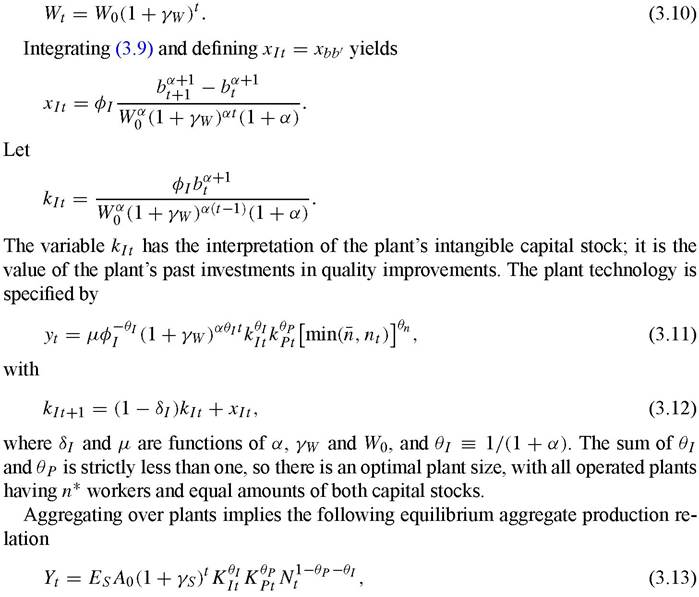
[1] See Hornstein and Prescott (1993) for a detailed coverage of this technology.
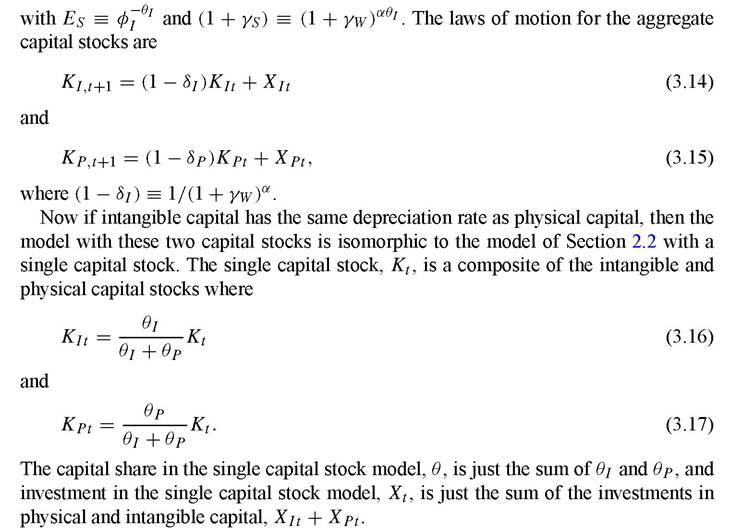
For the sake of consistency and brevity, we continue to use the model economy with a single capital stock in our presentation of the unified theory of the evolution of international incomes. In those instances where we wish to consider the role of intangible capital, we proceed by assigning a value to the capital share parameter in the modern production function that exceeds 0.40, the share of physical capital’s output in the national income accounts. We solve out the model economy with a single capital stock and then impute the intangible and physical capital components, as well as their investments. This can effectively be done using Equations (3.16) and (3.17) given a decomposition of the total capital share into its intangible and physical components.[262]
3.3. Estimates of aggregate relative efficiency
The mappings developed in the preceding subsection allow us to impute the aggregate relative efficiency associated with the modern production function for various constraints. In general, the size of the effect of the constraint on a country’s aggregate
efficiency depends on the factor input affected by the constraint and on that input’s share in the production function. In the special case where the constraints affect all inputs equally, that is, φ = φn = φj = φp,the individual factor shares are unimportant and the efficiency level of a country is just Es = φ~l. Hence, the implied difference in relative efficiencies is equal to the implied cost differences of policy. Thus, if the cost difference in policies between two countries is a factor of five, the implied factor difference in aggregate relative efficiency is also five.
Are factor differences in relative efficiency greater than five reasonable? Obviously, it is not possible to answer this question definitively without a comprehensive international study of the total costs of the constraints imposed by society. Some estimates of the cost differences associated with some country-specific policies do exist. Studies that estimate the costs of certain policies of individual countries that affect the technology and work practice choices of the production units located there do find that these costs vary systematically with income levels, with large differences existing between rich and poor countries. These studies suggest that factor differences in relative efficiencies could easily be as great as five.
For example, Djankov et al. (2002) calculate the costs associated with the legal requirements in 75 countries that an entrepreneur must meet in order to start a business. They find that the number of procedures required to start up a firm varies from a low of 2 in Canada to a high of 20 in Bolivia and that the minimum official time required to complete these procedures ranges from a low of 2 days in Canada to a high of 174 days in Mozambique. These costs do not reflect any unofficial costs involved with starting a firm, such as bribes or bureaucratic delays. Because these official cost measures are positively correlated with indexes that incorporate measures of bribes, the true difference in start-up costs between low-cost and high-cost countries is surely even larger than those reported in the study.
3.4. Reasons for constraints
The evidence strongly suggests that production units in poor countries are severely constrained in their choices, and the costs associated with these constraints are large. This prompts the question: Why does a society impose these constraints? A large number of studies, some of which are surveyed in Parente and Prescott (2000), suggest that constraints typically are imposed on firms in order to protect the interests of factor suppliers to the current production process. These groups stand to lose in the form of reduced earnings if new technology is introduced. These losses occur because either the input they supply is specialized with respect to the current production process or their industry’s demand is price inelastic.[263]
4.