<<
>>

Chapter 42 Racial Differences in Financial Socialization and Financial Behaviors of U.S. College Students

Michael S. Gutter

University of Florida, USA

Zeynep Copur

Hacettepe University, Turkey

Amanda Blanco

University of Florida, USA

ABSTRACT

This chapter focuses on the effect of race on financial socialization and financial behavior of college students.

Data (N = 13,845) were collected from current college students age 18 and over via an online survey throughout the United States during spring and fall of 2008. Results from means comparisons showed significant differences on the financial socialization between Black and White college students. Logistic regression results suggest important relationship exist between race and financial behaviors. Black students were less likely to save and more likely to engage in risky credit card behavior than White students after controlling for the effects of all other variables.

INTRODUCTION

The capacity to manage personal finances has become increasingly important, particularly for college students. Students are now leaving schools without the ability to make critical financial deci­sions affecting their future lives and thus, are in

danger of beginning a downward financial spiral of debt. This is debt that they will not easily repay while in college or even after they have gained fulltime employment in the workplace (Henry, Weber, & Yarbrough, 2001; Grable & Joo, 2006). Henry et al. (2001) revealed that 68% of college students rarely budgeted or did not budget at all. In a follow up study, Joo et al. (2003) found that only half of the students paid their credit card bills in full each month and 40% did not know the annual percentage rate of their credit cards. Some researchers concluded that Black students with low income were more likely to engage in responsible financial management behaviors than their White counterparts (e.g. Perry & Morris, 2005). Lyons’ (2004) study showed racial dif­ferences with students who are having difficulty making credit card payments were more likely to be Black, and/or Hispanic.

Her study also found that Black students were also significantly more likely to have credit card balances of $ 1000 or more and not to pay their balances in full each month. Grable and Joo (2006) found that racial differences between Black and White students on financial behaviors; Where Blacks held more credit card debt than others and credit card debt was positively related to negative financial be­haviors. Researchers have also speculated that White and Black families save differently and that these differences have important implications for wealth inequality (Brimmer, 1988; Parcel, 1982). Burlew, Banks, McAdoo, and Azibo (1992) suggested that a common goal among Blacks is to have a standard of living comparable to their peers, both Whites and Blacks. This goal might lead to a lower emphasis on savings (Yao, Gutter, & Hanna, 2005).

DOI: 10.4018∕978-1-4666-6268-1.ch042

.

An analysis of the 2004 Survey of Consumer Finances showed that Black households were significantly less likely to have spent less than their income when compared to Whites. Based on an analysis of the 2004 Survey of Consumer Finances, with 41 % of Black households, and 60% of White households reporting that they spent less than they had in income (Bucks, Kennickell, & Moore,2006), and Black families saw a 24.1 percent decline in their median net worth from 2004 to 2007 (Bucks et al., 2009). Also Black households were significantly more likely than White households to have missed or been late on a loan payment (40% versus 18%). Controlling for income and other factors, Black households had higher predicted delinquency rates than White households (Bucks et al. 2009). What is less well known is how financial socialization differs based on racial background. Thus, the current study aims exposure to potential differences in financial socialization between Black and White college students and the effects that these differ­ences may have on financial behaviors (budget­ing, saving, and risky credit card usage).This research is important, in that it is vital for Blacks and Whites to gain financial knowledge.

A few papers examine the link between knowledge and behavior and authors found strong links between knowledge and behavior (e.g., Borden, Lee, Serido, & Collins, 2008; Hilgert, Hogarth, & Beverly, 2003; Robb, 2011). Both Black and White college students will eventually be responsible for their own finances. If Blacks are missing out on early positive financial socialization opportunities, they may be negatively affected later in life by financial issues, in which they have little knowl­edge or tools to resolve. By finding out whether or not individuals are socialized differently in the financial realm, we can determine next steps in closing this potential race gap.

THEORETICAL FRAMEWORK

Socialization is often viewed as a social process by which norms, attitudes, motivations, and behaviors are transmitted from specific sources (commonly known as socialization agents) to the learner (Brim, 1966; Hira, 1997; McLeod &O’Keefe, 1972; McNeal, 1987; Moschis, 1981). Children who emulate their parents’ behavior through observations provide a good example of social learning (Bandura, 1977; Grossbart, Carlson, & Walsh, 1991; Maccoby, 1992; Mascarenhas & Higby, 1993; Moschis & Churchill, 1978). Based on social learning theory, consumer socialization research suggests that a great deal of consumer behavior, such as spending behavior among adults, is learned during the adolescent years through the influence of socialization agents such as parents, family members, and other influential individuals and can be taught from generation to generation (Churchill & Moschis, 1979; Moschis & Moore, 1984; Valence, d’Astous, & Fourtier, 1988). Consumer socialization theory explores the effects of both social-structural constraints (the social variables, such as social class, gender, and age, that can have an effect in socialization by influencing learning processes) and socializa­tion agents (that is, parents, peers, school, and/ or television,) on the mental and behavioral out­comes (e.g., the process through which parents teach consumer skills to children) (Moschis & Churchill, 1978).

Several previous studies have revealed that parents’ intentional instruction and reinforcing activities can directly and indirectly impact their children’s financial knowledge and behavior. Parents appear to play an important role in the consumer socialization of their offspring, and they are instrumental in teaching them the rational aspects of consumption (Danes, 1994; Drentea & Lavrakas, 2000; Hayhoe et al., 2000; Lyons, Scherpf, & Roberts, 2006; Moschis, 1985).

The cultural-difference version of the social­ization hypothesis states that Blacks socialize their children differently because they have a different culture which requires social and other competencies different from those valued in the white culture (Ogbu, 1979; Rong & Brown, 2002). Race and ethnicity is representative of the shared history and socialization of a group and, thus, should impact financial preferences. Differences in socialization among different racial and ethnic groups might also influence preferences such as budgeting or saving behavior (Dilworth-Anderson, Burton, & Johnson, 1993). In particular, a history of less exposure to financial markets and finan­cial information, greater labor force participation instability (Hsueh & Tienda, 1996), discrimina­tion, having lower levels of wealth (Kennickell, Starr-Mcluer, & Surette, 2000; Aizcorbe et al., 2003) and differences in family composition are likely to make Blacks are less likely to engage in positive financial behaviors (Dilworth-Anderson et al., 2005). Therefore, it is expected that Whites are more likely to engage in positive financial behaviors than Blacks. Some differences might be related to other factors such as gender, income, and debt, but if significant differences remain after controlling for these factors in multivariate analyses, the financial socialization explanation presents a plausible alternative. Thus, this research aims to look at differences in financial socialization between Black and White college students and the effects that these differences have on financial behaviors, such as budgeting and saving.

In the current study, financial socialization is represented by financial social learning opportunities such as discussing financial matters with parents and peers; or observing their financial behaviors.

Research Questions and Hypotheses

According to previous research (e.g. Chen & Volpe, 1998) we see that various behavior dif­ferences in Blacks and Whites may be partially affected by differences in socialization. There is evidence that race differences exist in various areas of financial behavior (e.g. Lyons, 2004). It stands to reason that if people are socialized differently based on race for some behaviors, that they may also be socialized differently for financial behav­iors. This study seeks to expand that research to the area of financial socialization and financial behaviors, with the following hypotheses:

1. Exposure to financial social learning op­portunities will differ by race of college students.

2. There is a relationship between race and financial behaviors when controlling for social learning opportunities, gender, marital status, income, amount of debt, and financial education.

METHOD

Data and Sample

Data for this study was collected as part of a larger study on the impact of financial education on financial behaviors during the spring and fall semesters of 2008. A stratified random sampling technique based on state policies toward financial education was utilized. Six policy categories were determined using the 2004 National Council on Economic Education report. States were randomly selected from each of the categories, with the target campuses being large state universities. The sampling pool consisted of college students, age 18 and over, from 15 public universities across the United States.

In total, emails were sent out to 172,412 students, with 16,876 students responding to the survey. Students who were not educated in the United States, who were homeschooled, who received a GED, or who did not indicate their state of high school attendance or whether they are Hispanic, Asian, and other ethnicity were removed from the sample, yielding a final sample of 13,845 students (5.3% Blacks, 94.7%Whites).

The sample profile is fairly typical, with an aver­age age of 21.3 years. In addition, most students were female (65.6%), most were White (94.7%), and most were unmarried (85.5%).

Measurement of Variables

Dependent Variables

Financial Behaviors: This includes budgeting, saving and risky credit usage behaviors. Budget­ing was measured with the question, “Do you currently use a system to manage expenses and avoid overspending?” Saving was measured with the question, “Are you currently depositing/invest- ing money on a regular basis into some sort of account (includes employer plans, mutual funds, individual retirement account (IRA), savings, CDs)?” Responses included yes or no. Credit usage behaviors are based on a score of risky credit card behaviors. Students were asked “how frequently in the past year they had done the fol­lowing: maxed out their credit, been delinquent, and carried a balance.” Responses included 0, 1-2, 3-5, 6 or more, and N/A represent if students doesn’t have credit card. For the analyses to each of the risky credit card behavior 1-2, 3-5, 6 or more were combined as 1 which indicated that students have engaged risky credit card behavior and 0 indicated that students have not engaged risky credit card behavior. Then, for the ordinal logistic regression analysis three risky credit card behaviors (“max out,” make late payments, and do not pay off credit card balance) combined as 0, (no risky credit card behavior) 1 (engaged one risky credit card behavior), 2 (engaged two risky credit card behavior), and 3 (engaged three risky credit card behavior) with more frequent behaviors indicating higher credit risk scores.

Independent Variables

Demographic Variables: The current study involved the following college students’ demo­graphic variables: gender, race, and marital status.

Financial Variables: In this research, financial variables were measured using monthly income, amount of debt, and number of credit cards.

Financial Education: Financial education was measured with the question, “Were you taught about personal finances in high school?” and “Have you ever taken a course, program, or seminar on personal finance issues in your com­munity, religious institution, or 4H-in other words not through school?” Responses were categorical and included yes or no.

Financial Social Learning Opportunities: The financial social learning opportunities score was a composite measure based on four dimensions: discussions with parents, discussions with peers, observing parents and observing peers. The score utilized responses to eight items representing these four dimensions. Scores for each dimen­sion ranged from 8 to 40. This measure is based on the work of Gutter and Garrison (2008). Stu­dents were asked how frequently in the past five years they had discussed the following with their parents and friends or other students: “managing expenses and avoiding over spending,” “checking their credit report,” “paying bills on time,” “sav­ing and investing,” “working with a mainstream financial institution,” “buying and maintaining health insurance,” “auto insurance” and “rent­ers’ insurance.” A similar set of questions was asked but focusing on observations of the same behaviors. The student answered by using a 5 point scale from 1= never to 5= often. In order to test the reliability of the measure, Cronbach’s Alpha was selected. Cronbach’s Alpha internal consistency reliability was calculated to be.86 for both discussion with parents and discussion with friends. The inter-item reliability was high for both observing parents (α=.87) and observing friends (α=.86).

Analyses

Preliminary exploration of the research questions included simple bivariate comparisons employ­ing cross-tabulation tables and chi-square test to examine whether or not the profile of the sample, financial socialization, risky credit usage behav­iors, and financial behaviors differed by race. For social learning opportunities, each of the four social learning opportunities scores was compared by race via independent sample t-test. The results of the t-test indicate overall significant race dif­ferences for each form of financial socialization. This was followed by binary logistic regression for budgeting, saving and ordinal logistic regression for risky credit card usage behavior. The dependent variables included using a budget, saving, and students’ risky credit usage behaviors. The purpose of this analysis was to determine the relationship of race on varying financial behaviors, controlling for financial social learning opportunities, gender, marital status, income, debt and prior financial education. The effect of race on varying risky credit card usage behavior also controlled for credit card number. Specifically, we used logistic regression equations to examine main effects and interaction models. Main effects models included race, gender, marital status, income, debt and prior financial education as predictors of financial behaviors and number of credit card as predictor of risky credit card usage. Interaction models added race by sample characteristics product terms (e.g., RaceXGender) to our main effects model. Interaction analyses addressed whether the effects of college students characteristics on financial behaviors differed between Blacks and Whites. The interaction model and the reduced model were compared to determine whether fac­tors improved the model. This was tested using a likelihood ratio test. The test was significant and the reduced model was rejected in favor of the full (interaction) model.

RESULTS

Comparing Students’ Profile by Race

The sample was composed of 94.7% Whites and 5.3% Blacks. Many of the students in both samples reported having a course in personal finance (41.1% of Blacks, 38.8% of Whites) in high school (p>.05). Black students were sig­nificantly more likely to have a personal finance education (22.6%) in their communities compared to White students (8.5%) (pbgcolor=white>.902 $500-$999 -.015 .985 .011 1.011 $1000 and above 329*** 1.389 347*** 1.414 Debt (Reference=None) $1-$999 -.180 .835 -.160 .852 $1000-$4999 -.115 .891 -.072 .930 $5000 and above -.018 .982 -.047 .954 Not sure -.066 .936 -.094 .910 Personal Finance High School 157*** 1.170 .161*** 1.174 Community ,410*** 1.507 ,407*** 1.503 Social Learning Financial discussions with parents .183*** 1.200 .182*** 1.200 Financial discussions with peers .112** 1.118 .085* 1.089
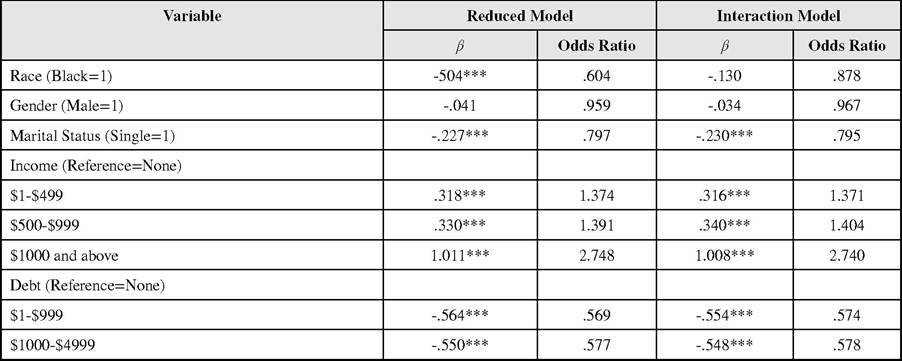
Table 3. Continued

Variable Reduced Model Interaction Model
β Odds Ratio β Odds Ratio
Observe parents’ behaviors .096*** 1.100 .098*** 1.103
Observe peers’ behaviors .000 1.000 .020 1.020
Interaction Variables
Race x gender -.145 .865
Race x marital status .343 1.409
Race x income$1-$499 -.488 .614
Race x income$500-$999 -.602 .548
Race x income$1000 and above -.627 .534
Race x debt$1-$999 -.285 .752
Race x debt$1000-$4999 -1.187* .305
Race x debt$5000 and above .874 2.398
Race x debt Not sure .484 1.622
Race x High School -.076 .927
Race x Community -.054 .948
Race x Financial discussions with parents .081 1.085
Race x Financial discussions with peers .491** 1.633
Race x Observe parents’ behaviors -.143 .867
Race x Observe peers’ behaviors -.379* .685
Constant -.905*** .405 -901*** .406
χ2 goodness-of-fit test 291.16*** df=16 319.94*** df=31
Cox & Snell R2 .033 .036
NagelkerkeR2 .044 .048
H-L goodness-of-fit test χ2 6.027>.05 df=8 5.3888>.05 df=8
Likelihood Ratio Test statistic -57.566 pabout 51.0% increase in the odds of budgeting (Reduced model).

The significant two-way interaction ofrace and all other independent variables tested in interaction model, we found a statistically significant two­way interaction between race and a $1000-4999 level of debt: $1000-4999 amount of debt had a strong, negative relation with budgeting among Black students as compared to White students. Black students who have $1000-4999 amount of debt were had a 69.5% decreases in the odds of budgeting. We also found statistically significant two-way interactions between race and discussed finance with peers, and race and observe peers’ financial behaviors, indicate that discussed fi­nance with peers and observed peers’ financial behaviors were more strongly related to budgeting among Black students than White students. Black students who more discussed finance with their peers were had about 63.0% increases in the odds of budgeting. However, Black students who more observed their peers financial behaviors were had about 31.5% decreases in the odds of budgeting (Interaction model).

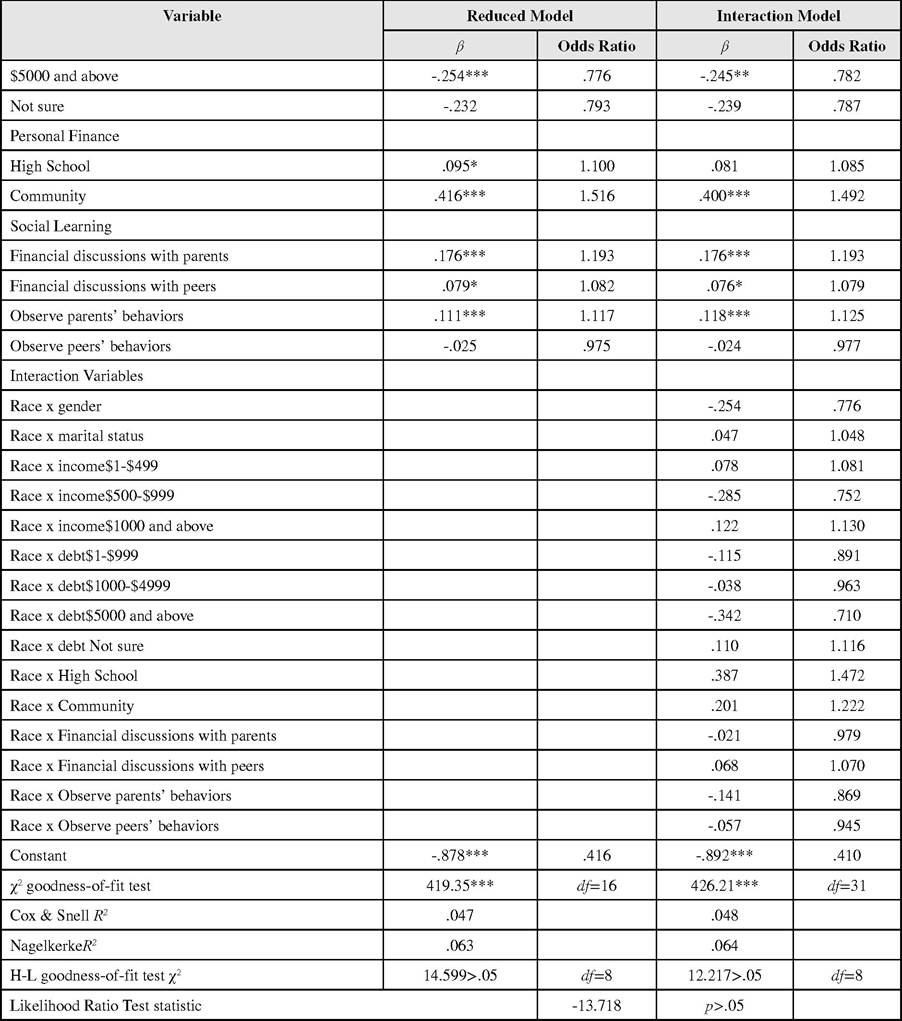
There was some support for the second hypoth­esis which proposed a relationship between the likelihood of students’ financial behaviors and race when controlling for social learning opportunities, gender, marital status, income, amount of debt, and financial education. As seen in Table 4, there was a negative relationship between students’ saving behavior and race, indicate that the odds of saving were 39.6% lower for Blacks than for Whites. There was a positive relationship between financial social learning opportunities and saving behavior. Students who more frequently discussed personal finances with their parents and friends, and observed their parents financial behaviors were more likely to be saving than others. The odds of saving increased by 19.3% for each one- unit increase in the parents discussion measure, the odds of saving increased by 8.2% for each one-unit increase in the peers discussion measure, and the odds of saving increased by 11.7% for each one unit increase in the observing parents behaviors measure.

Table 4. Logistic regression of saving

Table 4. Continued

NOTE: Odds ratio and unstandardized coefficients are reported. *pof college students. We report several major findings.

As expected, there were several significant differences inpersonal characteristics between the Black and White samples. Black students tended to be had more financial education in their com­munities than their White counterparts. There were significant differences among the financial resources variables of Blacks and White students. Although the higher levels of the sample reported no income, Blacks reported no income more fre­quently than did Blacks. For debt, Blacks reported no debt less than did Whites and Blacks more frequently reported debt than did Blacks. White students were more likely to holding credit cards than Black students. Bivariate analyses revealed that White students were saving significantly more than Black students, while Black students were engaging in significantly more risky credit card behaviors than White students. This suggests that Blacks differ from Whites regarding financial behaviors. However, it should be noted that there was no significant difference between Blacks and Whites on budgeting. It can be concluded that there are significant race differences in financial behaviors among college students, with Blacks being more likely to engage in be risky credit card behaviors and less likely to be saving than Whites.

The first hypothesis stated that exposure to financial social learning opportunities would dif­fer by race in college students. Previous research has noted that parents and peers play an important role in financial socialization (Gutter, Garrison, & Copur, 2010). This study also, focused on parents and peers as financial socialization agents. The results of the independent samples r-test between social learning dimensions and race, partly con­firm that those who discussed financial matters with parents and peers differ by race, with Blacks being significantly more likely to have discussed financial matters with their parents and peers than Whites.

To further explore this difference, each finan­cial social learning opportunity dimension was broken down by topic to determine whether there were specific race differences in topics discussed or behaviors observed with parents and peers. Consistent with the cultural-difference version of the socialization hypothesis, significant race differences were observed for many topics within each social learning dimension. Black students reported more discussion of finances with parents, on average (i.e., higher scores), on both the overall index and on each component items than Whites, but one of the items, particularly with regard to “buying and maintaining health insurance” was not significant. A similar relationship was found for financial discussions with peers. For this social learning dimension, Blacks significantly tended to have had more discussions with their peers on both the overall index and on each component items.

For observing parents’ financial behaviors, Blacks tended to have more overall exposure to observing their parents’ behaviors, but there was no significant difference between Blacks and Whites in the overall index. There were some significant racial differences on a few component items with regard to observing parents’ behaviors. These included that Blacks were more likely than Whites to have observed parents’ behaviors with regard to “checking their parents’ credit report” and “buying and maintaining health and auto insurance” behaviors while Whites were more likely than Blacks to have observed “saving and investing money.” The implications of Whites being significantly more likely to observe their parents saving and investing money behavior, when compared to Blacks, may be related why Whites are more likely to be saving than Blacks. For observing peers’ financial behaviors, there was a significant racial difference on two items. Blacks were more likely than Whites to have observed their peers’ behaviors with regard to “checking a credit report” and “buying and maintaining auto insurance.” It can be concluded that there were not significant racial differences in overall exposure to observing parents’ and peers’ financial behav­iors among college students, but there were some statistically significant difference in some topics that included both parents and peers.

The second hypothesis stated that the rela­tionship between race and financial behaviors when controlling for selected demographic and financial characteristics, financial social learning opportunities, and financial education. The results of logistic regression analyses partly support this hypothesis. Consistent with our expectation, in the current study, generally, results of the logistic regression analyses show that financial behaviors tended to be related to race when controlling for all other factors except budgeting. The results confirms the findings of previous studies (e. g. Joo et al., 2003; Grable & Joo, 2006; Gutter, Garrison, & Copur, 2010; Lyons, 2004), Black students were less likely saving than White students and Black students were more likely engaging risky credit card behaviors than White students. Results from the budgeting revealed that financial social learning opportunities except observing peers’ financial behaviors, marital status, income, and financial education significantly predicted col­lege students’ budgeting. To address whether there were differences in the effects of students characteristics on budgeting attributed to race, we examined interaction terms with race and each of the students’ characteristics. Our findings showed that there were significant interactions found between race and a $1000-4999 level of debt and both financial discussion with peers and observing peers’ behaviors. Regarding debt, it was revealed that Black students who have a $1000-4999 level of debt, were significantly less likely to budget than White students those had the same amount of debt. The interaction with Race also interacted with financial discus­sion with peers and observing peers’ behaviors it was discovered that these behaviors predicted in budgeting. It was revealed that among Black students who more discussed finance with their peers were significantly more likely to budget than their Whites counterparts, whereas among Black students who more observed their peers’ behavior had significantly less likely budgeting than their Whites counterparts. In particular, we believe that discussions with peers and observing peers’ behaviors had a varying influence on the budgeting between Blacks and Whites.

Saving and risky credit card behaviors tended to be related to race when controlling for other factors. Furthermore, in the reduced model, col­lege students ’ saving behavior tended to be related to financial social learning opportunities except observed peers’ financial behaviors, marital status, income, amount of debt and financial education. Additionally, college students’ risky credit card behavior tended to be related to financial social learning opportunities except discussed finance with parents and observed peers’ financial be­haviors, gender, marital status, income, amount of debt, and credit card number. In the interac­tion model, race interacted with $1000 and over income in predicting risky credit card behavior. Black students who have $1000 and over income reported less likely risky credit card behavior than their White counterparts. In contrast to Perry and Morris’ (2005) research, these findings may sug­gest that Black students, especially among those who are lower income, may engage more risky credit card behavior than White students who have lower income.

In conclusion, overall, the findings from this study highlight the effect of race on financial behaviors. These findings, we believe, move the discussion beyond using race as a proxy for un­derstanding cultural influences on financial issue (Dilworth-Anderson, Burton, & Johnson, 1993). In conformity with theoretical model, in the cur­rent study, it is possible to say that differences in cultural values and socialization among Blacks and Whites may influence engaging financial behaviors. As expected, Black students in this study expressed stronger financial socialization as a reason for engaging more negative financial behaviors than White students. Furthermore, Black students reported more discussions of financial issues with their parents and peers while they engage more negative financial behaviors. Hav­ing greater financial socialization did not relate to engaging positive financial behaviors for Black students. It may be possible that inappropriate financial behaviors are passed from one genera­tion to another. Additionally, some caution should be made when accepting the notion that Blacks more likely on risky credit card behavior given the emerging literature (Oliver & Shapiro, 1995; Aizcorbe, Kennickell, & Moore, 2003) states that Blacks have lower financial resources such as income as compared to Whites.

Another finding in this study is that financial education also plays an important role in budgeting and saving. Thus, financial education programs for Blacks should begin with a focus on budgeting, saving, and credit practices. Financial education programs should be designed that address the important differences between these groups in financial practices, cultural background and pre­ferred methods of receiving financial education. For Blacks, budgeting, credit management, and saving practices should be the primary focus on financial education efforts. Education on financial behaviors, including the rewards for accepting short-run volatility in order to obtain long-run investment gains, is very important for Blacks. However, the conclusion of many studies, that financial education is needed, does not answer the question of what type of education, or what approach, will work. A clear finding of the litera­ture review is that there have been few analyses of the effectiveness of previous financial education programs. Existing financial education programs for Blacks seem to have been designed without taking research findings or input from minority communities into account.

Several limitations exist in the study the first one being that the results of this study help to further document solely the racial differences in financial socialization and financial behaviors of college students. Furthermore, For example, future research should attempt to classify individuals into pure help-seeking cohorts based on (a) profes­sional help only, (b) nonprofessional help only, (c) no help only, and (d) a combination of help. In this way, future research can more definitely determine patterns of help-seeking behavior. Research shows that Black students are much more likely drop out of college due to financial reasons (e.g., Grable & Joo, 2006). It might be the reason for Black sample size was too small to differentiate between two groups. Future studies should measure the racial differences on financial socialization and financial behaviors for other emerging adult households, especially those not enrolled in a four-year university. Another limi­tation is that, this study focused on determining the Black and White college students’ financial behaviors influenced by their parents and friends, future studies should investigate other types of financial socialization agents, such as the media, school, and internet’s influence on college stu­dents’ financial behaviors. Finally the data for this study did not lend itself to explore additional racial or ethnic subgroups; future research should consider exploring socialization of other groups of interest.

ACKNOWLEDGMENT

This project is funded by a grant from the National Endowment for Financial Education.

REFERENCES

Aizcorbe, A. M., Kennickell, A. B., & Moore,

K. B. (2003). Recent changes in U.S. family fi­nances: Evidence from the 1998 and 2001 survey of consumer finances. Federal Reserve Bulletin, 89, 1-32.

Bandura, A. (1977). Self-efficacy: Toward a unifying theory of behavioral change. Psychologi­cal Review, 84(2), 191-215. doi:10.1037/0033- 295X.84.2.191 PMID:847061

Bernheim, D. B., Garrett, D. M., & Maki, D. M. (1997). Education and saving: The long-term ef­fects of high schoolfinancial curriculum mandates. Cambridge, MA: National Bureau of Economic Research.

Borden, L. M., Lee, S., Serido, J., & Collins, D. (2008). Changing college students’ financial knowledge, attitudes and behavior through seminar participation. Journal of Family and Economic Issues, 29(1), 23-40. doi:10.1007/s10834-007- 9087-2

Brim, O. G. (1966). Socialization through the life cycle. In O. Brim, & S. Wheeler (Eds.), Social­ization after childhood. New York: John Wiley & Sons, Inc.

Brimmer, A. F. (1988). Income, wealth, and in­vestment behavior in the Black community. The American Economic Review, 78(2), 151-155.

Bucks, B. K., Kennickell, A. B., Mach, T. L., & Moore, K. B. (2009). Changes in U. S. family finances from 2004 to 2007: Evidence from the survey of consumer finances. Federal Reserve Bulletin, A1-A56.

Bucks, B. K., Kennickell, A. B., & Moore, K. B. (2006). Recent changes in U.S. family finances: Evidence from the 2001 and 2004 survey of con­sumer finances. Federal Reserve Bulletin, A1-A38.

Burlew, A. K., Banks, W. C., McAdoo, H., Ajani, D., & Azibo, Y. A. (1992). African American psy­chology. Newbury Park, CA: Sage Publications.

Chen, H., & Volpe, R. P. (1998). An analysis of personal financial literacy among college stu­dents. Financial Services Review, 7(2), 107-128. doi:10.1016/S1057-0810(99)80006-7

Chen, H., & Volpe, R. P. (2002). Gender differ­ences in personal financial literacy among college students. Financial Services Review, 11,289-307.

Churchill, G. A., & Moschis, G. P. (1979). Televi­sion and interpersonal influences on adolescent consumer learning. The Journal of Consumer Research, 6(1), 23-35. doi:10.1086/208745

Danes, S. M. (1994). Parental perceptions of chil­dren’s financial socialization. Financial Counsel­ing and Planning, 5, 127-149.

Dilworth-Anderson, P., Brummett, B. H., Good­win, P., Wallace-Williams, S., Williams, R., & Siegler, I. C. (2005). Effect of race on cultural jus­tifications for care giving. Journal of Gerontology: Social Sciences, 60B(5), 257-262. doi:10.1093/ geronb/60.5.S257

Dilworth-Anderson, P., & Gibson, B. E. (2002). The cultural influence of values, norms, meanings, and perceptions in understanding dementia in eth­nic minorities. Alzheimer Disease and Associated Disorders, 16, 56-S63. doi:10.1097/00002093- 200200002-00005 PMID:12351916

Drentea, P., & Lavrakas, P. J. (2000). Over the limit: The association among health, race and debt. Social Science & Medicine, 50(4), 517-529. doi:10.1016/S0277-9536(99)00298-1 PMID:10641804

Goodenough, W. H. (1981). Culture, language, and society. Menlo Park, CA: Benjamin/Cum- mings Publication Co.

Grable, J. E., & Joo, S. (2006). Student racial dif­ferences in credit card debt and financial behaviors and stress. College Student Journal, 40, 400-408.

Grossbart, S., Carlson, L., & Walsh, A. (1991). Consumer socialization and frequency of shop­ping with children. Journal of the Academy of Marketing Science, 19(3), 155-163. doi:10.1007/ BF02726492

Gutter, M., Garrison, S., & Copur, Z. (2010). Social learning opportunities and the financial behaviors of college students. Family and Con­sumer Sciences Research Journal, 38(4), 387-404. doi:10.1111/j.1552-3934.2010.00034.x

Gutter, M. S., & Garrison, S. (2008). Perceived norms, financial education, and college student credit card behavior. Journal of Consumer Educa­tion, 24, 73-88.

Hayhoe, C. R., Leach, L. J., Turner, P. R., Bruin, M. J., & Lawrence, F. C. (2000). Differences in spending habits and credit use of college students. The Journal of Consumer Affairs, 34(1), 113-133. doi:10.1111/j.1745-6606.2000.tb00087.x

Henry, R. A., Weber, J. G., & Yarbrough, D. (2001). Money management practices of college students. College Student Journal, 35(2), 244-249.

Hilgert, M. A., Hogarth, J. M., & Beverly, S. G. (2003). Household financial management: The connection between knowledge and behavior. Federal Reserve Bulletin. Retrieved from http:// www.nefe.org/hsfppportal/includes/main/home. asp?page=4000#ExecutiveSummary2

Hira, T. K. (1997). Financial attitudes, beliefs and behaviors: differences by age. Journal of Con­sumer Studies & Home Economics, 21, 271-290. doi:10.1111/j.1470-6431.1997.tb00288.x

Hsueh, S., & Tienda, M. (1996). Gender, ethnic­ity, and labor force instability. Social Science Research, 25, 73-94. doi:10.1006/ssre.1996.0004

Joo, S., Grable, J. E., & Bagwell, D. C. (2003). Credit card attitudes and behaviors of college students. College Student Journal, 37(4), 405-419.

Kennickell, A. B., Starr-McCluer, M, & Surette,

B. J. (2000, January). Recent changes in family finances: Results from the 1998 survey of con­sumer finances. Federal Reserve Bulletin, 1-29.

Lyons, A. C. (2004). A profile of financially at-risk college students. The Journal of Consumer Affairs, 38(1), 56-80. doi:10.1111/j.1745-6606.2004. tb00465.x

Lyons, A. C., Scherpf, E., & Roberts, H. (2006). Financial education and communication between parents and children. Journal of Consumer Educa­tion, 23, 64-76.

Maccoby, E. E. (1992). The role of parents in the socialization of children: An historical overview. Developmental Psychology, 28, 1006-1017. doi:10.1037/0012-1649.28.6.1006

Mascarenhas, O. A. J., & Higby, M. A. (1993). Peer, parent, and media influences in teen apparel shop­ping. Journal of the Academy of Marketing Science, 21(1), 53-58. doi:10.1177/0092070393211007

McLeod, J. M., & O’Keefe, G. J. (1972). The socialization perspective and communication behavior. In Current Perspectives in Mass Com­munication Research. Beverly Hills, CA: Sage.

McNeal, J. V. (1987). Children as consumers: Insights and implications. Lexington, MA: Lex­ington Books.

Moschis, G. P. (1985). The role of family commu­nication in consumer socialization of children and adolescents. The Journal of Consumer Research, 11(4), 898-913. doi:10.1086/209025

Moschis, G. P., & Churchill, G. A. (1978). Con­sumer socialization: A theoretical and empirical analysis. JMR, Journal of Marketing Research, 15, 599-609. doi:10.2307/3150629

Moschis, G. P., & Moore, R. (1984). Anticipa­tory consumer socialization. Academy of Mar­keting Science, 12(4), 109-123. doi:10.1007/ BF02721803

Ogbu, J. U. (1979). Social stratification and the socialization of competence. Anthropology & Education Quarterly, 10(1), 3-20. doi:10.1525/ aeq.1979.10.1.05x1460d

Ogden, D. T., Ogden, J. R., & Schau, H. J. (2004). Exploring the impact of culture and acculturation on consumer purchase decisions: Toward a micro cultural perspective. Academy of Marketing Sci­ence Review, (8): 1-22.

Oliver, M. L., & Shapiro, T. M. (1995). Black wealth/white wealth. New York: Routledge.

Parcel, T. L. (1982). Wealth accumulation ofblack and white men: The case of housing equity. Social Problems, 30(2), 199-211. doi:10.2307/800518

Perry, V., & Morris, M. (2005). Who is in con­trol? The role of self-perception, knowledge, and income in explaining consumer financial behavior. The Journal of Consumer Affairs, 39(2), 299-313. doi:10.1111/j.1745-6606.2005.00016.x

Robb, C. A. (2011). Financial knowledge and credit card behavior of college students. Journal of Family and Economic Issues, 32, 690-698. doi:10.1007/s10834-011-9259-y

Rong, X. L., & Brown, F. (2002). Socializa­tion, culture, and identities of black immigrant children what educators need to know and do. Education and Urban Society, 34(2), 247-273. doi:10.1177/0013124502342008

Valence, G., d’Astous, A., & Fourtier, L. (1988). Compulsive buying: Concept and measurement. Journal of Consumer Policy, 11, 419-433. doi:10.1007/BF00411854

Varcoe, K. P., Martin, A., Devitto, Z., & Go, C. (2005). Using a financial education curriculum for teens. The Journal ofthe Associationfor Financial Counseling and Planning Education, 16, 63-71.

Yao, R., Gutter, M. S., & Hanna, S. D. (2005). The financial risk tolerance of blacks, hispanics and whites. Financial Counseling and Planning, 16(1), 51-62.

KEY TERMS AND DEFINITIONS

Certificate of Deposit (CD): A time deposit, a financial product commonly sold in the United States by banks, thrift institutions, and credit unions.

Chi-Square: The distribution of the sum of the squares of a set of normally distributed ran­dom variables. A chi-squared test, also referred to as chi-square test or X2 test, is any statistical hypothesis test in which the sampling distribution of the test statistic is a chi-squared distribution when the null hypothesis is true.

Financial Behavior: It can be defined as any human behavior that is relevant to money manage­ment. Common financial behaviors include use of cash, credit, and saving.

Financial Socialization: It covers many di­mensions of money handling, e.g., earning, spend­ing, saving, borrowing, and sharing behaviors are learned during adolescent years through the influence of socialization agents such as parents, family members, peers, school, and other influ­ential individuals and that financial behaviors can be passed on from generation to generation.

Individual Retirement Account (IRA): A form of “individual retirement plan,” provided by many financial institutions, that provides tax advantages for retirement savings in the United States.

Logistic Regression or Logit Regression: A type of regression analysis used for predicting the outcome of a categorical dependent variable (a dependent variable that can take on a limited number of values, whose magnitudes are not meaningful but whose ordering of magnitudes may or may not be meaningful) based on one or more predictor variables.

Socialization: It is often viewed as a social process by which norms, attitudes, motivations, and behaviors are transmitted from specific sources (commonly known as socialization agents) to the learner.

This work was previously published in Global Strategies in Banking and Finance, edited by Hasan Dincer and Umit Hacioglu, pages 272-292, copyright 2014 by Business Science Reference (an imprint of IGI Global).

<< | >>
More financial literature on Economics.Studio

More on the topic Chapter 42 Racial Differences in Financial Socialization and Financial Behaviors of U.S. College Students: