INCOME STATEMENT RATIOS
Although an older approach to credit analysis places primary emphasis on liquidity and asset protection, both of which are measured by balance-sheet ratios, the more contemporary view is that profits are ultimately what sustain liquidity and asset values.
High profits keep plenty of cash flowing through the system and confirm the value of productive assets such as plant and equipment. In line with this latter view, the income statement is no longer of interest mainly to the equity analyst, but is essential to credit analysis as well.A key income statement focus for credit analysis is the borrower’s profit margin (profit as a percentage of sales). The narrower the margin, the greater is the danger that a modest decline in selling prices or a modest increase in costs will produce losses, which will in turn begin to erode such balance sheet measures as total-debt-to-total-capital by reducing equity.
Profit can be measured at several levels of the income statement, either before or after deducting various expenses to get to the bottom line, net income. The most commonly used profit margins are the following:
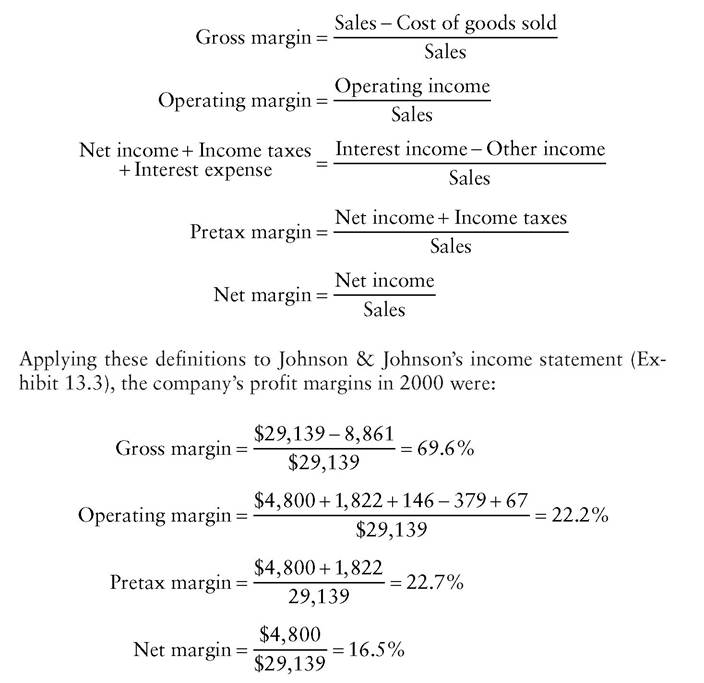
Johnson & Johnson’s profit margins are atypically high, relative to industrial companies in general, but less exceptional compared with its peers in the pharmaceutical business. Observe also that in the operating margin calculation, the deduction of other income called for by the formula becomes an addback of a negative figure, since other expenses exceeded other income. Finally, note that the formula does not call for adding back the $33 million restructuring charge, which does not qualify for aftertax treatment as an extraordinary item (see Chapter 3).
Analysts should nevertheless be cognizant of such nonrecurring charges when forming an impression of a company’s bona fide profitability.In some instances, an aftertax nonoperating item can produce a disparity between the numerators in the pretax and operating margins, as calculated from the bottom up in accordance with the formula, and the
width=436 height=393 id="Picutre 111" class="lazyload" data-src="/files/uch_group74/uch_pgroup295/uch_uch7164/image/image110.jpg">
Source: 10-K405 March 30, 2001.
corresponding figure derived by working from the top down. For example, the cumulative effect of a change in accounting procedures will appear below the line, or after income taxes have already been deducted. The sum of net income and provision for income taxes will then differ from the pretax income figure that appears in the income statement. To ensure comparability across companies, analysts should take care to follow identical procedures in calculating each company’s margins, rather than adopting shortcuts that may introduce distortion.
The various margin measures reflect different aspects of management’s effectiveness. Gross margin, which is particularly important in analyzing retailers, measures management’s skill in buying and selling at advantageous prices. Operating margin shows how well management has run the business—buying and selling wisely, and controlling selling and administrative expenses—before taking into account financial policies (which largely determine interest expense) and the tax rate (which is outside management’s control).6 These last two factors are sequentially added to the picture by calculating pretax margin and net margin, with the latter ratio reflecting all factors, whether under management’s control or not, that influence profitability.
In calculating profit margins, analysts should eliminate the effect of extraordinary gains and losses to determine the level of profitability that is likely to be sustainable in the future.
Fixed-charge coverage is the other income statement ratio of major interest to credit analysts.
It measures the ability of a company’s earnings to meet the interest payments on its debt, the lender’s most direct concern. In its simplest form, the fixed-charge coverage ratio indicates the multiple by which operating earnings suffice to pay interest charges:
This basic formula requires several refinements, however. As with profit margins, extraordinary items should be eliminated from the calculation to arrive at a sustainable level of coverage. The other main adjustments involve capitalized interest and payments on operating leases.
Capitalized Interest
Under SFAS 34, companies may be required to capitalize, rather than expense, a portion of their interest costs. The underlying notion is that like the actual bricks and mortar purchased to construct a plant, the cost of the money borrowed to finance the purchase provides benefits in future periods and therefore should not be entirely written off in the first year. Whether it is expensed or capitalized, however, all interest accrued must be covered by earnings and should therefore appear in the denominator of the fixed- charge coverage calculation. Accordingly, the basic formula can be rewritten to include not only the interest expense shown on the income statement, but also capitalized interest, which may appear either on the income statement or else in the Note to Financial Statements. (If the amount is immaterial, capitalized interest will not be shown at all, and the analyst can skip this adjustment.) The numerator should not include capitalized interest, however, for the amount is a reduction to total expenses and consequently reflected in net income.
Including capitalized interest in the numerator would therefore constitute double counting:
Lease Expense
As mentioned, off-balance-sheet operating leases have virtually the same economic impact as on-balance-sheet debt. Just as credit analysts should take into account the liabilities represented by these leases, they should also factor into coverage calculations the annual fixed charges associated with them. One approach simply adds the total current-year rental expense from Notes to Financial Statements to both the numerator and denominator of the fixed-charge coverage calculation. An alternate method includes one- third of rentals (as shown in the following calculation) on the theory that one-third of a lease payment typically represents interest that would be paid if the assets had been purchased with borrowed money, and two-thirds is equivalent to principal repayment:

Two complications arise in connection with incorporating operating lease payment into the fixed-charge coverage calculation. First, the SEC does not require companies to report rental expense in quarterly statements. The analyst can therefore only estimate where a company’s fully adjusted coverage stands, on an interim basis, in relation to its most recent full-year level. (Capitalized interest, by the way, presents the same problem, although a few companies voluntarily report capitalized interest on an interim basis.) Second, retailers in particular often negotiate leases with rents that are semifixed, tied in part to revenues of the leased stores. Some argue that the variable portion—contingent rentals—should be excluded from the fixed- charge coverage calculation.
That approach, however, results in a numerator that includes income derived from revenues in excess of the threshold level, while omitting from the denominator charges that were automatically incurred when the threshold was reached. A better way to recognize the possible avoidance of contingent lease payments is by capitalizing only the mandatory portion when calculating the balance sheet ratio of total-debt- to-total-capital.Interest Income
A final issue related to fixed-charge coverage involves interest income. Companies sometimes argue that the denominator should include only net interest expense; the difference between interest expense and income derived from interest-bearing assets, generally consisting of marketable securities. They portray the two items as offsetting, with operating earnings having to cover only the portion of interest expense not “automatically” paid for by interest income. Such treatment can be deceptive, however, when a company holds a large but temporary portfolio of marketable securities. In this situation, fixed-charge coverage based on net interest expense in the current year can greatly overstate the level of protection that may be expected in the succeeding year, after the company has invested its funds in operating assets. If, however, a company’s strategy is to invest a substantial portion of its assets indefinitely in marketable securities (as some pharmaceutical manufacturers do, to capture certain tax benefits), analysts should consider the associated liquidity as a positive factor in their analysis.