RECOMMENDATIONS
Relentless monitoring and focus on the continuous viability of the borrowing concern with improved asset classification is must. At the same time all accounts in the Standard category should not be taken for granted and should be subjected to periodical and in-depth review in a systematic manner through a sound adequate loan review mechanism in place.
Banks should ensure that they should move with speed and charged with momentum in disposing off the loss assets. This is because as uncertainty increases with the passage of time, there is all possibility that the recoverable value of asset also reduces and it cannot fetch good price. If faced with such a situation than the very purpose of getting protection under the Securitization Act, 2002 would be defeated and the hope of seeing a must have growing banking sector can easily vanish.
Bank should adhere to “Know Your Customer” norms for identification of borrower, guarantor and verification of their addresses to minimize the risk of default in case of housing sector lending. In respect of agricultural advances, recovery camp should be organized during the harvest season.
Ongoing monitoring of banks borrowers is important to understand the primary cause of corporate decline and to be able to identify the symptoms of a potential distress situation. Loan Officers and staff should be alert and diligent for signs of borrower distress. It is essential to identify signs of distress which diminish the Borrowers capacity to repay debt. Early recognition followed by aropriate action is essential if the bank is to minimize NPAs.
Loan Workout Unit should be created which should be exclusively responsible for managing non-performing and under performing loans to maximize the recovery value from a portfolio of distressed loans, through the employment of an equitable and professional workout process.
REFERENCES
Bodla & Verma. (2006). Determinants of profitability of banks in India: A multivariate analysis. Journal of Service Research, 6(2), 75-89.
Chaudhuri, S. (2002, June). Some issues of growth and profitability in Indian public sector banks. Economic and Political Weekly.
Das & Ghosh. (2006). Financial deregulation and efficiency: An empirical analysis of Indian banks during post-reforms period. Review of Financial Economics, 15, 193-221. doi:10.1016/j. rfe.2005.06.002
Gupta, S., & Kumar, S. (2004). Dimensions and prospects of non-performing assets: Challenges before the banking sector reforms in the new millennium. Academic Press.
Indira, R., & Vasishtha, G. (2001). Non-performing loans of PSU banks: Some panel results (working paper 105). National Institute of Public Finance and Policy.
Karunakar. (2008). Are non-performing assets gloomy or greedy from Indian perspective?. India: Research Journal of Social Sciences, 3, 4-12.
Kumar, R. (2000). NPA management for better banking. In Proceedings of the Bank Economist Conference, (pp. 68-73). Academic Press.
Mishra, N. (2011). Banks NPA and impact on Indian economy. India: Audit Articles.
Pradeep. (2007). Banking sector reform: NPA management assets reconstruction company (ARC) in Indian scenario. Currently Viewing, 42(10).
Prasad., et al. (2004). Post-reform performance of public sector banks with special reference to non-performance assets. In India, banking in the new millennium (pp. 259-267). Academic Press.
Ual, R. K. (2011). New competition and emerging changes in Indian banks: An analysis of comparative performance of different bank groups. Indian Journal of Commerce & Management Studies, 2(1), 223-237.
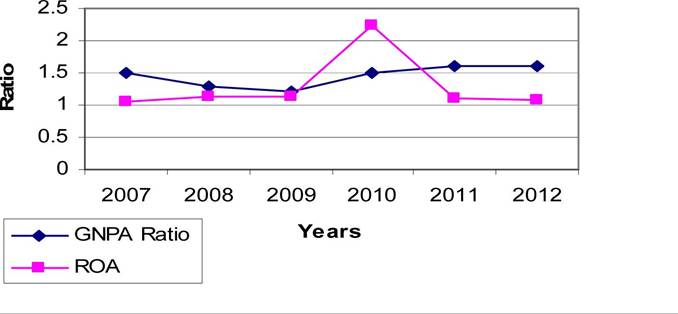
Figure 6. Correlation between GNPAs and ROA
This work was previously published in Handbook of Research on Strategic Business Infrastructure Development and Contemporary Issues in Finance, edited by Nilanjan Ray and Kaushik Chakraborty, pages 124-134, copyright 2014 by Business Science Reference (an imprint of IGI Global).
410
More on the topic RECOMMENDATIONS:
- The Meaning of Welfarism and Non-welfarism
- OUTSOURCING RISK IN E-BANKING
- WHEN THE PRESS Council was disbanded in 1990 and succeeded by the Press Complaints Commission, there was a strong plea that the new body should set about establishing a code of future adjudication on privacy;
- Prevention and Control of BTB
- Preconceptional evaluation of women with heart disease
- The Post-Trial Case Studies
- Oetzel John, Ting-Toomey Stella. The SAGE Handbook of Conflict Communication: Integrating Theory, Research and Practice. SAGE Publications,2013. — 912 p., 2013
- 13.10 SUMMARY
- WAIVER OF JURY TRIAL
- The Cypriot Advisory Model