The Federal Reserve and the FOMC
The Federal Reserve is the central bank of the United States. It is charged with making monetary policy and with partially regulating the country's banking system (Blinder, 1998).
In practice, this means three things. The Federal Reserve supervises and sets regulations for a variety of commercial banks, including capital reserve requirements. It sets the discount rate, the rate at which banks can borrow from the Federal Reserve. Finally, it engages in open market operations, the buying and selling of US Treasury securities and other assets, in order to control the federal funds rate and thereby influence economic activity and inflation. The Federal Reserve also uses this power to actively manage the links between the US economy and the world economy. The Federal Reserve has a congressional mandate to set monetary policy consistent with achieving maximum employment and price stability.The FOMC is the primary policymaking body of the Federal Reserve. The FOMC consists of twelve members: the seven members of the Federal Reserve Board of Governors; the president of the Federal Reserve Bank of New York, who serves as vice chair; and four of the other eleven Reserve Bank presidents, who serve on an annually rotating basis. All other Reserve Bank presidents attend FOMC meetings, presenting reports and participating in discussion, but they cannot vote (Blinder, 1998).
The FOMC holds eight regularly scheduled meetings per year, about once every six weeks. The main purpose of these meetings is to discuss economic and financial conditions in the United States and to make monetary policy decisions. The meetings are highly structured (Abolafia, 2012; Baez and Abolafia, 2002). Every meeting begins with a round of oral reports on the current conditions and future direction of the economy. These reports fall into two categories, those presented by staff and those presented by each committee member and Reserve Bank president.
Staff reports always include general data about GDP growth, employment, and inflation. But they can also be geared to a special topic that the FOMC wishes to explore. The reports by the governors and presidents concern their own analyses and forecasts of output and inflation based on their econometric modeling. The presidents' reports also cover current business conditions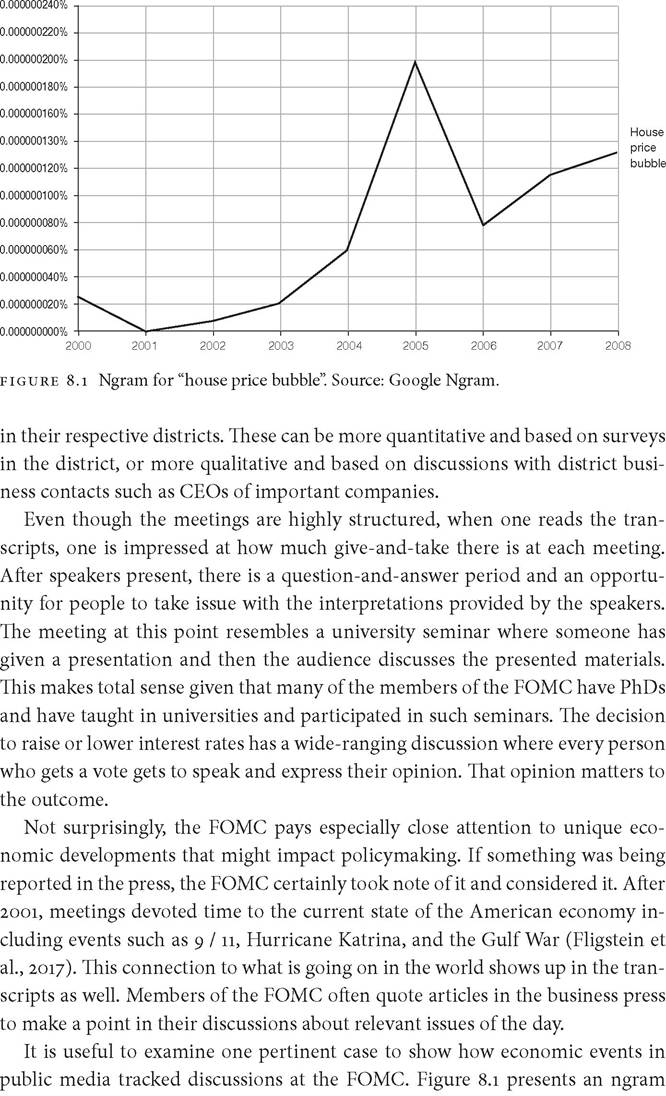
“House price bubble” mentioned at meetings
grnrraSrd in Googlr ShaS illusSraSrs Shr amounS of Nrdia inSrrrsS in Shr SrrN house price bubble. Onr can srr ShaS NrnSions of Shr SrrN incrrasr draNaSically from 2000 So 2005, Shr prriod of Shr grraSrsS incrrasr in housing pricrs. Housr pricrs prakrd in 2005 and drclinrd Shrrraftrr. Onr can oCsrrvr ShaS inSrrrsS in Shr Sopic in Shr mrdia dropprd in 2006 as Shosr pricrs sSopprd rising. IS rosr again in 2007 and 2008 in Shr wakr of Shr financial crisis. Hrrr, Shr Srrm was NosSly usrd So drscricr hog Shr housr pricr cucclr had cursS.
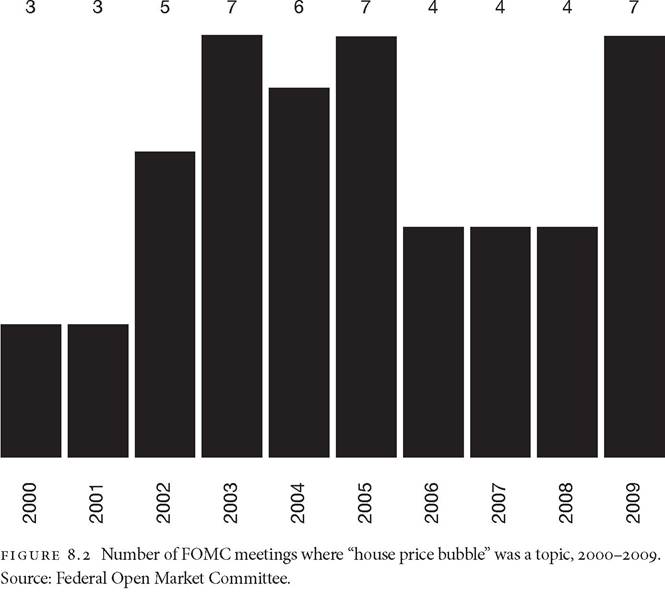
oigurr 8.2 Sracks Shr inSrrrsS of Shr oOM) in Shr Sopic of Shr housr pricr CuCClr. Thr figurr rxaminrs how many NrrSings of Shr OOMC had NrnSions of Shr SrrN. Onr can srr ShaS crginning in 2002, NrnSions of Shr housr pricr cucclr incrrasrd, praking in 2005. In 2005, Shr OOMC had a NrrSing So discuss whrShrr Shrrr was a CuCClr and, if so, whrShrr Shr Ordrral Rrsrrvr should do soNrShing aCouS iS. LaSrr in Shis chapSrr, I prrsrnS rvidrncr of whaS Shr NrNCrrs of Shr OOMC wrrr saying aS ShaS NrrSing. OroN Shr figurr, onr can srr ShaS oncr housr pricrs sSopprd rising, Shr issur CrcoNrs lrss salirnS in 2006-2007. BuS Shr issue reemerged in 2008 when the topic of house prices shifted from a bubble to a burst bubble. These two figures illustrate that the FOMC's interest in a particular economic topic tracked almost exactly the public's interest in the topic.
Not all issues considered by the FOMC show up as clearly in the national media as the term house price bubble. But the FOMC was diligent in paying attention to how events in the real world might impact the economy enough that it could impact their decision-making about the direction of the economy and whether they should change the level of interest rates.The second part of the meeting is devoted to the FOMC's main policy decision: setting the target for the federal funds rate. Committee members discuss whether to raise, lower, or hold constant the federal funds target rate. At the end of that discussion, committee members vote on the policy decision. The result is announced publicly in a press release immediately after the meeting, which states the balance of risks to growth and inflation and notes the reasons for the vote. The FOMC spends a great deal of time crafting the wording of the press release. They know that financial market analysts will read the document carefully in order to try to predict the direction of the economy. If the vote is split, the press release documents the difference of opinion. The FOMC's actions are widely watched by Wall Street and the financial community at large as a harbinger of the future direction of the real economy, inflation, and interest rates. These actions move financial markets in the United States and the world (Holmes, 2014).
More on the topic The Federal Reserve and the FOMC:
- Monetary Control in the United States
- CHAPTER SUMMARY
- Principles of Money Supply Determination
- References
- Making Monetary Policy in Practice
- INDEX
- Glossary