THE PORTFOLIO MANAGEMENT PROCESS
Portfolio management is a process in which securities are collected in a portfolio considering the investors’ needs and choices and the perfomance of the portfolio is evaluated (Bodie, Kane, & Marcus, 1996, p.
2). In simple terms, portfolio management, also known as the investment management, is the process of money management (Sharpe & Alexander, 1990, p. 711). The first goal ofportfolio management is to earn higher - or at least equal - rates from the the awkwardly chosen portfolios having equal risks. The second goal is to make a full diversification compared to a benchmark portfolio (Reilly & Brown, 1999, p. 1153). In other words, the portfolio manager’s aim is to get profit above the avarage level while minimizing the risks. Factors such as upgrading asset pricing models, increasing institutionalization of the market, monitoring the volatility of the financial markets, and increasing the use of computers to collect and analyze data caused the theoretical and practical form of portfolio management to develop into broader dimensions (French, 1989, p. 487). Therefore, portfolio management process has become a very dynamic process requiring great caution and care.The portfolio management process consists of the following five steps (Sharpe & Alexander, 1990, pp. 9-12):
• Setting Investment Policy: This involves determination of the instruments and the amount of accumulations (potential investment portion) to be canalized into the investment. It begins by determining the appropriate profit and risk combination and ends with defining financial assets which will be included in the portfolio.
• Performing Security Analysis: This step involves careful scrutiny of the securities in financial asset categories which include Technical Analysis and Fundamental Analysis. The goal is to detect under-valued stocks.
• Constructing a Portfolio: This is the step in which it is decided what portion of money will be invested on which asset by estimating future price movements and diversification (risk minimization).
• Revising the Portfolio: This is the revision of the previous three steps. The portfolio is arranged according to changes in various factors (e.g., investor’s goals, increase/de- crease in security prices, changes in transaction costs or economic conditions).
• Evaluating Performance: Refers to the portfolio’s periodical evaluation in terms of profit and risks.
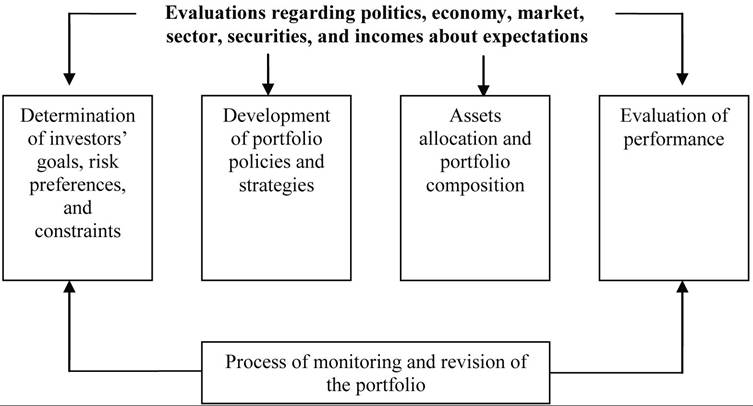
Each step of portfolio management requires the designated manager to create a delicate observation and analysis system. The portfolio management process is shown in Figure 1.
As can be seen in Figure 1, the portfolio management process requires vital decisions at each stage. Being continuous, the process is circular in nature which allows an investor to return to previous steps when necessary and make remedial changes in order to reach optimal portfolio creation and subsequently resume the process.
Figure 1. Overview of the portfolio management process
Source: French, D. W (1989) Security and Portfolio Analysis: Concepts and Management, Merrill Publishing Company, p. 488.