Answers to Analyzing Data 11.1 Questions
1.
| Year | r |
| 1 | 0.00028 |
| 400 | 0.00037 |
| 800 | 0.00123 |
| 1200 | 0.00094 |
| 1550 | 0.00252 |
| 1825 | 0.00660 |
| 1930 | 0.0135 |
| 1960 | 0.0178 |
| 1999 | 0.0123 |
| 2010 | 0.0113 |
| 2016 | 0.0155 |
| 2019 | (N/A) |
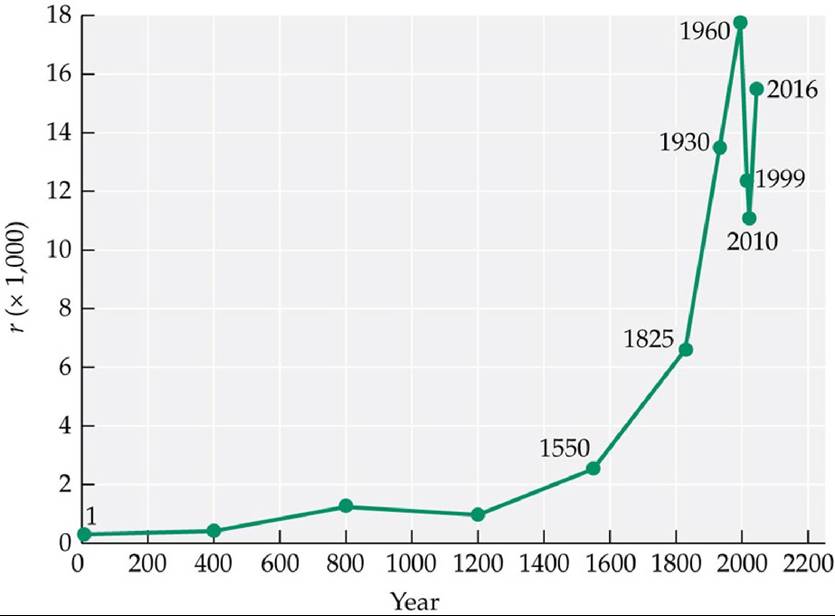
2.
Based on a value of r = 0.0155 and a population size of 7.35 billion in2016, we can use Equation 11.4 to estimate the population size in 2066: 
3. The calculations in Question 2 assume that the human population is growing exponentially and that the exponential growth rate, r, remains constant and equal to 0.0155 from 2016 to 2066. However, the answer to Question 1 indicates that r reached a maximum value (0.0178) in 1960 and has declined since that time, although it has risen from 2010 to 2016. If r continues to decline from the 1960 value, it is unlikely that the human population will reach 15.9 billion in 2066.
More on the topic Answers to Analyzing Data 11.1 Questions:
-
General ecology -
-
Conflictology -
Ecology -
Economy -
Finance -
History -
Law -
Medicine -
Philosophy -
Religious studies -