Answers to Review Questions
1.
a. 3,240
b. Substituting the values N0 = 40, λ = 3, and t = 27, we have

c.
In this case, we have the values N0 = 100, λ = 0.75, and t = 3, which we plug into the relation
2. Factors that regulate population size are density dependent: when N (the number of individuals in a population) is below some level, they cause the population size to increase, whereas when N is above some level, they cause the population size to decrease. Even if density-independent factors, such as year-to-year variations in temperature or rainfall, are the primary cause of year-to-year changes in abundance, those factors do not regulate population size.
3.
a.
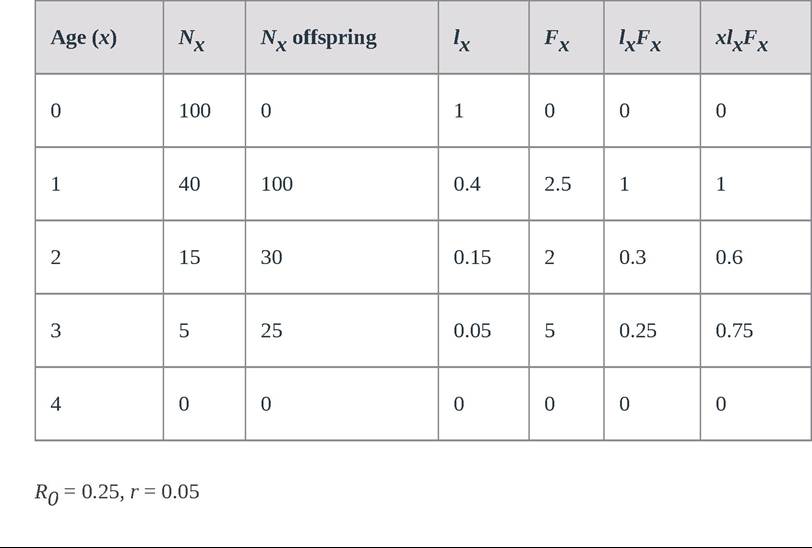
b. In a cohort life table, the fate of a group of individuals born during the same time period (a cohort) is followed from birth to death. This type of life table is often used for sessile or relatively immobile organisms that do not have long life spans but is less useful for organisms that are highly mobile or long-lived. For those organisms, a static life table may be used, in which the survival and fecundity of individuals of different ages are observed during a single time period.
4. Each student will calculate their own answer.
More on the topic Answers to Review Questions:
- Answers to Review Questions
- Answers to Review Questions
- Reviewers
- 14.7 SUMMARY
- If you are working on a motion brief, your research questions will be crucial components of your research plan.
- REVIEW OF FORENSIC ASSESSMENT INSTRUMENTS
- 13.10 SUMMARY
- 9.1.2 QUESTIONS PRESENTED
- Chapter summary
- Chapter summary