Answers to Figure Legend Questions
FIGURE 10.3 There was considerable variation in abundance from one field site to another in many of the years. In 1984 and 1989, for example, abundance was high at Hector but low at the other two locations.
FIGURE 10.10 From 1988 to 2000, the collared lemming population exhibited regular cycles, reaching peak abundance every 4 years. Because abundances peaked at about 10 lemmings per hectare in 1990, 1994, and 1998, we would have expected the next peak to occur in 2002, again at about 10 lemmings per hectare. However, the actual abundance in 2002 was less than 1 lemming per hectare.
FIGURE 10.11 In (A), abundance rises and falls in a regular manner, reaching a peak about every 40 days; thus, this curve shows regular population cycles. In (B), to the left of the dotted vertical line, the results are again consistent with a regular population cycle that reaches peak abundance every 40 days. After food for adults is limited, however, the regular population cycle no longer occurs. Instead, abundance rises and then fluctuates around a roughly stable population size. This pattern that can be viewed as illustrating either population fluctuations or logistic growth (with fluctuations).
FIGURE 10.13 About 100 breeding pairs would be needed for the risk of extinction to drop to 5%.
FIGURE 10.19 From 1952 to 1957, the abundance of predatory fish increased while the abundance of planktivorous fish showed little change. In the 1970s, predatory fish abundance dropped, planktivorous fish abundance increased, zooplankton abundance dropped, and phytoplankton abundance increased. Overall, the chain of feeding relationships for the Black Sea in the 1970s is more similar to that in Alaska pre-1990 than to that in Alaska in the late 1990s. In both cases, the organisms at the base of the food chain (phytoplankton in the Black Sea, kelp in Alaska) were only weakly controlled by their grazers (zooplankton in the Black Sea, urchins in Alaska), which in turn were strongly controlled by the organisms that ate them (planktivorous fish in the Black Sea, otters in Alaska). 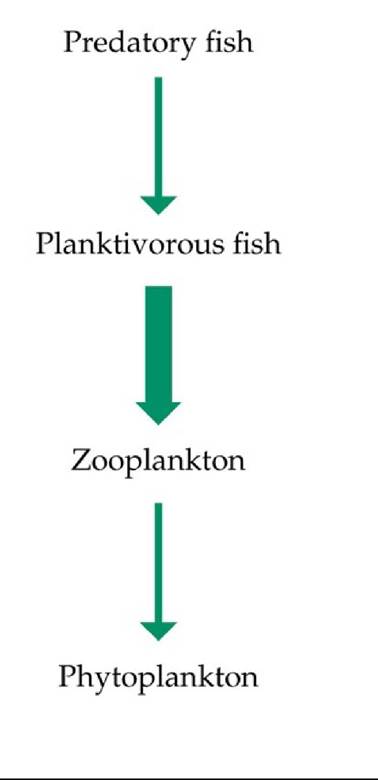
More on the topic Answers to Figure Legend Questions:
- Answers to Figure Legend Questions
- Answers to Figure Legend Questions
- Answers to Figure Legend Questions
- Answers to Figure Legend Questions
- Reviewers
- Reclamation of Soil
- The Formative Age