Bonfires
After the shelter is built, you need to take care of the fire. Matches should always be kept in a plastic bag. If they are still wet, but not deoxidized, they can be dried in the hair under the headdress.
The key to any good fire is a quick start.
Good tinder - small dry shavings or strands or globs or drippings of quickly combustible material used to start a fire - is critical.
Tinder is usually dry sticks and twigs that can usually be collected on the ground, or in wet country, from downed and dead branches and trees. It's often called "squaw wood" inferring it can be gathered without tools and much effort.
All fires are not the same; they can be built for specific purposes, to accent either heat or light, and can be constructed so as to radiate heat in a certain direction (fig. 11).
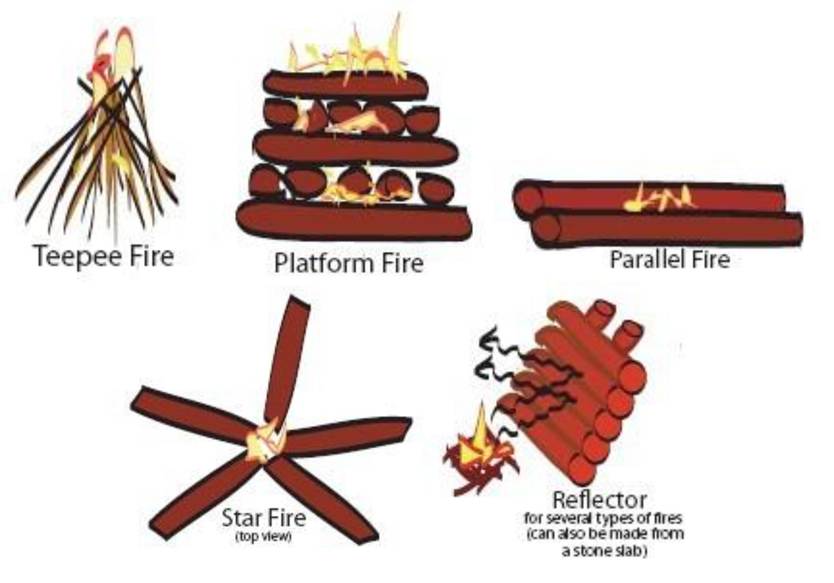
Figure 11 - Types of Campfires
Teepee fire. This is probably the most basic of fire designs. It is often used as a starter upon which bigger, longer-lasting fires are founded. It's also a great fire for a quick warm-up or water-boiling snack break. A teepee fire is a good fire to direct heat upward and can be used beneath a hung pot on a tripod for fast heating.
Pyramid/platform fire. This fire consists of a foundation framework of large logs laid side by side to form a solid base. A slightly shorter log is laid perpendicular and on top of this first layer. Each subsequent layer is slightly shorter as the platform or pyramid rises. This solid mass of right angle firewood takes a little effort to light but it's well worth it for the huge amount of coals it produces, especially when the fire is lit on the top most layer and burns down through the layers.
Parallel fire. Sometimes a fire is build between two long logs. If the logs are the same size, the tops of the log can be used to place pots for cooking.
It has the added advantage of prolonging the fire since the insides of the log are burning too, and its easy to direct the fire up or down the length of the side log, literally until the entire log eventually consumed. A similar fire is the trench fire, used almost exclusively for cooking. These work by either blocking the wind or in funneling the wind into the fire for a more concentrated and hotter "burn". Several pots can be placed over the trench and the fire can be maintained at different levels for a variety of cooking options.Star or Indian fire. A star fire, or Indian fire, is the fire design often depicted as the campfire of the old West. Imagine five or six logs laid out like the spokes of a wheel (star shaped). A fire is started at the "hub" and each log is pushed towards the center as the ends are consumed. It's another fire that can be kept burning all night long with little maintenance.
Reflector fire. A reflector fire is really any fire that has some sort of flat surface behind it to direct the heat back out past the fire. This surface is erected behind the fire and pointed, for example, at the face of a tent, lean-to or other shelter. This back reflector can be made out of a few large slabs of bark, several logs laid against supports and stacked upon each other to form the surface. Rocks can also be used but just like those used to ring a fire, make sure they do not contain moisture. That trapped moisture can be heated to where it's like a steam engine with no release valve. Exploding rocks can send shrapnel and shards flying in every direction!
Answer these questions:
1. What is an extreme situation?
2. What are the preconditions for an extreme situation?
3. How is the daily loss of water distributed?
4. Name the sources of water.
5. Name the stages of fear.
6. Stages of overcoming stress and fear.
7. The simplest ways of signaling.
8. Name the signs of edible plants.
9. Name the types of bonfires.
More on the topic Bonfires:
- References
- Blood Sport and Ritual
- Topic: First-aid dressing
- Issues with economic sociology
- Pre-independence India
- 11 Meanwhile in Europe
- Modern versus Ancient Concepts
- DEALING WITH POISONS
- CHAPTER FIVE A Meaningless Fragment: Chernivtsi
- CHAPTER SIX The Great Hunger: Matussiv and Lukovytsya