CAM photosynthesis enhances water conservation
When plants first colonized the terrestrial environment, they evolved adaptations to restrict water losses to a dry atmosphere. Among these adaptations is a unique photosynthetic pathway called crassulacean acid metabolism (CAM), which occurs in over 10,000 plant species belonging to 33 families.
While C4 photosynthesis separates CO2 uptake and the Calvin cycle spatially, CAM separates these two steps temporally (FIGURE 5.15). CAM plants open their stomates at night, when C3 and C4 plants have their stomates closed. Because air temperatures at night are cooler, humidity is higher. Higher humidity results in a lower water potential gradient between the leaf and the air (see Concept 4.3), so the plant loses less water by transpiration than it would during the day. CAM plants close their stomates during the day, when the potential for water loss is highest.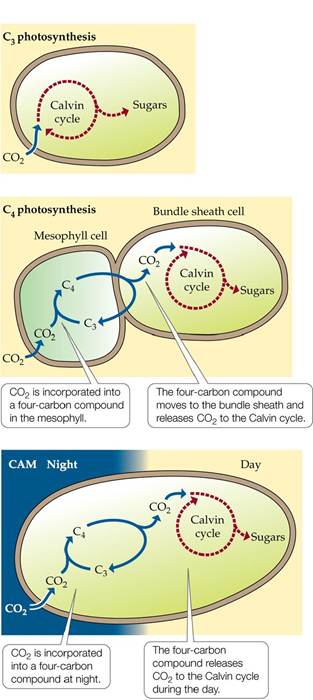
pathways fix carbon and produce sugars, but C4 photosynthesis separates these steps spatially, while CAM separates them temporally. View larger image
During the night, when the stomates are open, CAM plants take up CO2 using PEPcase and incorporate it into a four-carbon organic acid, which is stored in vacuoles (FIGURE 5.16). The resulting increase in acidity in the plants' tissues during the night is characteristic of CAM plants and can be used to estimate their photosynthetic rates. During the day, when the stomates are closed, the organic acid is broken down, releasing CO2 to the Calvin cycle. CO2 concentrations in the photosynthetic tissues of CAM plants are thus higher than those in the atmosphere during the day. These high CO2 concentrations increase the efficiency of photosynthesis as they suppress photorespiration.
Photosynthetic rates in CAM plants are usually related to the capacity of the plant to store the four-carbon organic acid, so many CAM plants are succulent, with thick, fleshy leaves or stems, which enhances their nighttime acid storage capacity.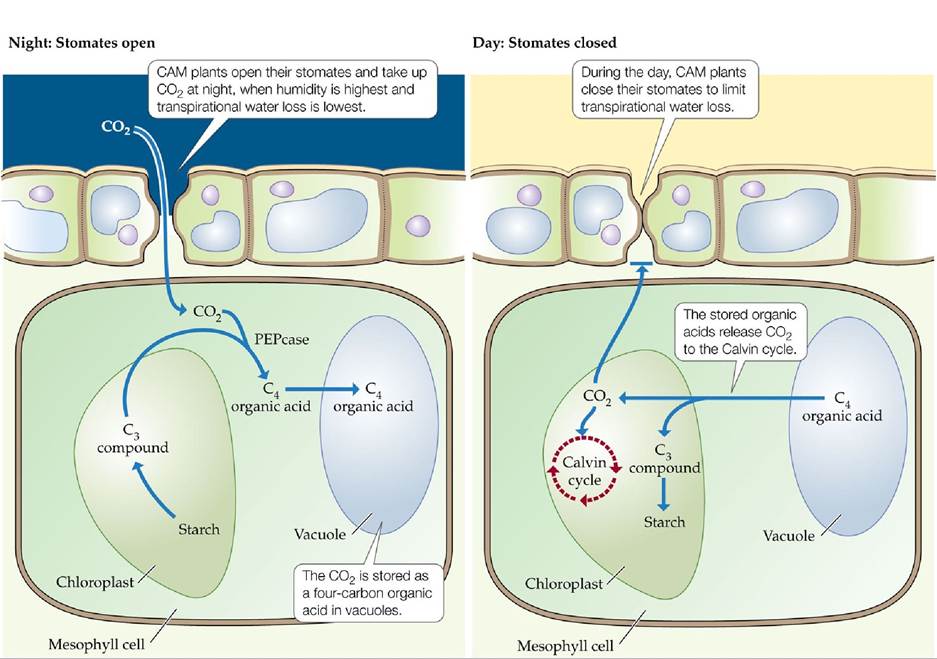
FIGURE 5.16 CrassulaceanAcidMetabolism Plants using CAM open their stomates and take up CO2 at night, then run the Calvin cycle during the day. View larger image
CAM plants are typically associated with arid and saline environments, such as deserts and Mediterranean-type ecosystems (FIGURE 5.17). Some CAM plants, however, are found in the humid tropics. Tropical CAM plants are typically epiphytes growing on the branches of trees, without access to the abundant water stored in the soil. These epiphytes rely on rainfall for their water supply and may be subject to long periods without access to water.
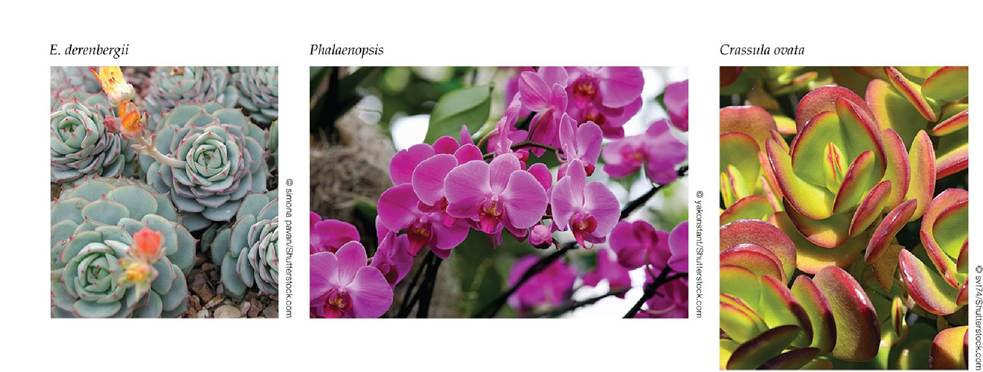
FIGURE 5.17 Examples of Plants with the CAM Photosynthetic Pathway MostCAM plants are found in arid and saline regions or in other habitats where water availability is periodically low. View larger image
The CAM pathway is also found in some aquatic plants, such as quillworts (Isoetes), which are closely related to the club mosses. This observation suggests that water conservation was probably not the only driving force for the evolution of CAM, which evolved independently in at least 35 different families. The rate of CO2 diffusion into water is low, and CAM has been hypothesized to facilitate the uptake of CO2 at the low concentrations found in the aquatic environment.
A unique property of some CAM plant species is the ability to switch between C3 and CAM photosynthesis, known as facultative CAM. When conditions are favorable for daytime gas exchange (i.e., abundant water is available), these plants utilize the C3 photosynthetic pathway, which allows greater carbon gain than CAM.
As conditions become more arid or more saline, the plants switch over to CAM. The reversibility of the transition from C3 to CAM varies among species. For example, the common ice plant (Mesembryanthemum crystallinum), which has been intensively studied as a facultative CAM model system, undergoes an irreversible transition from C3 to CAM photosynthesis when salinity increases or the soil dries out (Osmond et al. 1982). In contrast, some species in the genus Clusia can switch relatively rapidly between C3 and CAM (Borland et al. 1992). These plants start out as epiphytes in canopy trees but grow toward the base of their host tree, eventually strangling it and taking on a tree growth form. The capacity to switch between C3 and CAM facilitates the change from epiphyte to tree form, and it supports continued photosynthesis during the transition from wet season to dry season characteristic of some tropical locations.How can we tell what photosynthetic pathway a plant is using? The morphology of the plant gives us a clue: succulent plants suggest CAM photosynthesis, and plants with a well-developed bundle sheath suggest C4 photosynthesis. These clues provide a starting point, but they are far from foolproof. We can measure the presence and activity of specific enzymes, but this approach requires substantial sample preparation and laboratory time. A simpler approach is to measure the ratio of stable carbon isotopes (13C∕12C) in plant tissues. Although the isotopic technique uses sophisticated equipment, sample preparation is simple, and there are numerous laboratories that can routinely analyze plant tissue samples (see ECOLOGICAL TOOLKIT 5.1).
ECOLOGICAL TOOLKIT 5.1
Stable Isotopes
Many biologically important elements, including carbon, hydrogen, oxygen, nitrogen, and sulfur, have an abundant “light” isotopic form and one or more “heavy” nonradioactive isotopic forms, which contain additional neutrons.
Because isotopes of these elements do not decay over time as radioactive isotopes do, they are referred to as stable isotopes. An example of a stable isotope is carbon-13 (13C), which is heavier than the more abundant form, carbon-12(12C), because it has one more neutron. Groups of stable isotopes include hydrogen (H) and deuterium (D or 2H); nitrogen-14 and nitrogen-15 (14N and 15N); and oxygen-16, oxygen-17, and oxygen- 18 (16O, 17O, and 18O). The lighter isotopes of these elements are much more abundant than the heavier forms. For example, 12C constitutes 98.9%, and 13C only 1.1%, of the C on Earth. Similarly, 14N constitutes 99.6%, and 15N 0.4%, of the N on Earth.
The isotopic composition of a material is usually expressed as delta (δ), the difference between the ratio of the isotopic forms in a sample (Asample) and that in a standard material (Astandard), divided by the ratio in the standard, multiplied by 1,000 [to give parts per thousand (‰) difference]:

Examples of the standard materials chosen for stable isotopes include a limestone rock from South Carolina for C, atmospheric N2 for N, and ocean water for O and H.
Naturally occurring stable isotopes have become an important tool in ecological research (Fry 2007). Stable isotopes have been used to determine photosynthetic pathways in plants, identify food sources for animals, and track the movements of elements and rates of nutrient cycling in ecosystems. Because of differences in mass, the isotopes are affected differently by biological and physical processes. Generally, the heavier isotope is discriminated against and the lighter isotope enriched. For example, when rubisco catalyzes the uptake of CO2, it favors 12CO2 over 13CO2.
As a result, plants are enriched in 12C, and depleted in 13C, relative to the C in atmospheric CO2: atmospheric CO2 has a δ 13C value of -7 parts per thousand (in other words, it is 7 parts per thousand more depleted in 13C than the standard), and C3 plants have a δ 13C value of about -27 parts per thousand. C4 and CAM plants, however, have less 12C and more 13C than C3 plants. That is because initial CO2 uptake in these plants is catalyzed by PEPcase, which discriminates against 13CO2 less than rubisco does, and rubisco in C4 and CAM plants takes up CO2 in a semi-closed system (in the bundle sheath or with stomates closed), which inhibits enzymatic discrimination. As a result, measurement of the C isotope ratio in plant tissues can be used to determine the photosynthetic pathway used by a plant species, as shown in the figure.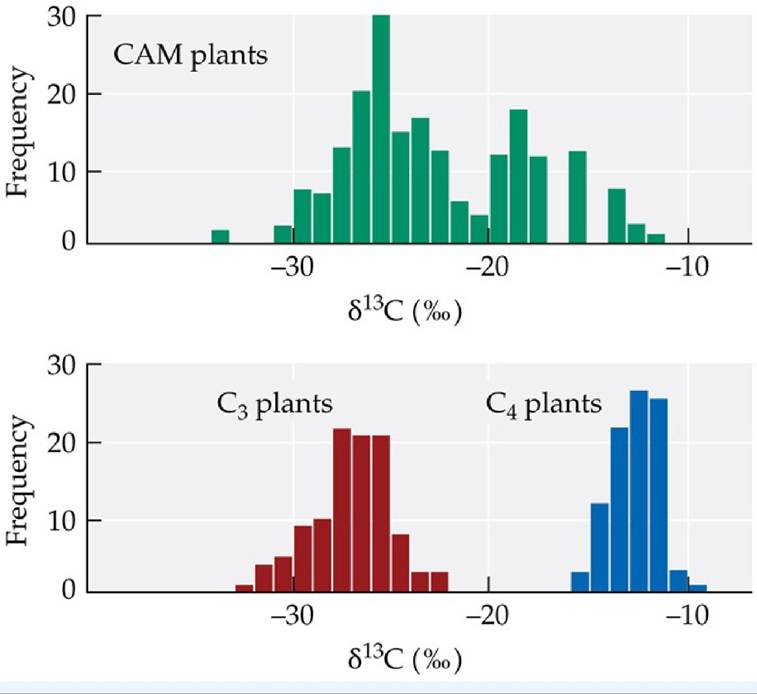
Carbon Isotopic Composition of Plants with Different Photosynthetic Pathways
Plants with the C3 photo-synthetic pathway show the greatest discrimination against 13C (and thus the most negative δ 13C, expressed in parts per thousand), while C4 and CAM plants are more enriched in 13C (have a less negative δ 13C).
Why is the range of δ 13C values for CAM plants larger, bridging the values for C3 and C4 plants?
(After M. A. Maslin and E. Thomas. 2003. Quat Sci Rev 22: 1729-1736.) View larger image
Stable isotopes have also been used to determine food sources for animals. The isotopic ratios of C, N, and S in various potential food sources may differ significantly, and measurement of one or more of these isotopes in potential food sources and in consumer tissues can determine what is being eaten.
For example, in this chapter's Case Study Revisited, we will see how isotopic ratios were used to determine the diet of New Caledonian crows. In Concept 20.4, we will describe how N and C isotopes were used to study the diets of both modern North American grizzly bears and extinct cave bears.Stable isotopes can also be added to the environment to help trace the movements of elements. This approach is often used to trace the fate of nutrients in ecosystems.
Isotopic analysis of biological samples is relatively straightforward. For C and N, the samples are dried, ground, and burned in a closed furnace. The gases liberated by the combustion are then analyzed for isotopic composition using an instrument called a mass spectrometer. Many commercial laboratories specialize in the isotopic analysis of biological materials, owing in part to the demand for such analyses from ecologists and other environmental scientists.
Now that we have reviewed the ways in which autotrophs acquire energy, let's turn our attention to how that energy is acquired by heterotrophs.