C4 photosynthesis lowers Photorespiratory energy loss
The C4 photosynthetic pathway reduces photorespiration. C4 photosynthesis evolved independently several times in different plant species. It is found in 18 plant families (FIGURE 5.12) but is most closely associated with the grass family, including several important crop plants such as corn, sugarcane, and sorghum.
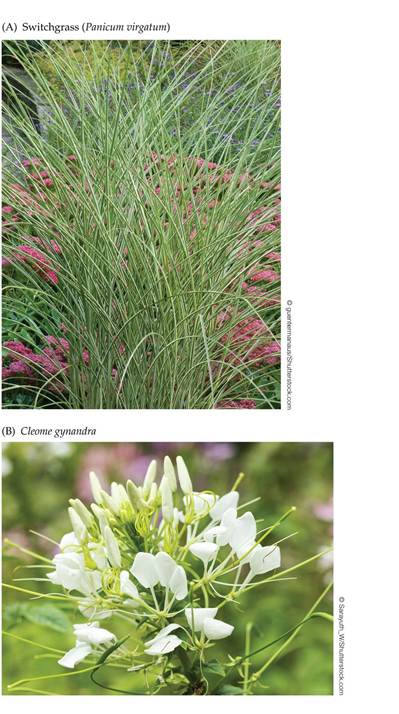
pathway has evolved multiple times. It is found in plants of 18 different families encompassing a variety of growth forms, from switchgrass (Panicum virgatum) (A) to eudicots such as Cleome gynandra, commonly found in Africa (B). View larger image
C4 photosynthesis involves both biochemical and morphological specialization. The biochemical specialization can be thought of as a pump that provides high concentrations of CO2 to the Calvin cycle. This greater supply of CO2 lowers the rate of O2 uptake by rubisco, substantially reducing photorespiration. The morphological specialization involves spatial separation of the regions in the leaf where CO2 is taken up (mesophyll) and where the Calvin cycle operates (bundle sheath), which increases the concentration of CO2 where rubisco is found.
In C4 plants, CO2 is initially taken up by an enzyme called phosphoenolpyruvate carboxylase, or PEPcase, that has a greater capacity to take up CO2 than rubisco and lacks oxygenase activity. PEPcase fixes CO2 in the mesophyll tissue of the plant. Once the CO2 is taken up, a four-carbon compound is synthesized and transported to a group of cells surrounding the vascular tissues (xylem and phloem), known as the bundle sheath, where the Calvin cycle occurs. The four- carbon compound is broken down in the bundle sheath cells, releasing CO2 to the Calvin cycle, and a three-carbon compound is transported back to the mesophyll to continue the C4 cycle.
The bundle sheath is surrounded by a waxy coating that keeps CO2 from diffusing out (FIGURE 5.13). As a result, CO2 concentrations inside the bundle sheath may reach a high of 5,000 parts per million (ppm), even though external CO2 concentrations are only 412 ppm. Additional energy in the form of ATP must be expended to operate the C4 photosynthetic pathway, but the increased efficiency of carbon fixation usually compensates for the higher energy requirement.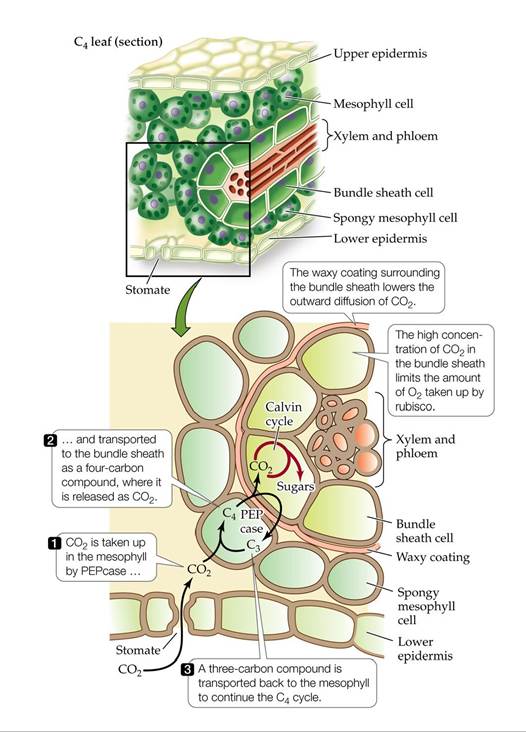
FIGURE 5.13 Morphological Specialization in the Leaves of C4 Plants The spatial separation of CO2 uptake (in the mesophyll cells) and the Calvin cycle (in the bundle sheath cells) minimizes photorespiration and maximizes photosynthetic rates under high temperatures. View larger image
As is apparent from the discussion above, plants with the C4 photosynthetic pathway can photosynthesize at higher rates than C3 plants under environmental conditions that elevate rates of photorespiration, such as high temperatures. In addition, most C4 plants have lower rates of transpiration at a given photosynthetic rate, known as water use efficiency, than C3 plants. This difference is due to the ability of PEPcase to take up CO2 under the lower CO2 concentrations that exist when stomates are not fully open.
If we assumed that photosynthetic rates determine ecological success, we could use climate patterns to predict where C4 plants should predominate over C3 plants. Such an analysis would be overly simplistic, however, because multiple factors other than temperature influence the biogeography of C3 and C4 plants, including abiotic factors such as light levels and biotic factors such as competitive ability and the pool of species available to colonize an area.
However, analyses of similar communities across latitudinal and elevational gradients provide support for the benefit of C4 photosynthesis at high temperatures and for the role this benefit plays in C4 plant distribution (Ehleringer et al. 1997). In particular, studies of grass- and sedge-dominated communities in Australia suggest a close correlation between growing-season temperature and the proportion of C3 and C4 species in the community (FIGURE 5.14). As atmospheric CO2 concentrations continue to increase because of burning of fossil fuels, however, photorespiration rates are likely to decrease, and the advantages of C4 over C3 photosynthesis may be diminished in some regions, leading to changes in the proportions of C3 and C4 plants.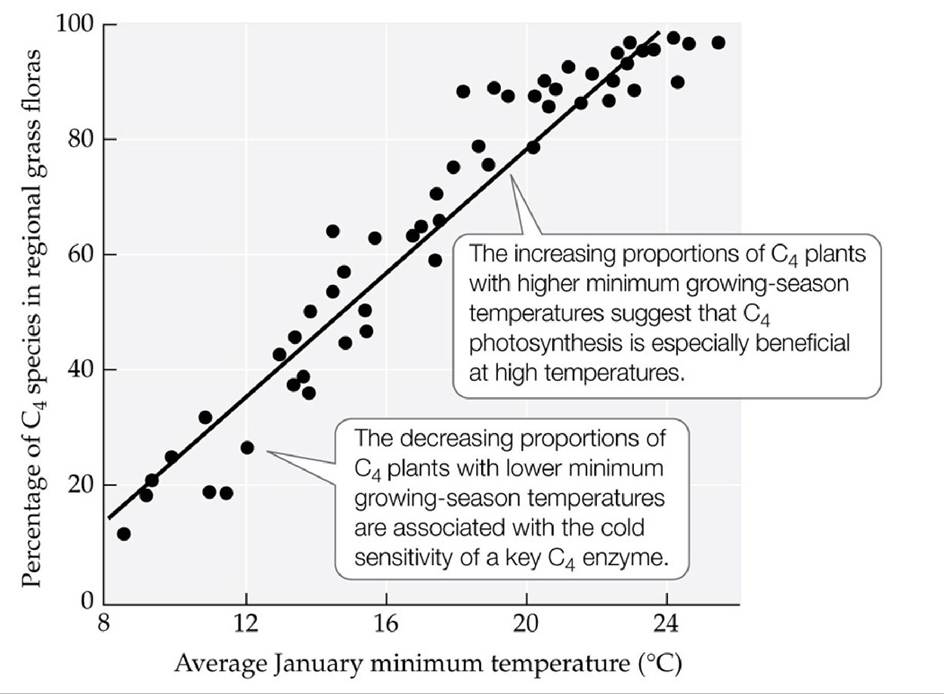
FIGURE 5.14 C4 Plant Abundance and Growing-Season Temperatures Theproportions of C4 plants in Australian grass- and sedge-dominated communities correlate with the average minimum growing-season temperatures in the different locations.
Using the data in this graph and the seasonal temperature trends from the climate diagrams in Concept 3.1 (assume that the monthly minimum temperature is 5°C cooler than the monthly average), what biome(s) should lack C4 species?
(After P. W. Hattersley. 1983. Oecologia 57: 113-128.) View larger image