Photorespiration lowers the efficiency of photosynthesis
Earlier, we described a key enzyme in the Calvin cycle, rubisco, and noted that the “o” in the abbreviation stands for “oxygenase.” Rubisco can catalyze two competing reactions. One is a carboxylase reaction, in which CO2 is taken up, leading to the synthesis of sugars and the release of O2 (i.e., photosynthesis; see Equation 5.1).
The other is an oxygenase reaction, in which O2 is taken up, leading to the breakdown of carbon compounds and the release of CO2. This oxygenase reaction is part of a process called photorespiration, which results in a net loss of energy and is thus potentially detrimental for plants.The balance between photosynthesis and photorespiration is related to two main factors: (1) the relative amounts of O2 and CO2 in the atmosphere and (2) temperature. As the atmospheric concentration of CO2 decreases relative to that of O2, the rate of photorespiration increases relative to the rate of photosynthesis (FIGURE 5.10). Since the evolution of C3 photosynthesis over 3 billion years ago, atmospheric CO2 concentrations have changed repeatedly over periods of hundreds of thousands of years in response to major global geologic and climate events (see Concepts 25.1 and 25.2). These shifts in atmospheric CO2 concentrations would have influenced the balance between photosynthesis and photorespiration. Furthermore, as temperatures increase, the rate of O2 uptake catalyzed by rubisco increases relative to the rate of CO2 uptake. As a result of these two processes, photorespiration increases more rapidly at high temperatures than photosynthesis does. Thus, energy loss due to photorespiration is particularly acute at high temperatures and low atmospheric CO2 concentrations.
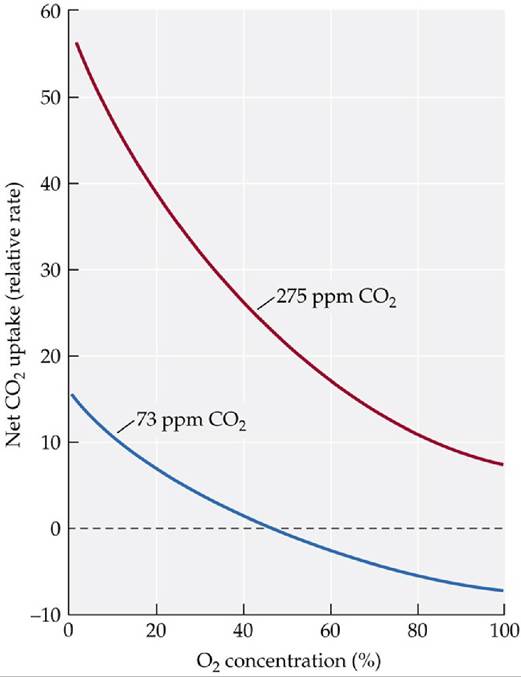
atmospheric oxygen concentration increases, net photosynthetic uptake of CO2 decreases because of greater photorespiration, as shown here for soybean leaves in light levels equal to about 20% of full sun.
Why does the net rate of CO2 uptake drop below zero at high oxygen levels for leaves exposed to 73 ppm CO2?
(After M. L. Forrester et al. 1966. PlantPhysiol 41: 428-431.) View larger image
If photorespiration is detrimental to the functioning of photosynthetic organisms, why hasn't a new form of rubisco evolved that minimizes uptake of O2? Is it possible that photorespiration provides some benefit to the plant? A possible clue comes from experiments with Arabidopsis thaliana. Arabidopsis plants with a genetic mutation that knocks out photorespiration die under normal light and CO2 conditions (Ogren 1984). One hypothesis for a potential benefit of photorespiration is that it protects the plant from damage to the photosynthetic machinery at high light levels. This hypothesis is supported by the results of a study by Akiko Kozaki and Go Takeba, who used tobacco plants (Nicotiana sp.) that they genetically altered to elevate or lower the plants' rates of photorespiration (Kozaki and Takeba 1996). They subjected these experimental plants to high-intensity light and recorded the damage to their photosynthetic machinery. Plants with higher rates of photorespiration showed less damage than control plants with normal rates of photorespiration (FIGURE 5.11) or plants with depressed rates of photorespiration.
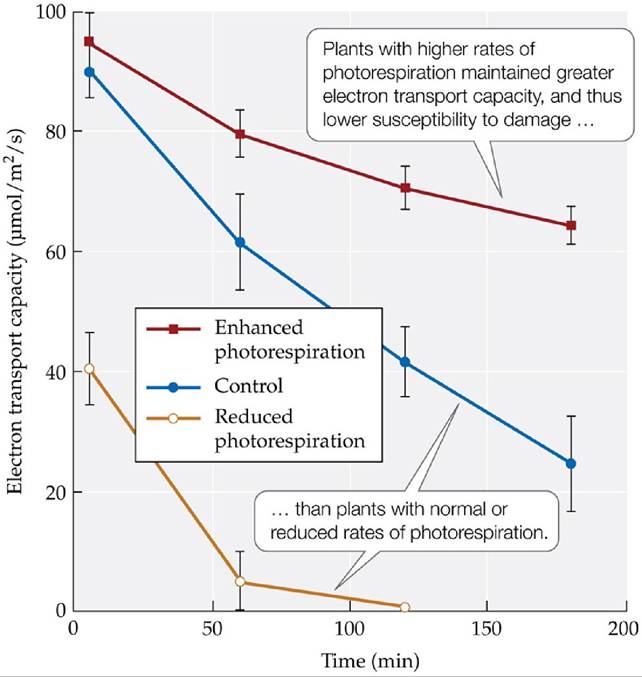
FIGURE 5.11 Does Photorespiration Protect Plants from Damage by Intense Light?
The ability of plants to process light energy for photosynthesis (electron transport capacity) under conditions that promote damage to photosynthetic membranes (high light levels, low CO2 concentrations) is greater in genetically altered plants with high rates of photorespiration than in control plants or in genetically altered plants with low rates of photorespiration. Error bars show ± one standard error (SE) of the mean. (After A. Kozaki and G. Takeba. 1996. Nature 384: 557-580.) View larger image
Despite this possibility that photorespiration plays a role in protecting plants from damage at high light levels, there are conditions in which the decrease in photosynthetic CO2 uptake it causes could be a serious problem for the plant. If atmospheric CO2 concentrations are low and temperatures high, photosynthetic energy gain might not keep pace with photorespiratory energy loss. Such conditions existed 7 million years ago, at about the time when plants with a unique biochemical pathway, C4 photosynthesis, became far more abundant
(Cerling et al. 1997).
More on the topic Photorespiration lowers the efficiency of photosynthesis:
- C4 photosynthesis lowers Photorespiratory energy loss
- CONCEPT 5.3 Environmental constraints have resulted in the evolution of biochemical pathways that improve the efficiency of photosynthesis.
- The efficiency of energy transfer varies among consumers
- Gross primary production is total ecosystem photosynthesis
- Anything that influences energy gain by photosynthesis has the potential to affect the survival, growth, and reproduction of the organism.
- CAM photosynthesis enhances water conservation
- The generation of chemical energy by autotrophs, known as primary production, is derived from the uptake of carbon during photosynthesis and chemosynthesis (see Chapter 5).
- Photosynthesis is the powerhouse for life on Earth
- Market Efficiency and Security Return Patterns
- Chapter 62 Analyzing the Efficiency of European Banks: A DEA-Based Risk and Profitability Approach
- Scale & Efficiency versus Diversity & Safety
- The vast majority of the autotrophic production of chemical energy on Earth occurs through photosynthesis, a process that uses sunlight to provide the energy needed to take up carbon dioxide and synthesize organic compounds, principally carbohydrates.