Gross primary production is total ecosystem photosynthesis
The amount of carbon taken up by the autotrophs in an ecosystem is called gross primary production (GPP). The GPP in most terrestrial ecosystems is equivalent to the total of all plant photosynthesis.
The GPP of an ecosystem is controlled by climate through its influence on rates of photosynthesis, as we saw in Concept 5.2, and by the leaf area of the plants, expressed as the leaf area index, the amount of leaf area over an area of ground.
The leaf area index varies among biomes, from less than 0.1 in tundra (i.e., less than 10% of the ground surface has leaf cover) to 12 in boreal and tropical forests (i.e., on average, there are 12 layers of leaves between the canopy and the ground). Shading of the leaves below the uppermost layer increases with the addition of each new leaf layer, so the incremental gain in photosynthesis for each added leaf layer decreases (FIGURE 20.4). Eventually, the respiratory costs associated with building and maintaining additional leaf layers outweigh the photosynthetic benefits. Plants generally match their leaf area index to the climate conditions and the supplies of resources, particularly water and nutrients, in order to maximize carbon gain.
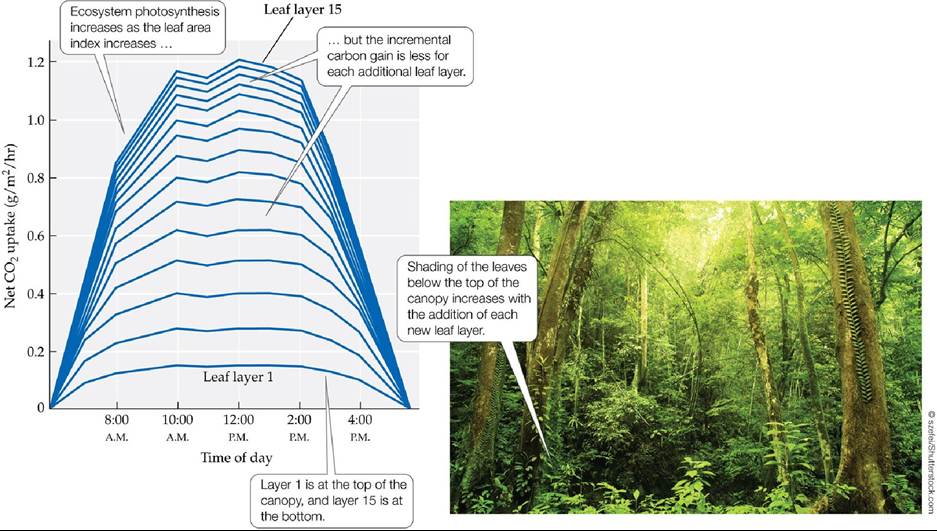
FIGURE 20.4 Diminishing Returns for Added Leaf Layers Rates of photosynthesis (expressed here as CO2 uptake) for a tropical rainforest increase as the number of leaf layers, or leaf area index, increases, but the increase is smaller with each additional leaf layer. (After W. Larcher. 1980. Physiological Plant Ecology. Springer: New York; based on L. H. Allen and E. R. Lemon. 1976. In Vegetation and the Atmosphere, Vol. 2, J. L. Monteith [Ed.], pp. 265-308. Academic Press: London.) View larger image
A plant uses approximately half of the carbon it fixes by photosynthesis in cellular respiration to support biosynthesis and cellular maintenance. All living plant tissues lose carbon via respiration, but not all of them acquire carbon via photosynthesis. Thus, plants that have a large proportion of nonphotosynthetic stem tissue, such as trees and shrubs, tend to have higher overall respiratory carbon losses than herbaceous plants such as grasses and forbs. Plant respiration rates increase with increasing temperatures, and as a result, respiratory carbon losses are higher in tropical forests than in temperate and boreal forests.