Climate Variation and Salmon Abundance: A Case Study
Grizzly bears of the Pacific Northwest feast seasonally on the salmon that arrive in huge numbers to reproduce in the streams of the region (FIGURE 2.1).
Salmon are anadromous; that is, they are born in freshwater streams, spend their adult lives in the ocean, and then return to spawn in the freshwater habitats where they were born.
Grizzlies capitalize on the salmon's reproductive habits, gorging themselves on this rich food resource. These normally aggressive bears will forgo their usual territorial behavior and tolerate high densities of other bears while fishing for salmon.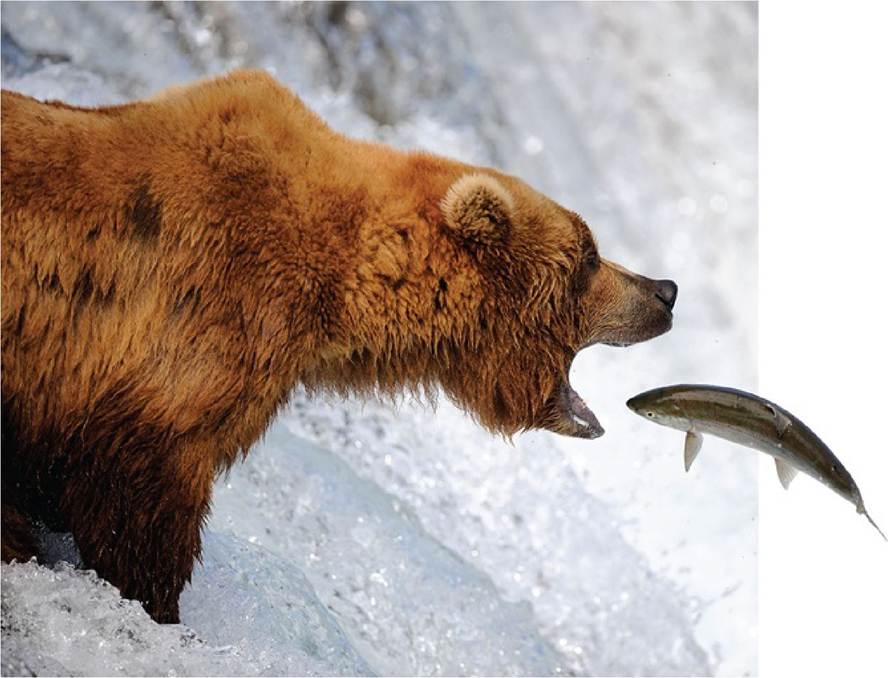
FIGURE 2.1 A Seasonal Opportunity Grizzly bears feed on salmon migrating upstream in streams and rivers in Alaska to reproduce. The size of the salmon run each year depends in part on physical conditions in the Pacific Ocean, many miles away. © Eric Baccega/NPL/Alamy Stock Photo View larger image
Bears are not the only species that rely on salmon for food. Salmon have been an important part of the human economy of the Pacific Northwest for millennia.
The fish were a staple of the diets of Native Americans in this region as well as a central part of their cultural and spiritual lives. Salmon are now fished commercially in the waters of the North Pacific Ocean, providing a $3 billion economic base for coastal communities across the North Pacific. Commercial salmon fishing is a risky venture, however. Successful reproduction for salmon depends on the health of the streams in which they spawn. The construction of dams, increased stream sediments due to forest clear-cutting, water pollution, and overharvesting have all been blamed for declines in salmon populations, primarily from the California coast northward to British Columbia (Pacific Fishery Management Council 2008).
Despite efforts to mitigate this environmental degradation, the recovery of salmon stocks has been marginal at best in the southern portion of the region.Researchers, environmental advocates, and government policy experts have focused primarily on the deterioration of freshwater habitat as a cause for the declines in salmon. In 1994, however, Steven Hare and Robert Francis at the University of Washington suggested that changes in the marine environment, where salmon spend the majority of their adult lives, could be contributing to the declines in salmon abundance. In particular, they noted that records of fish harvests covering more than a century indicated that multi-decadal periods of low or high fish production have occurred repeatedly, separated by abrupt changes in production rather than gradual transitions (FIGURE 2.2). In addition, Nathan Mantua and colleagues (1997) noted that periods of high salmon production in Alaska corresponded with periods of low salmon production at the southern end of the salmon range, particularly in Oregon and Washington. They found telling quotes in commercial fishing publications that told the same story: when the fishing was poor in Washington and Oregon, it was good in Alaska, and vice versa.
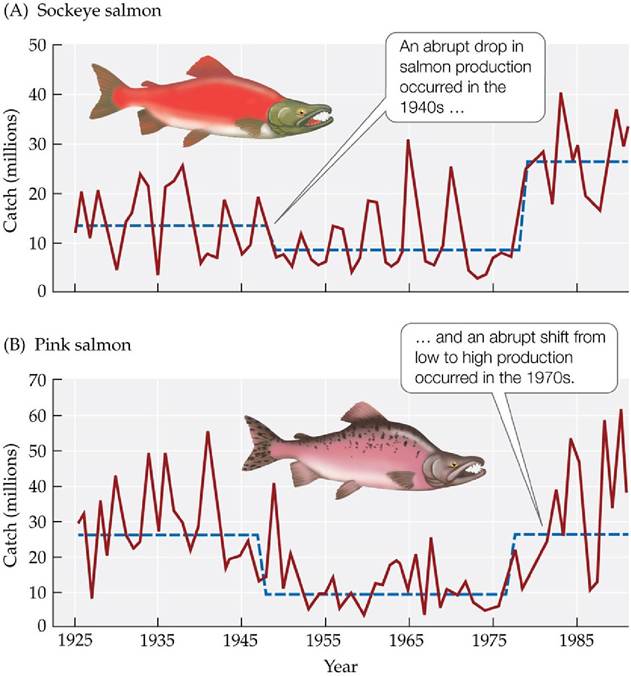
FIGURE 2.2 Changes in Salmon Harvests over Time Records of commercial harvests of
(A) sockeye salmon and (B) pink salmon in Alaska over 65 years show abrupt drops and increases in production. Solid lines represent annual catch; dashed lines are a statistical fit to the data. (After S. R. Hare and R. C. Francis. 1994. In Climate Change and Northern Fish Populations. Can Spec Publ Fish Aquat Sci 121. R. J. Beamish [Ed.], pp. 357-372. National Research Council of Canada: Ottawa. © Canadian Science Publishing or its licensors.) View larger image
From Pacific Fisherman (September 1915):
“Never before have the Bristol Bay [Alaska] salmon packers returned to port after the season's operations so early.
” [That is, it was a bad year, with few fish to catch.]“The spring [Chinook salmon] fishing season on the Columbia River [Washington and Oregon] closed at noon on August 25, and proved to be one of the best for some years. ”
From Pacific Fisherman (1939 Yearbook):
The Bristol Bay Red [Alaska sockeye salmon] run was regarded as the greatest in history.
“The [Chinook] catch this year is one of the lowest in the history of the Columbia [Washington], ”
Hare and Francis hypothesized that the abrupt shifts in salmon production were associated with long-term climate variation in the North Pacific. The nature and cause(s) of these underlying climate shifts, however, were unclear. Additional work by Mantua and colleagues found good correspondence between the multidecadal shifts in salmon production and changes in sea surface temperatures in the North Pacific.
How widespread is this variation in climate and its effects on salmon and the associated marine ecosystem? As we will see at the end of this chapter, the research on variation in salmon production led to the discovery of an important long-term cyclic climate pattern that affects a large area.