Competition is often asymmetrical
When two species compete for a resource that is in short supply, each obtains less of the resource than it could if the competitor were not present. Because competition reduces the resources available for the growth, reproduction, and survival of both species, the abundance of each species is reduced to some extent.
In many cases, however, the effects of competition are unequal, or asymmetrical: one species is harmed more than the other. This asymmetry is especially clear in situations in which one competitor drives another to extinction.For example, in a laboratory experiment, Tilman et al. (1981) examined competition for silica (SiO2) between species of freshwater diatoms, which use silica to construct their cell walls. Tilman and colleagues grew two diatom species, Synedra ulna and Asterionella formosa, alone and in competition with each other. They measured how the population densities of the diatoms and silica concentrations in the water changed over time. When grown alone, each species reduced silica (the resource) to a low and approximately constant concentration; each species also reached a stable population size (FIGURE 14.6). Synedra had a lower stable population size than Asterionella, and it reduced silica to lower levels than did Asterionella. When the two species competed with each other, Synedra drove Asterionella to extinction, apparently because it reduced silica to such low levels that Asterionella could not survive.
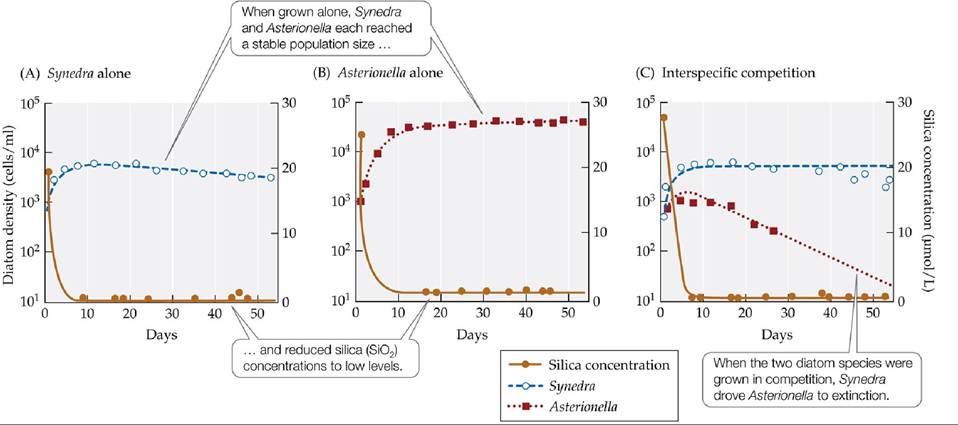
FIGURE 14.6 CompetitionIsOftenAsymmetrical DavidTilmanandhiscolleagues demonstrated competition between two diatom species for silica by growing them alone and in competition with each other. Synedra (A) reduced silica concentrations to lower levels than did Asterionella (B) This result may explain why Synedra outcompeted Asterionella when the two species were grown together (C).
Suppose a third diatom species reduced the concentration of silica to 5 μmol∕L when grown alone.
Predict what would happen if this species weregrown in competition with Asterionella.
(After D. Tilman et al. 1981. Limnol Oceanogr 26: 1020-1033.) View larger image
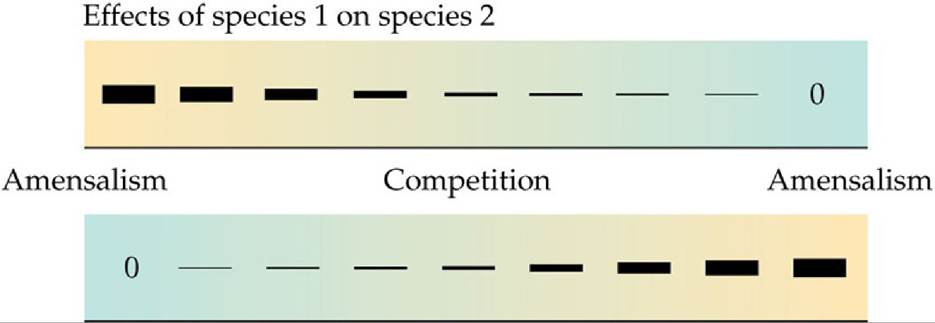
As this example suggests, before the inferior competitor goes extinct, the superior competitor typically loses potential resources to its competitor or invests energy in the competitive interaction. Hence, even when one species drives the other to extinction, both the superior and the inferior competitor are harmed to some extent. However, the effect of the superior competitor is still greater than the effect of the inferior competitor. Indeed, in general, there is a continuum in how strongly each competitor affects the other (FIGURE 14.7). Note that the two ends of this continuum do not represent competitive (-/-) interactions. Instead, such interactions are referred to as amensalism, -/0 interactions in which individuals of one species are harmed while individuals of the other species are not affected at all. Possible examples of amensal interactions include small woody plants that grow beneath towering trees, or corals in which the individuals of one species can grow over those of another, depriving them of light.
Effects of species 2 on species 1
FIGURE 14.7 AcontinuumofCompetitiveEffects Competitionmayaffectmembersof both species equally, or the members of one species may be harmed more than are members of
the other species. The thickness of the bars represents the strength of the competitive effects and the -/0 represents amensalism.
Indicate the interactions that represent asymmetrical competition.
View larger image