Competition can occur between closely or distantly related species
We've seen that competition can occur between pairs of closely related species, such as the diatom species studied by Tilman. Brown and Davidson (1977) examined whether competition also occurs between groups of more distantly related species.
In particular, they suspected that rodents and ants might compete because both eat the seeds of desert plants, and the sizes of the seeds they eat overlap considerably (FIGURE 14.8).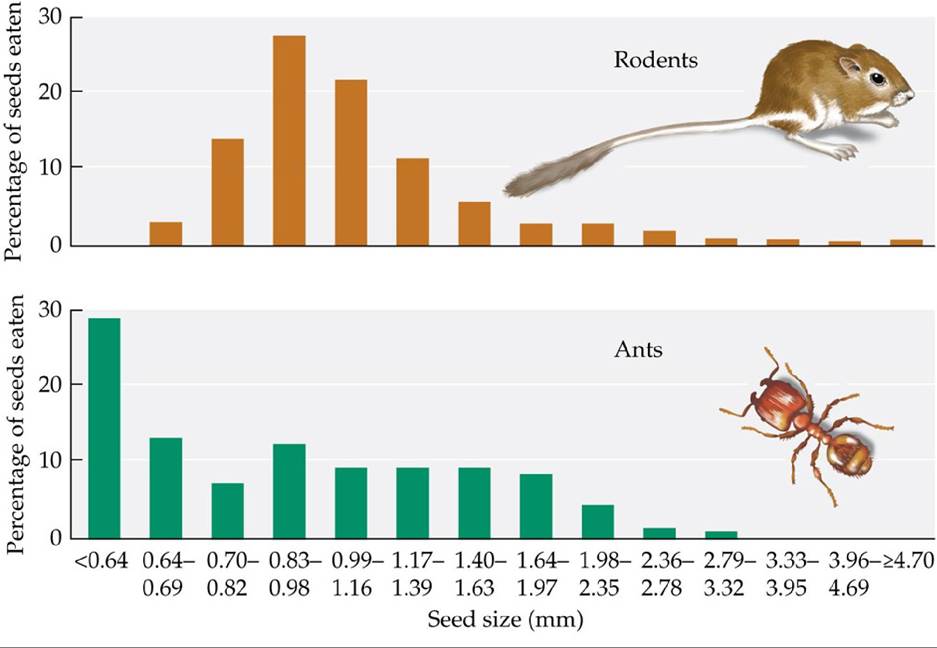
FIGURE 14.8 Ants and Rodents Compete for Seeds Thereisextensiveoverlapinthe sizes of seeds eaten by ants and by rodents. Removal experiments showed that these two distantly related groups compete for this food source. (After J. H. Brown and D. W. Davidson. 1977. Science 196: 4292.) View larger image
Brown and Davidson established experimental plots (each about 1,000 m2) in a desert region near Tucson, Arizona. Their experiment lasted 3 years and used four treatments: (1) plots in which a ¼-inch wire mesh fence excluded seedeating rodents and from which rodents within the fence were removed by trapping; (2) plots in which seed-eating ants were excluded by applying insecticides; (3) plots in which both rodents and ants were excluded by fencing, trapping, and insecticides; and (4) plots in which both rodents and ants were left undisturbed (control plots).
The results indicated that rodents and ants do compete for food. Relative to the control plots, the number of ant colonies increased by 71% in the plots from which rodents were excluded, and rodents increased by 18% in number and 24% in biomass in the plots from which ants were excluded. In the plots from which both rodents and ants were excluded (treatment 3), the density of seeds increased by 450% compared with all other plots. Treatments 1 (no rodents), 2 (no ants), and 4 (the control plots, with both rodents and ants present) all resulted in similar densities of seeds. These results suggest that when either rodents or ants were removed, the group that remained ate roughly as many seeds as rodents and ants combined ate in the control plots. Thus, under natural conditions, each group would be expected to eat fewer seeds in the presence of the other group than it could eat when alone.
It is not surprising that species as different as ants and rodents compete. After all, people differ greatly from bacteria, fungi, and insects, yet we compete with these organisms for food in farm fields, in grain storage bins—even in our refrigerators. Overall, whether they are closely or distantly related, organisms can compete if they share the use of a limiting resource.