Competition in Plants That Eat Animals: A Case Study
Despite repeated reports that plants could eat animals, early scientists were skeptical of those claims. Charles Darwin (1875) laid their doubts to rest by providing clear experimental evidence of carnivory by plants.
Today, more than 600 species of plants that eat animals have been identified, including bladderworts, sundews, pitcher plants, and the well-known Venus flytrap.Plants use a variety of mechanisms to eat animals. The Venus flytrap has modified leaves that look like fanged jaws yet attract insects with a sweetsmelling nectar (FIGURE 14.1). The inner surface of the leaf has touchsensitive hairs; if an insect trips those hairs, the leaf snaps shut in less than half a second. Once the insect is captured, the trap tightens further, forming an airtight seal around its victim, which is then digested over the course of 5-12 days. Some plants can capture animals at truly blinding speeds. For example, aquatic bladderworts (Utricularia spp.) have a trapdoor that springs inward when touched, creating a suction that pulls in prey in less than half a millisecond.
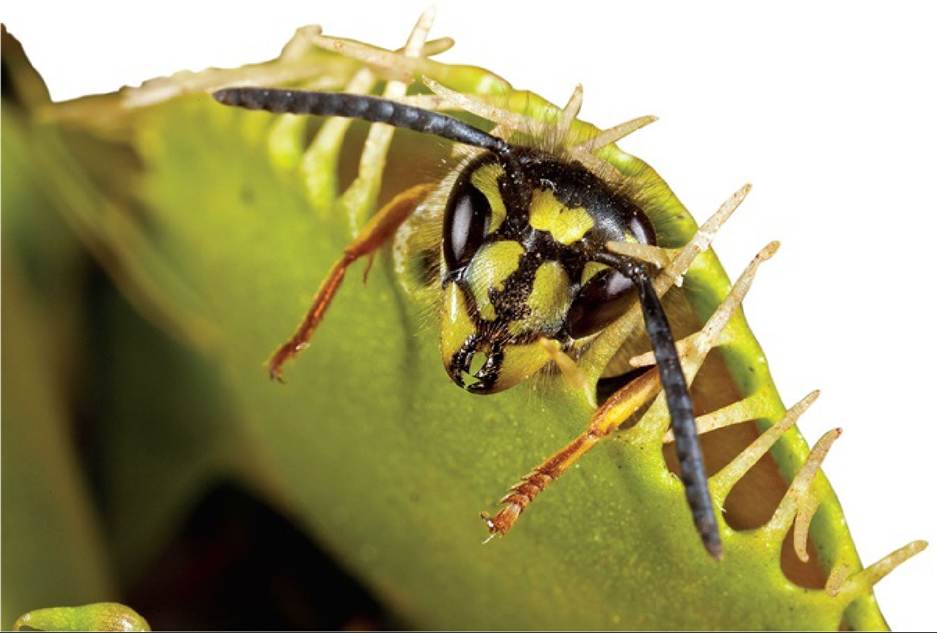
FIGURE 14.1 APlantThatEatsAnimals Attracted to the plant's sweet-smelling nectar, this wasp is about to become a meal. Although the Venus flytrap typically captures insects, it can also feed on other animals, such as slugs and small frogs. © Chris Mattison/Alamy Stock Photo View larger image
Other plants lack moving parts yet still can eat animals. Consider the pitcher plants, which can use nectar or visual cues to lure insects into a pitcher-shaped trap. The inside of the pitcher often has downward-facing hairs, which make it easy for the insect to crawl in, but hard to crawl out. What's more, in many pitcher plants, once it is about halfway down, the insect encounters a layer of flaky wax.
An insect that steps onto this wax is doomed: the wax sticks to its feet, causing it to lose its grip and tumble into a vat that contains either water (in which it drowns) or deadly digestive juices.Why do some plants eat animals? The answer may relate to the subject of this chapter: competition. Because plants are immobile, competition for limiting resources such as nutrients or water can be intense. Many carnivorous plants are found in environments with nutrient-poor soils. Furthermore, evolutionary relationships among plants reveal that in nutrient-poor environments, carnivory has evolved multiple times, in a variety of independent plant lineages. Overall, these observations suggest that carnivory in plants is an adaptation for life in nutrient-poor environments—perhaps providing a way to avoid competing with other plants for soil nutrients. Hence, carnivorous plants could use animal prey as an alternative source of nutrients when competition is intense.
To test this idea, Stephen Brewer (2003) measured how the growth of the pitcher plant Sarracenia alata was affected when he cut off its access to prey (by covering the pitchers) and when he reduced noncarnivorous competitor plant species (“neighbors”) by weeding and clipping. His results show that biomass in Sarracenia increased when neighbors were reduced (FIGURE 14.2), suggesting that competition had an important effect on growth. But further examination of Figure 14.2 reveals that matters are not as simple as they may at first appear. Although the growth of pitcher plants with competition was expected to decline when they were deprived of prey, that did not happen. Instead, it seems that pitcher plants were only able to benefit from animal prey when neighbors were removed. Why is this so?
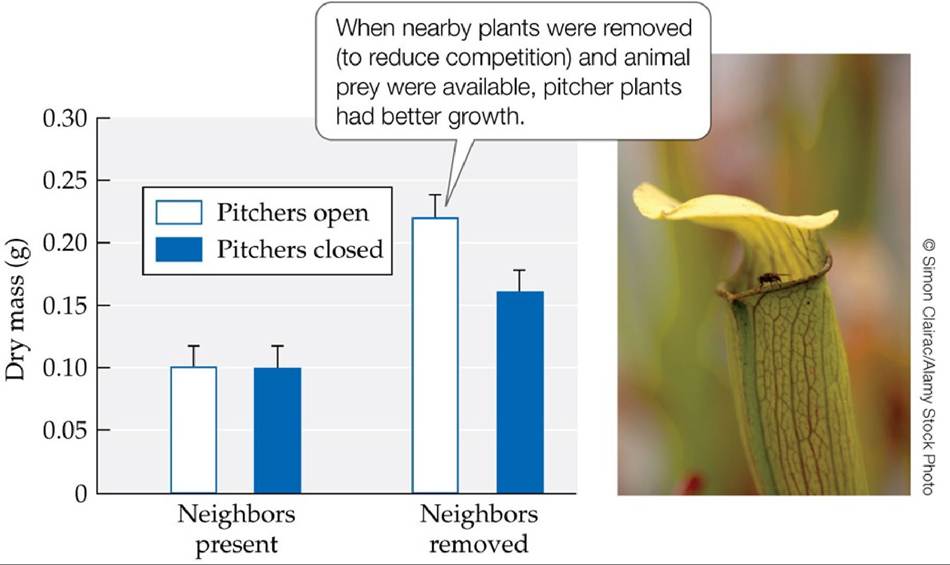
FIGURE 14.2 Competition Decreases Growth in a Carnivorous Plant To test the effects of competition on the carnivorous pitcher plant Sarracenia alata, the growth of control plants (“neighbors present”) was compared with the growth of plants whose noncarnivorous competitors were weeded and clipped (“neighbors removed”). Neighbor removal increased plant growth, especially when animal prey were available. Error bars show one standard error of the mean. (After J. S. Brewer. 2003. Ecology 84: 451-462.) View larger image