Introduction
In 1917, A. G. Tansley reported results from a series of experiments designed to explain the distribution in Britain of two species of bedstraw plants, Galium hercynicum and G. pumilum (then known as G.
sylvestre). Galium hercynicum was restricted to acidic soils, G. pumilum to calcareous soils. Even in places where the two species grew within inches of each other, each remained confined to its characteristic soil type. In his experiments, Tansley found that when grown alone, each species could survive on both acidic and calcareous soils. However, when he grew the species together on acidic soils, only G. hercynicum survived, and if he grew them together on calcareous soils, only G. pumilum survived. Tansley concluded that the two species competed with each other and that when grown on its native soil type, each species drove the other to extinction.Tansley's work on bedstraws is one of the first experiments ever performed on competition, a non-trophic interaction between individuals of two or more species in which all species are negatively affected by their shared use of a resource that limits their ability to grow, reproduce, or survive (see Figure 12.3). In this chapter, we specifically focus on interspecific competition (between individuals of different species) as opposed to intraspecific competition (between individuals of a single species), as in density-dependent growth, a topic we addressed in Chapters 10 and 11.
What are some of the resources that species compete for? Resources are simply the components of the environment, such as food, water, light, and space, that are required by species. Food is an obvious example—when food is scarce, population growth rates fall unless individuals can successfully compete. In terrestrial ecosystems—especially arid ones—water is also a resource. But an organism does not need to consume a substance for it to be a resource.
Plants “consume” light in the sense that they use it to fix carbon, and they can deplete the supply available to other plants by shading them. Space is also an important resource. Plants, algae, and sessile animals require space to attach and grow, and competition for space can be intense. Mobile animals also compete for space as they seek access to foraging grounds, territories to attract mates, or refuges from heat, cold, or predators.Finally, the full set of resources, along with other biotic and abiotic requirements, is what is known as the ecological or fundamental niche of a species (FIGURE 14.3A). However, within the context of species interactions, no one species has exclusive access to all the resources within its fundamental niche. Thus, ecologists recognize a more restricted set of conditions that a species is limited to, in large part because of species interactions. These more restricted conditions form the realized niche of a species (FIGURE 14.3B). We will consider the niche concept later in Concept 14.2 and in Chapter 19 when we discuss resource partitioning. For now, let's begin our exploration of competition by considering some of its general characteristics.
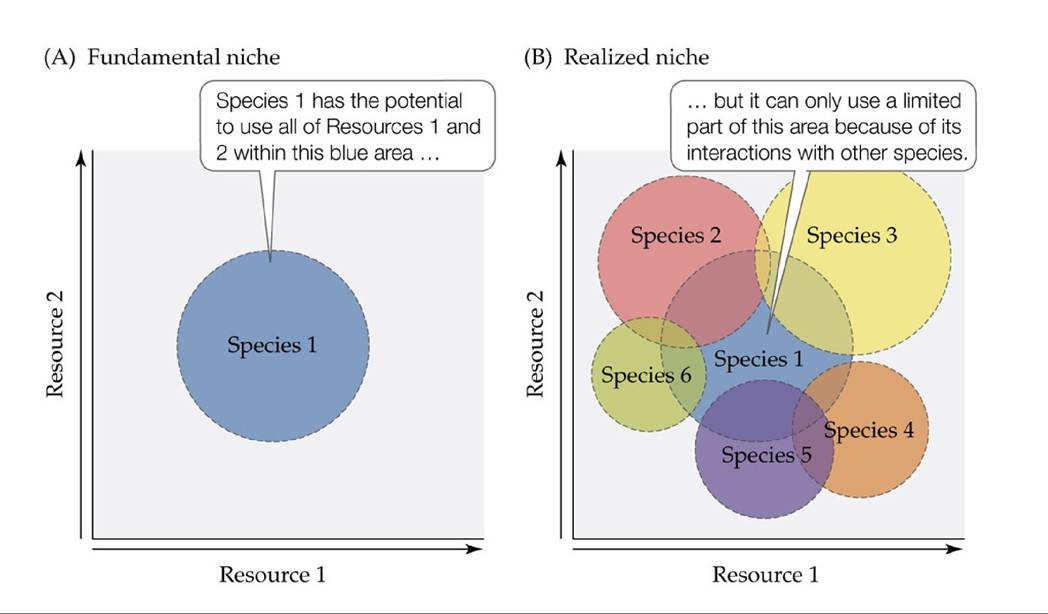
FIGURE 14.3 The Concept of the Fundamental and the Realized Niche Inthis conceptual representation of species 1's use of two resources, (A) its fundamental niche is contained within the entire blue area, but (B) the use of resources in that area is limited by interactions with other species, which set the limits of its realized niche. View larger image
More on the topic Introduction:
- Introduction
- Introduction
- Introduction
- INTRODUCTION
- Contents
- Contents
- Contents
- Contents
- Contents
- AVIAN CHOLERA