Ecology is broad in scope
Ecologists study interactions in nature across many levels of biological organization. For example, some ecologists are interested in how particular genes or proteins enable organisms to respond to environmental challenges.
Other ecologists study how hormones influence social interactions in animals, or how specialized tissues or organ systems allow animals to cope with extreme environments. However, even among ecologists whose research is focused on lower levels of biological organization (e.g., from molecules to organ systems), ecological studies usually emphasize one or more of the following levels: individuals, populations, communities, ecosystems, landscapes, or the entirebiosphere (FIGURE 1.8).
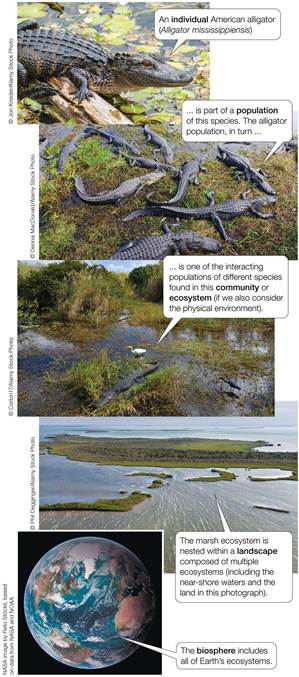
FIGURE 1.8 An Ecological Hierarchy As suggested by this series of photographs, life in the rocky intertidal ecosystem can be studied at a number of levels, from individuals to the biosphere. These levels are nested within one another, in the sense that each level is composed of groups of the entity found in the level below it. View larger image
A population is a group of individuals of a single species that live in a particular area and interact with one another. Many of the central questions in ecology concern how and why the locations and abundances of populations change over time. To answer such questions, it is often helpful to understand the roles played by other species. Thus, many ecologists study nature at the level of the community, which is an association of interacting populations of different species that live in the same area at the same time. Communities can cover large or small areas, and they can differ greatly in terms of the numbers and types of species found within them (FIGURE 1.9).
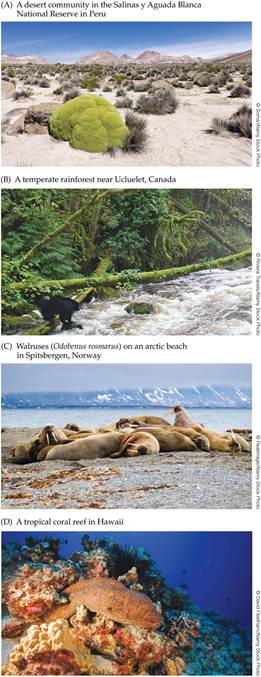
FIGURE 1.9 A Few of Earth’s Many Communities These photo-graphs show (A) a desert community in Peru; (B) a temperate rainforest in Canada; (C) walruses on an arctic beach in Norway; and (D) a coral reef with a variety of corals and sponges in Hawaii. View larger image
Ecological studies at the population and community levels often examine not only the effects of the biotic, or living, components of a natural system, but also those of the abiotic, or physical, environment.
For example, a population or community ecologist might ask whether features of the abiotic environment, such as climate and soils, influence the growth of individuals or the relative abundances of the different species found in a community. Other ecologists are particularly interested in how ecosystems work. An ecosystem is a collection of communities of organisms (e.g., plants, birds) plus the physical environment in which they live. An ecologist studying ecosystems might want to know the rate at which a chemical (such as nitrogen) moves through a particular community, as well as how the species living in the ecosystem affect what happens to the chemical once it enters the community. For example, ecosystem ecologists studying amphibian deformities might document the rates at which nitrogen from fertilizers enters ponds that do and do not contain deformed amphibians, or they might determine how the presence or absence of algae affects what happens to nitrogen once it has entered the ponds.Across larger spatial regions, ecologists study landscapes, which are areas that vary substantially from one place to another, typically including multiple ecosystems. Finally, global patterns of element, air, and water circulation (see Concept 2.2) link the world's ecosystems into the biosphere, which consists of all living organisms on Earth plus the environments in which they live. The biosphere forms the highest level of biological organization. Over recent decades, as we will see in Unit 7, ecologists have acquired new tools that improve their ability to study the big picture: how the biosphere works. As just one example, ecologists can now use satellite data to answer questions such as, How do different ecosystems contribute to ongoing changes in the global concentration of carbon dioxide (CO2) in the atmosphere?