Some key terms are helpful for studying connections in nature
Whether we are discussing individuals, populations, communities, or ecosystems, all chapters of this book incorporate the principle that events in the natural world are interconnected.
For example, in Unit 3, we will see how an explosion in the population size of an introduced species (the comb jelly Mnemiopsis leidyi) altered the entire Black Sea ecosystem. Because we stress connections in nature in every chapter, and hence may discuss ecosystems in a chapter about organisms, or vice versa, we describe here a handful of key terms that you will need to know as you begin your study of ecology. These terms are also summarized in TABLE 1.1.TABLE 1.1 Key Terms for Studying Connections in Nature
| Term | Definition |
| Adaptation | A feature of an organism that improves its ability to survive or reproduce in its environment |
| Natural selection | An evolutionary process in which individuals that possess particular characteristics survive or reproduce at a higher rate than other individuals because of those characteristics |
| Producer | An organism that uses energy from an external source, such as the sun, to produce its own food without having to eat other organisms or their remains |
| Consumer | An organism that obtains its energy by eating other organisms or their remains |
| Net primary production (NPP) | The amount of energy (per unit of time) that producers fix by photosynthesis or other means, minus the amount they use in cellular respiration |
| Nutrient cycle | The cyclic movement of a nutrient between organisms and the physical environment |
A universal feature of living systems is that they change over time, or evolve.
Depending on the questions or time scale of interest, evolution can be defined as (1) a change in the genetic characteristics of a population over time or as (2) descent with modification, the process by which organisms gradually accumulate differences from their ancestors. We will discuss evolution in the context of ecology more fully in Chapter 6, but here we define two key evolutionary terms: adaptation and natural selection.An adaptation is a genetically based characteristic of an organism that improves its ability to survive or reproduce within its environment. Adaptations are of critical importance for understanding how organisms function and interact with one another. As we'll see in Concept 6.3, although several mechanisms can cause evolutionary change, only natural selection can produce adaptations consistently. In the process of natural selection, individuals with particular characteristics tend to survive and reproduce at a higher rate than other individuals because of those characteristics. If the characteristics being selected for are heritable, then the offspring of individuals favored by natural selection will tend to have the same characteristics that gave their parents an advantage. As a result, the frequency of those characteristics in a population may increase over time. If that occurs, the population will have evolved.
Consider what happens within the body of a person taking an antibiotic. Some of the bacteria that live inside that person may possess genes that provide resistance to the antibiotic. The bacteria with the resistance genes will survive and reproduce at a higher rate than will nonresistant bacteria lacking the genes (FIGURE 1.10). Because the trait on which natural selection acts (antibiotic resistance) is heritable, the offspring of the resistant bacteria will tend to be resistant. As a result, the proportion of resistant bacteria in the person's body will increase over time, and the bacterial population will have evolved.
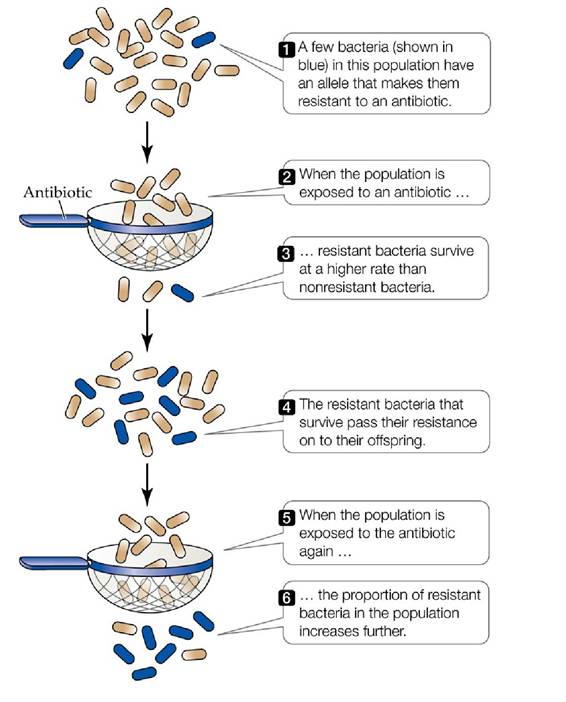
FIGURE 1.10 NaturalSelectioninAction As shown in this diagram, in which a sieve represents the selective effects of an antibiotic, natural selection can cause the frequency of antibiotic resistance in bacteria to increase over time. View larger image
The remaining four key terms that we'll introduce here concern ecosystem processes. One way to look at how ecosystems work is to consider the movement of energy and materials through a community. Energy enters the community when an organism such as a plant or bacterium captures energy from an external source, such as the sun, and uses that energy to produce food. An organism that can produce its own food from an external energy source without having to eat other organisms or their remains is called a producer (such organisms are also called primary producers or autotrophs). An organism that obtains its energy by eating other organisms or their remains is called a consumer (or a heterotroph). Per unit of time, the amount of energy that producers capture by photosynthesis or other means, minus the amount they lose in cellular respiration, is called net primary production (NPP). Changes in NPP can have large effects on ecosystem function, and NPP varies greatly from one ecosystem to another.
Each unit of energy captured by producers is eventually lost from the ecosystem as respiration (FIGURE 1.11). As a result, energy moves through ecosystems in a single direction only—it cannot be recycled. Nutrients, however, are recycled from the physical environment to organisms and back again. The cyclic movement of a nutrient such as phosphorus between organisms and the physical environment is referred to as a nutrient cycle. Life as we know it would cease if nutrients were not cycled, because the molecules organisms need for their growth and reproduction would be much less readily available.
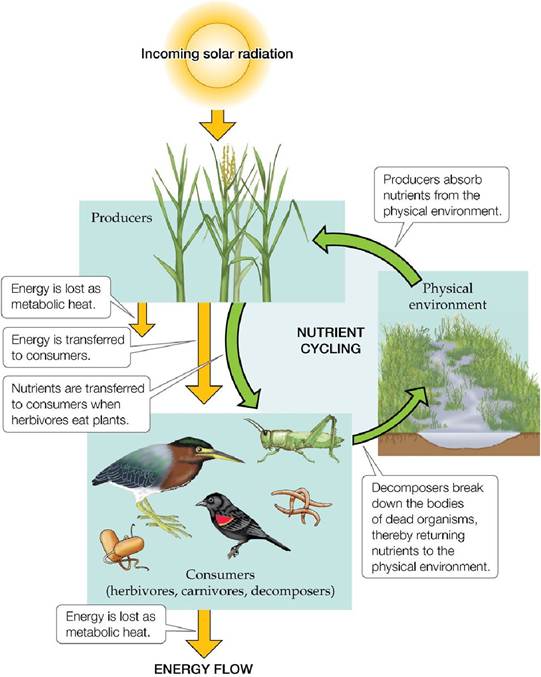
FIGURE 1.11 HowEcosystemsWork Each time one organism eats another, a portion of the energy originally captured by a producer is lost as heat given off during the chemical breakdown of food by cellular respiration.
As a result, energy flows through the ecosystem in a single direction and is not recycled. Nutrients such as carbon and nitrogen, on the other hand, cycle between organisms and the physical environment.Describe the three main steps by which a nutrient cycles through an ecosystem.
View larger image
Whether they are concerned with adaptations or NPP, populations or ecosystems, the scientists who study ecological systems have not produced a fixed body of knowledge. Instead, what we know about ecology changes constantly as ideas are tested and, if necessary, revised or discarded as new information emerges. As we will see in the next section, ecology, like all branches of science, is about answering questions and seeking to understand the underlying causes of natural phenomena.