A laboratory experiment tests the role of parasites
When Ruth first observed deformed amphibians in the mid-1980s, he assumed that they were an isolated, local phenomenon. By 1996, Pieter Johnson, then an undergraduate at Stanford University, had learned of the Minnesota students' findings and of the paper by Sessions and Ruth.
Although Sessions and Ruth provided indirect evidence that Ribeiroia may have caused amphibian deformities, they did not infect P. regilla or A. macrodactylum with Ribeiroia and show that deformities resulted. Furthermore, the two amphibian species they used in their experiments (the African clawed frog, Xenopus laevis, and the axolotl salamander, A. mexicanum) were not known to have limb deformities in nature. Building on the work done by Sessions and Ruth (1990), Johnson and his colleagues set out to provide a more direct test of whether Ribeiroia parasites can cause limb deformities in amphibians.They began by surveying 35 ponds in Santa Clara County, California. They found Pacific tree frogs in 13 of the surveyed ponds, and 4 of these ponds had deformed frogs. Concentrating on 2 of the ponds with deformed frogs, they found that 15%-45% of the tadpoles undergoing metamorphosis had extra limbs or other deformities (Johnson et al. 1999). One source of concern was that the deformities might be caused by pollutants, such as pesticides, polychlorinated biphenyls (PCBs), or heavy metals. However, none of these substances were found in water from the 2 ponds.
Johnson and his colleagues then turned their attention to other factors that might cause the deformities. Aware that Sessions and Ruth had hypothesized that parasites could be the cause, Johnson et al. noted that of the 35 ponds they surveyed, the 4 ponds with deformed frogs were the only ponds that contained both tree frogs and the aquatic snail Helisoma tenuis. As shown in FIGURE 1.3, this snail is the first of two intermediate hosts required for the Ribeiroia parasite to complete its life cycle and produce offspring.
The parasite also requires an amphibian or fish as a second intermediate host. In addition, dissections of abnormal frogs collected from the two ponds they studied in detail revealed Ribeiroia cysts in all the frogs with deformed limbs.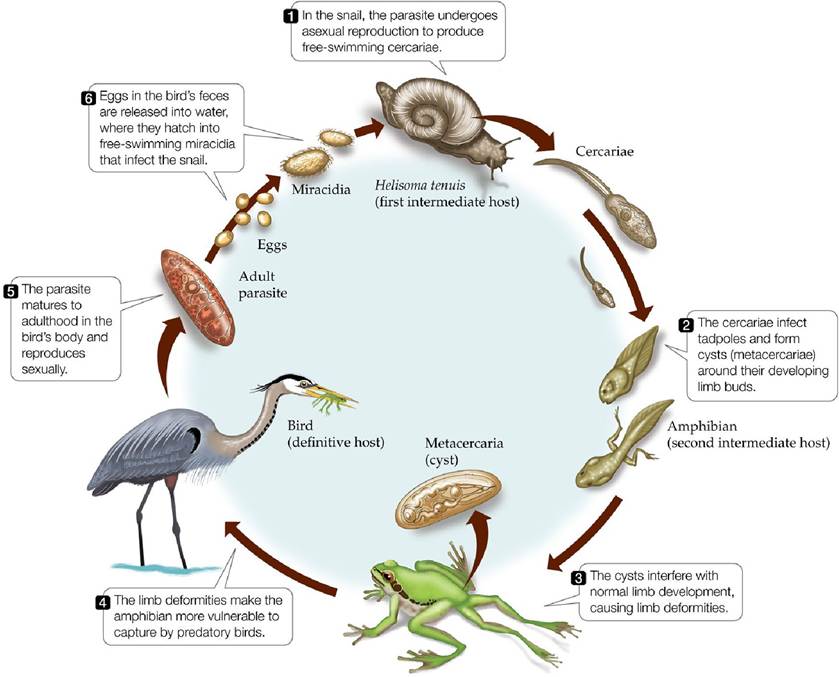
FIGURE 1.3 TheLifeCycleofRibeiroia TheparasiticflatwormRibeiroiausesthree different kinds of hosts: snails, fishes or larval amphibians, and birds or mammals. Many other parasites have similarly complex life cycles. Some parasites, like Ribeiroia, can alter the appearance or behavior of their second intermediate host in ways that make the host more vulnerable to predation by their final or definitive host. View larger image
Like the findings of Sessions and Ruth, Johnson's observations provided only indirect evidence that Ribeiroia caused deformities in Pacific tree frogs. Next, Johnson and his colleagues returned to the laboratory to perform a more rigorous test of that idea. They did this by using a standard scientific approach: they performed a controlled experiment in which an experimental group (that has the factor being tested) was compared with a control group (that lacks the factor being tested). Johnson et al. collected P. regilla eggs from a region not known to have frog deformities, brought the eggs into the laboratory, and placed the tadpoles that hatched from them in 1-liter containers with one tadpole per container. Each tadpole was then assigned at random to one of four treatments, in which 0 (the control group), 16, 32, or 48 Ribeiroia parasites were placed in its container; these numbers were selected to match parasite levels that had been observed in the ponds.
Johnson and his colleagues found that as the number of parasites increased, fewer of the tadpoles survived to metamorphosis, and more of the survivors had deformities (FIGURE 1.4). In the control group (with zero Ribeiroia), 88% of the tadpoles survived, and none had deformities (Johnson et al. 1999). The link had been made: Ribeiroia could cause frog deformities. Furthermore, since exposure to Ribeiroia killed up to 60% of the tadpoles, the results also suggested that the parasites could contribute to amphibian declines.
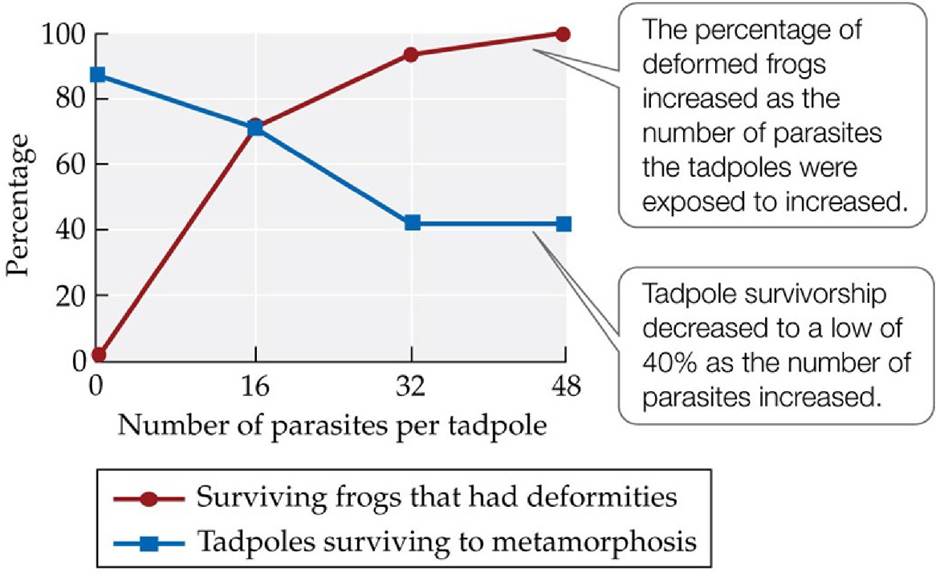
FIGURE 1.4 ParasitescanCauseAmphibianDeformities Thegraphshowsthe relationship between the numbers of Ribeiroia parasites that tadpoles were exposed to and their rates of survival and deformity. Initial numbers of tadpoles were 35 in the control group (0 parasites) and 45 in each of the other three treatments.
Estimate the number of tadpoles in the control group that survived, as well as the number that had deformities.
(After P. T. J. Johnson et al. 1999. Science 284: 802-804.) View larger image