A field experiment suggests that multiple factors influence frog deformities
A few years after Johnson and his colleagues published their research, other scientists showed that Ribeiroia parasites could cause limb deformities in other amphibian species, including western toads (Anaxyrus boreas), wood frogs (Lithobates sylvaticus), and leopard frogs (L.
pipiens, the species in which the Minnesota students had discovered deformities). While Ribeiroia was clearly important, some researchers suspected that other factors might also play a role. Pesticides, for example, were known to contaminate some of the ponds in which deformed frogs were found. To examine the possible joint effects of parasites and pesticides, Joseph Kiesecker conducted a field experiment in six ponds, all of which contained Ribeiroia, but only some of which contained pesticides (Kiesecker 2002).Three of the ponds in Kiesecker's study were close to farm fields, and water tests indicated that each of these ponds contained detectable levels of pesticides. The other three ponds were not as close to farm fields, and none of them showed detectable levels of pesticides. In each of the six ponds, Kiesecker placed wood frog tadpoles in cages made with a mesh through which water could flow but tadpoles could not escape. Six cages were placed in each pond; three of the cages had a mesh through which Ribeiroia parasites could pass, while the other three had a mesh too small for the parasites. Thus, in each pond, the tadpoles in three cages were exposed to the parasites, while the tadpoles in the other three cages were not.
The results showed that Ribeiroia caused limb deformities in the field (FIGURE 1.5). No deformities were found in frogs raised in cages whose small mesh size, 75 micrometers (μm), prevented the entry of Ribeiroia, regardless of which pond the cages were in. Deformities were found in some of the frogs raised in cages whose larger mesh size (500 μm) allowed the entry of Ribeiroia.
In addition, dissections revealed that every frog with a deformity was infected by Ribeiroia. However, a greater percentage of frogs had deformities in the ponds that contained pesticides than in the ponds that did not (29% vs. 4%). Overall, the results of this experiment indicated that (1) exposure to Ribeiroia was necessary for deformities to occur, and (2) when frogs were exposed to Ribeiroia, deformities were more common in ponds with detectable levels of pesticides than in ponds without detectable levels of pesticides.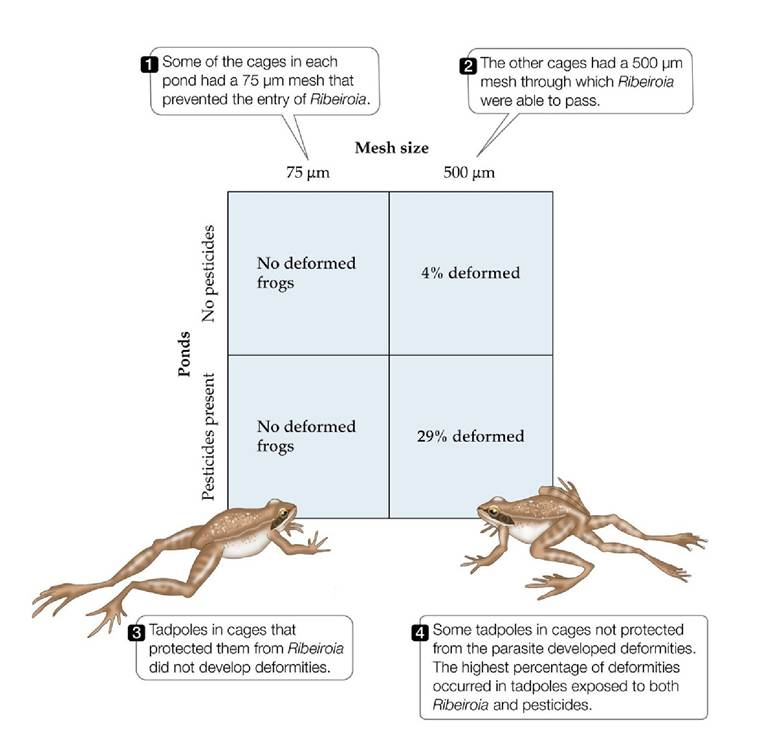
FIGURE 1.5 Do the Effects of Ribeiroia and Pesticides Interact in Nature? To test the effects of Ribeiroia and pesticides on frog deformities in the field, screened cages were placed in six ponds. Three of the six ponds contained detectable levels of pesticides; the other three did not.
Based on the results shown here, do pesticides acting alone cause frog deformities? Do the results indicate that pesticides affect frogs? If so, do they indicate how? Explain.
(After J. M. Kiesecker. 2002. Proc NatlAcad Sci USA 99: 9900-9904. © 2002 National Academy of Sciences, u.s.a.) View larger image
Based on these results, Kiesecker hypothesized that pesticides might decrease the ability of frogs to resist infection by parasites. To test whether pesticides had such an effect, Kiesecker (2002) brought wood frog tadpoles into the laboratory, where he reared some in an environment with pesticides and others in an environment without pesticides, then exposed all of them to Ribeiroia. The tadpoles exposed to pesticides had fewer white blood cells (indicating a suppressed immune system) and a higher rate of Ribeiroia cyst formation (FIGURE 1.6). Together, Kiesecker's laboratory and field results suggested that pesticide exposure can affect the frequency with which parasites cause deformities in amphibian populations. This conclusion has since been supported by other studies.
Field surveys and laboratory experiments reported in Rohr et al. (2008), for example, indicated that exposure to pesticides can increase the number of trematode infections and decrease survival rates in several frog species. As in Kiesecker's study, one reason for the increased number of parasitic infections appeared to be that the frogs' immune response was suppressed by the pesticide.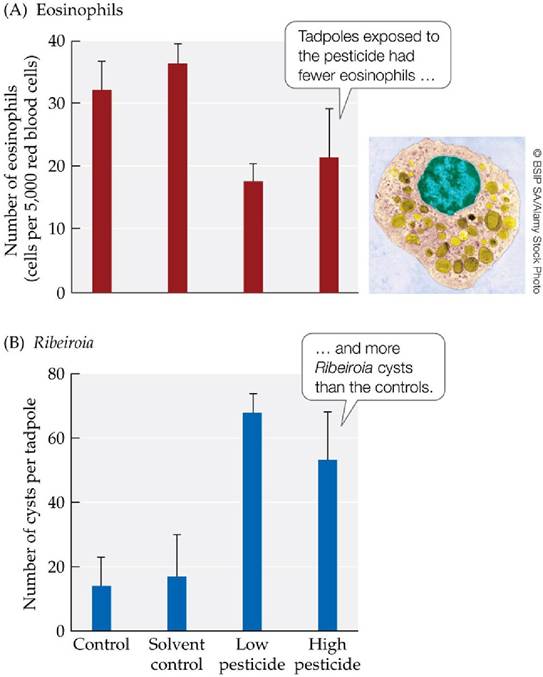
FIGURE 1.6 Pesticides May Weaken Tadpole Immune Systems In a laboratory
experiment, wood frog (Lithobates sylvaticus) tadpoles were exposed to low or high concentrations of the pesticide esfenvalerate and then exposed to 50 Ribeiroia parasites per tadpole. The tadpoles were then examined for (A) numbers of eosinophils (a type of white blood cell used in the immune response) and (B) numbers of Ribeiroia cysts. Two types of controls were used: one in which only parasites were added to the tadpoles' containers (“control”), and another in which both parasites and the solvent used to dissolve the pesticide were added (“solvent control”). Error bars show one standard error (SE) of the mean.
What was the purpose of using two types of controls in this experiment?
(After J. M. Kiesecker. 2002. Proc Natl Acad Sci USA 99: 9900-9904. © 2002 National Academy of Sciences, u.s.a.) View larger image