Connections in nature can lead to unanticipated impacts
As we have seen, the immediate cause of amphibian deformities is often infection by Ribeiroia parasites. But we also noted in the Case Study that amphibian deformities are occurring more often now than in the past.
Why has the frequency of amphibian deformities increased?One possible answer is suggested by the results of Kiesecker (2002) and Rohr et al. (2008): pesticides may decrease the ability of amphibians to ward off parasite attack, and hence deformities are more likely in environments that contain pesticides. The first synthetic pesticides were developed in the late 1930s, and their use has risen dramatically since that time. Thus, it is likely that amphibian exposure to pesticides has increased considerably through time, which may help to explain the recent rise in the frequency of amphibian deformities.
Other environmental changes may also contribute to the observed increase in amphibian deformities. For example, the addition of nutrients to natural or artificial ponds (used to store water for cattle or crops) can lead to increases in parasite infections and amphibian deformities (Johnson et al. 2007). Nutrients can enter a pond when rain or snowmelt washes fertilizers from an agricultural field into it. Fertilizer inputs often stimulate increased growth of algae, and the snails that harbor Ribeiroia parasites eat algae (to refresh your memory of the parasite's life cycle, see Figure 1.3). Thus, as the amount of algae increases, so do the snail hosts of Ribeiroia. An increase in snails tends to increase the number of Ribeiroia found in the pond.
Here, a chain of events that begins with increased fertilizer use by people ends with increased numbers of Ribeiroia, and hence increased numbers of deformed amphibians. As this example illustrates, events in the natural world are connected. As a result, when people alter one aspect of the environment, we can cause other changes that we do not intend or anticipate.
When we increased our use of pesticides and fertilizers, we did not intend to increase the frequency of deformities in frogs. Nevertheless, we seem to have done just that.The indirect and unanticipated effects of human actions include more than bizarre deformities in frogs. Indeed, some changes we are making to our local and global environment appear to have increased human health risks. The damming of rivers in Africa has created favorable habitat for snails that harbor trematode parasites that cause schistosomiasis, thereby increasing the spread of an infection that can weaken or kill people. Globally, the past few decades have seen an increase in the appearance and spread of new diseases, such as COVID 19, AIDS, Lyme disease, hantavirus pulmonary syndrome, Ebola hemorrhagic fever, and West Nile virus. Many public health experts think that the effects of human actions on the environment have contributed to the emergence of these and other new diseases (Weiss and McMichael 2004).
For example, West Nile virus, which is transmitted by mosquitoes and infects birds and humans, is thought to have been introduced into North America by people in 1999 (FIGURE 1.7). Furthermore, the incidence of West Nile virus in humans is influenced by factors such as human population size, the extent of land development, the abundance and identity of mosquito and bird species, and variations in temperature and rainfall (Reisen et al. 2006; Landesman et al. 2007;
Allan et al. 2009). Each of these factors can be affected by human actions, either directly (e.g., by urban or agricultural development) or indirectly (e.g., as a result of climate change; see Concepts 25.2 and 25.3).
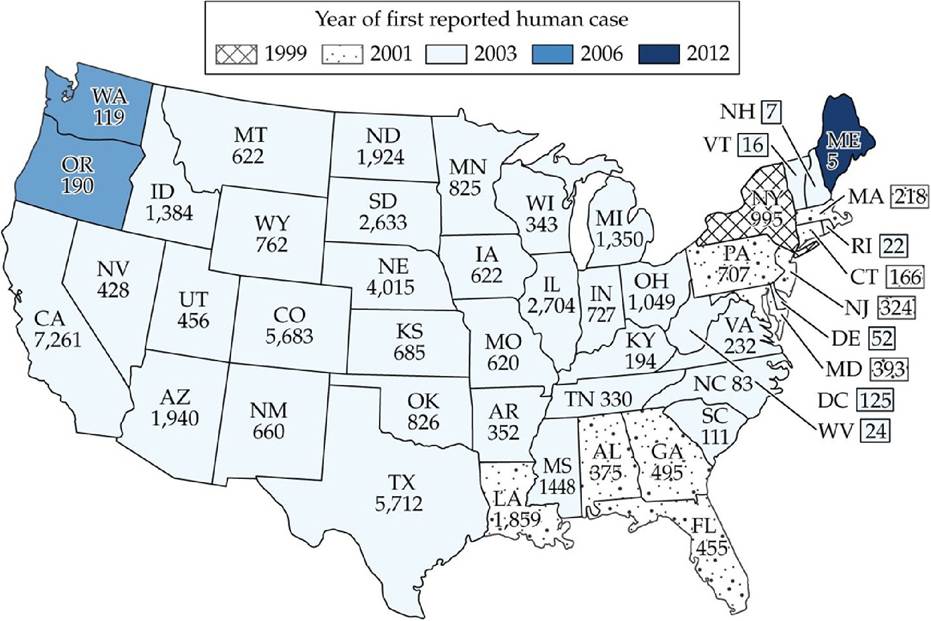
FIGURE 1.7 Rapid Spread of a Deadly Disease Within 13 years, West Nile virus had spread from its North American point of entry (New York City) to all of the lower 48 states. Birds are a primary host for West Nile virus, which may help to explain its rapid spread.
Mosquitoes transmit the disease from birds and other animal hosts to people. Numbers show the cumulative number of human cases in each state by December 31, 2020. Not shown: Data for Alaska (2 cases; first reported case in 2018), Hawaii (1 case in 2014), and Puerto Rico (1 case in 2012). (Data from Centers for Disease Control and Prevention.) View larger imageAs we've seen, connections in nature can cause human actions to have unanticipated side effects. Moreover, if you live in a city, it can be easy to forget the extent to which everything you do depends on the natural world. Your house or apartment shelters you from the elements and keeps you warm in winter and cool in summer. Similarly, you obtain food from a grocery store, clothes from a store or online supplier, water from a faucet. Ultimately, however, each of these items—and everything else you use or own—comes from or depends on the natural environment. No matter how far from the natural world our day-to-day activities take us, people, like all other organisms on Earth, are part of an interconnected web of life. Let's turn now to the study of these connections, the scientific discipline of ecology.
More on the topic Connections in nature can lead to unanticipated impacts:
- Reviewers
- B Curiosity-Driven Science (Stuart Firestein)
- The Last Century
- Means of Acquisition: corpore et animo
- Emergency Room Communication Issues: Dealing with Crisis
- Isis in the Greco-Roman World: Cultural Memory and Imagination
- 47 Muscateers and Mogadorians