Learning Objectives
6.5.1 Evaluate how ecological processes can result in evolutionary changes in populations.
6.5.2 Describe how an evolutionary change in a population has the potential to impact ecological processes.
Ecological and evolutionary processes can influence each other greatly. Consider the sunflower species Helianthus anomalus. This species originated from a speciation event in which two other sunflowers, H. annuus and H. petiolaris, produced hybrid offspring. As Loren Rieseberg and colleagues have shown in a series of experiments and genetic analyses (Rieseberg et al. 2003), the new gene combinations generated by hybridization appear to have facilitated a major ecological shift in H. anomalus. This hybrid species grows in a much drier environment than does either of its two parental species (FIGURE 6.21)—an ecological shift that illustrates how evolution influences ecology. Simultaneously, however, life under different ecological conditions provided the selection pressures that molded the hybrid offspring of H. annuus and H. petiolaris into a new species, H. anomalus, showing how ecology influences evolution. Such joint ecological and evolutionary effects are common—as we should expect, given that both evolution and ecology depend on how organisms interact with one another and with their physical environment.
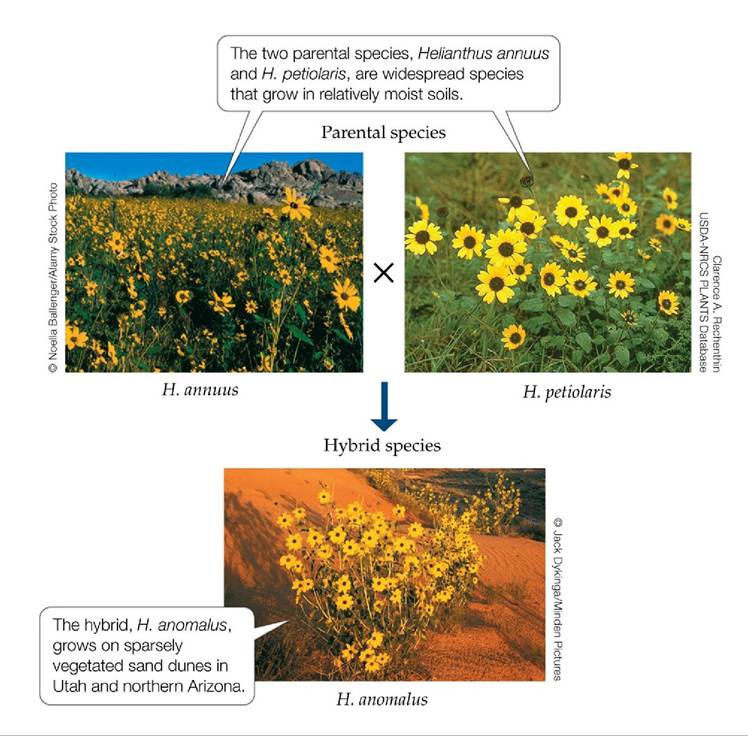
FIGURE 6.21 A Hybrid That Lives in a New Environment The two sunflower species
Helianthus annuus and H. petiolaris gave rise to a new hybrid species, H. anomalus. This species grows in a drier environment than either of the two parental species. View larger image
More on the topic Learning Objectives:
- Learning Objectives
- Learning Objectives
- Learning Objectives
- Learning Objectives
- Learning Objectives
- Learning Objectives
- Learning Objectives
- Learning Objectives
- Learning Objectives
- Learning Objectives