Long-term ecosystem development affects nutrient cycling and constraints on primary production
As terrestrial ecosystems develop on new substrates (e.g., in primary succession on new volcanic flows), soil weathering, nitrogen fixation, and the buildup of organic matter in the soil determine the supply of nutrients available to plants.
Early in ecosystem development, there is little organic matter in the soil, so supplies of nitrogen derived from decomposition are low. Supplies of mineral nutrients derived from weathering are also low, but higher relative to the supply of nitrogen. Accordingly, nitrogen availability should be an important constraint on primary production and plant community composition early in primary succession (see Chapter 17). As the pool of nitrogen in soil organic matter increases, its limitation of primary production should decrease.Phosphorus enters ecosystems through the weathering of a single rock mineral (apatite), and its supply is high relative to that of nitrogen early in succession. As the supply of phosphorus from weathering is exhausted over time, however, decomposition becomes increasingly important as a source of phosphorus for plants. In addition, soluble phosphorus may combine with iron, calcium, or aluminum to form secondary minerals that are unavailable as nutrients, a process known as occlusion. The amount of phosphorus in occluded forms increases over time, further reducing its availability. As a result, phosphorus should become more limiting to primary production during later stages of succession (Walker and Syers 1976).
These observations of changes in nutrient cycling during ecosystem development provide a hypothetical framework for considering how those changes should influence the specific nutrients that limit primary production. Nitrogen should be most important in determining rates of primary production early in succession, nitrogen and phosphorus should both be important at intermediate stages of succession, and phosphorus should be most important late in succession.
This hypothesis was tested in the Hawaiian Islands by Peter Vitousek and his colleagues. The movement of the Pacific tectonic plate over millions of years has given rise to the chain of volcanoes that form these islands. The oldest islands are in the northwestern part of the chain, the youngest in the southeast (FIGURE 22.14A). Vitousek's group studied Hawaiian ecosystems on soils with ages ranging from 300 years to over 4 million years to determine which nutrients were most limiting to primary production. Their study was aided by the similarity of the vegetation and climate at each of the study sites. Vitousek and colleagues added nitrogen, phosphorus, or both nitrogen and phosphorus to plots in three ecosystems of different ages and measured the effects of these treatments on the growth of the dominant tree, Ohi'a (Metrosideros polymorpha). Consistent with their hypothesis, nitrogen was most limiting to tree growth in the youngest ecosystem, while phosphorus was most important in the oldest ecosystem (Vitousek and Farrington 1997) (FIGURE 22.14B). Nitrogen and phosphorus added in combination increased tree growth in the intermediate-aged ecosystem. In contrast to these tropical soils, the soils ofecosystems in temperate, high-latitude, and high-elevation zones are often subjected to major disturbances (e.g., large-scale glaciation, landslides) and are less likely to reach ages at which phosphorus becomes limiting.
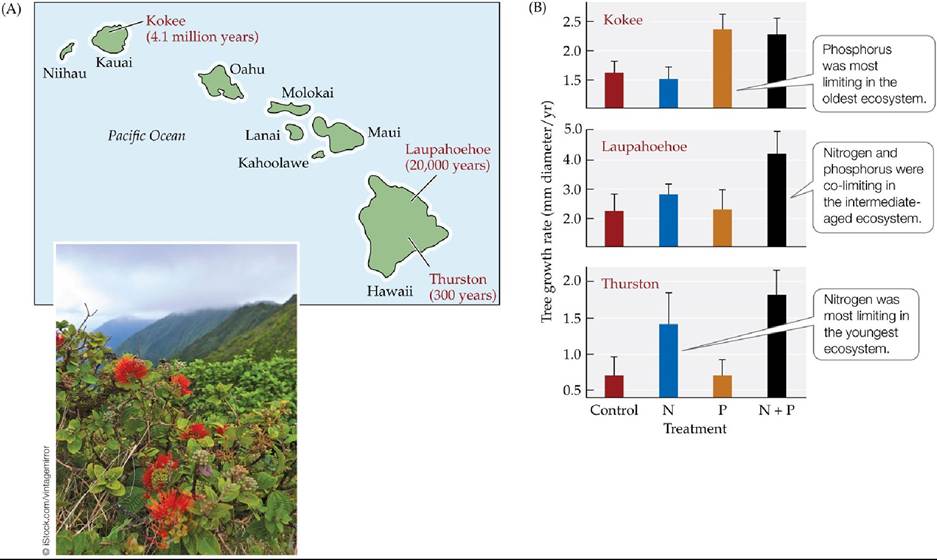
FIGURE 22.14 Nutrient Limitation of Primary Production Changes with Ecosystem Development (A) Fertilization experiments were conducted in three ecosystems of different ages in the Hawaiian Islands: Thurston (300 years old), Laupahoehoe (20,000 years old), and Kokee (4.1 million years old). Vegetation at all three sites is dominated by a single tree species, Ohi'a (Metrosideros polymorpha). (B) Ohi'a growth rates in response to fertilization treatments with nitrogen (N), phosphorus (P), and both (N + P) in the three ecosystems. The more an added nutrient increased tree growth, the more limiting it was assumed to be. Note the differences in the ranges of the y axes. Error bars show one SE of the mean. (A after T. E. Crews et al. 1995. Ecology 76: 1407-1424; B after P. M. Vitousek and H. Farrington. 1997. Biogeochemistry 37: 63-75; Thurston data from P. M. Vitousek et al. 1993. Biogeochemistry 23: 197-215; Kokee data from D. Herbert et al. 1999. Ecology 80: 908-920.) View larger image
Nutrients lost from terrestrial ecosystems often end up in streams, lakes, and oceans. They are a critical source of nutrients for those aquatic ecosystems, but they can have negative effects as well, as we'll see in the next section.