Major Regions of Atmosphere
The atmosphere extends up to about 500 km above the earth’s surface. It is divided into four major regions depending on the height as shown below in Table 3.2.
Table 3.2 Major regions of atmosphere
| Region | Height range (km) | Temperature range (oC) | Main constituents |
| Troposphere | 0-11 | 15 to -56 | O2, N2, CO2, H2O |
| Stratosphere | 11-50 | -56 to -2 | O3 |
| Mesosphere | 50-90 | -2 to -92 | O2+ NO+ |
| Thermosphere | 90-500 | -92 to 1200 | O2+, O+, NO+ |
Besides the above major regions, the region of atmosphere lying between the altitudes of 50 km tol00 km is called ionosphere.
This region has appreciable levels of positive ions (e.g. O2+, O+, NO2+ etc.) and electrons. These ions are formed due to the UV radiation from the sun. During night when there is no solar radiation, the ions combine with free electrons and give neutral species from which they originally originated. The division of atmosphere into various regions is shown in Fig 3.1.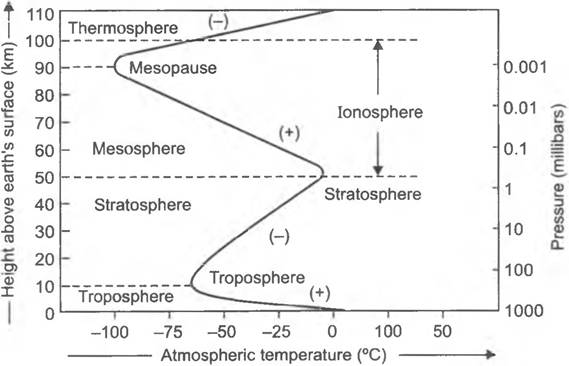
Fig. 3.1 : Various Regions of the Atmosphere
(i) Troposphere
The region nearest to the earth, extending up to a height of about 11 km is called troposphere.
About 70% of the total mass of air is contained in the troposphere. The temperature in this region steadily decreases from ground temperature of about 15° to about -56° (see Fig. 3.1). The fall in temperature is due to fall in pressure and density of air. The change in temperature is known as lapse rate. The decrease of temperature with increasing height in the troposphere is called positive lapse rate. This region is the most important zone of the atmosphere for sustaining life on earth since it contains mainly nitrogen and oxygen. It also contains argon, carbon dioxide and traces of He, Ne, CH4, H2, N2O, CO, O3, NO2, SO2, etc. Troposphere is a dusty zone containing water vapours.lt is the region of strong air currents and cloud formation and is also referred to as a turbulent zone. The composition of air in the troposphere remains more or less constant provided there is no significant air pollution.(ii) Stratosphere
The region above the troposphere is the stratosphere and extends up to an altitude of about 50 km. In stratosphere, the temperature rises from -56o to -2° C. The increase in temperature is due to absorption of solar radiation. The stratosphere is rich in ozone, which absorbs the harmful ultraviolet radiations and prevents it from reaching the earth, and raises the temperature causing negative lapse rate. Besides ozone, stratosphere also contains nitrogen and oxygen along with small amount of water vapour. In stratosphere, ozone is formed from oxygen by a photochemical reaction in which energy from the sun decomposes the oxygen molecule into reactive atomic oxygen, which in turn combines with molecular oxygen to form ozone.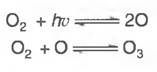
The ozone content of stratosphere is more or less constant. In fact, ozone is in equilibrium with oxygen. This implies that ozone is being produced from oxygen as fast as it is broken down to molecular oxygen.
Ozone layer is of great importance since it absorbs the harmful UV radiations coming from the sun and prevents them from reaching to the surface of the earth.(iii) Mesosphere
Next to stratosphere is the mesosphere which extends up to an altitude of 90 km. It is characterized by low temperature (-2° to -92oC) and very low atmospheric pressure. The region having temperature of about -92oC is the coldest region of the atmosphere. In mesosphere, the decrease in temperature is attributed to low levels of the ozone present. Ozone, as we know absorbs UV radiations from the sun. The main constituents of mesosphere are the positive ions viz. O2+, NO+ etc.
(iv) Thermosphere
This region is above mesosphere and it extends up to a height of about 500 km. The temperature in this region rises from -92o C to 1200o C. The atmospheric gases (oxygen and nitrogen) in the region absorb the solar radiation in the far ultra violet region and undergo ionisation.
(v) Ionosphere
This is the region of atmosphere lying between the altitudes of 50 km to 100 km. In this region, there are high levels of ions like O2+, O+, NO+ and electrons; these species are formed due to solar radiations. During night, the UV radiations are not available and so the ions recombine with free electrons to give neutral species from which they originated.
(vi) Exosphere
This is upper most layer of atmosphere and is above the thermosphere. It extends up to a height of about 1600 km. This region contains hydrogen and helium and has very high temperature due to solar radiation. This region is referred to as the outer space. The division of the atmosphere into various regions is shown in a simplified way in Fig. 3.2.
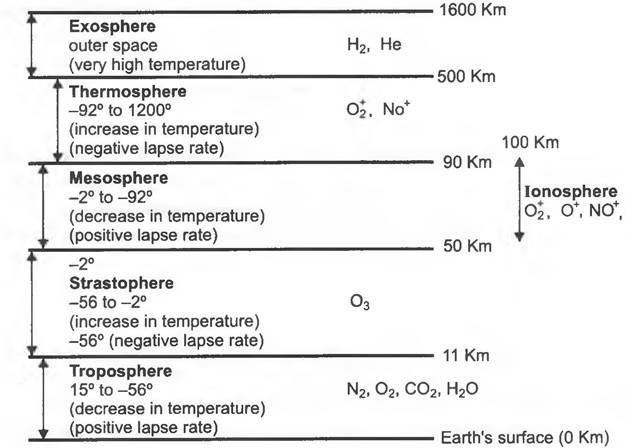
Fig 3.2: Simple Representation of Various Region of the Atmosphere
3.3
More on the topic Major Regions of Atmosphere:
- Composition of Atmosphere
- Lameness is not only a major economic problem, but it is also a major welfare issue - for both the cow and the herdsman!
- Chemical and Photochemical Reactions in Atmosphere
- Atmosphere
- The biotas of biogeographic regions reflect evolutionary isolation
- Emblems of Violence in Other Regions of the Americas
- The Rise and Fall of Quaker Regions
- EPILOGUE: AMERICAN RELIGIOUS REGIONS
- PART 2 Countries, Regions, Eras and Organisations
- Did the Donbas stand out among other Ukrainian regions during the late Soviet period and the post-communist transformation?
- Why did the armed conflict with the new Ukrainian authorities start in the Donbas and not in other eastern regions in the spring of 2014?
- Chapter 7 The Situation of Knowledge Economy in the Arab and EEE Regions