Marine biological zones have been impacted by human activities
Our discussion of marine biological zones has alluded to several services they provide to humans, including food production (e.g., fisheries in the nearshore and open ocean zones), protection of coastal areas from erosion (e.g., mangrove forests), uptake and stabilization of pollutants and nutrients (estuaries and marshes), and recreational benefits (Barbier et al.
2011). These services, along with ocean biodiversity, are increasingly threatened by human activities.Despite the vastness of the ocean, human activities have affected it to varying degrees over the majority of its area (FIGURE 3.27). These include land-based activities that release nutrients, pollutants, and trash into rivers; ocean-based activities such as commercial fishing; and emissions of greenhouse gases. The effects of these activities include changes in water temperature and ocean acidification due to increases in greenhouse gases, increases in UV radiation due to the loss of protective stratospheric ozone, inputs of pollutants, and overharvesting of sea creatures, particularly fishes and whales (Halpern et al. 2008). (See Concepts 25.2 and 25.4 for more discussion of ozone loss and the greenhouse effect.) These impacts have the potential to influence the services on which humans depend, as well as the composition and abundance of the biota that inhabit different marine biological zones. The greatest estimated impacts are in nearshore marine ecosystems (estuaries, rocky intertidal zones, and sandy shores) near terrestrial regions that are sources of pollutants and nutrients, such as the regions adjacent to northern Europe and eastern Asia. Concern is increasing about the role of discarded plastics in the marine environment, with plastic trash found in nearly all marine zones, imparting a high potential to adversely impact marine organisms (Rochman et al. 2016; Law 2017).
Despite the widespread nature of human impacts, large areas of the ocean remain only moderately affected, and greater recognition of these impacts could lead to increased conservation and more sustainable use of ocean resources.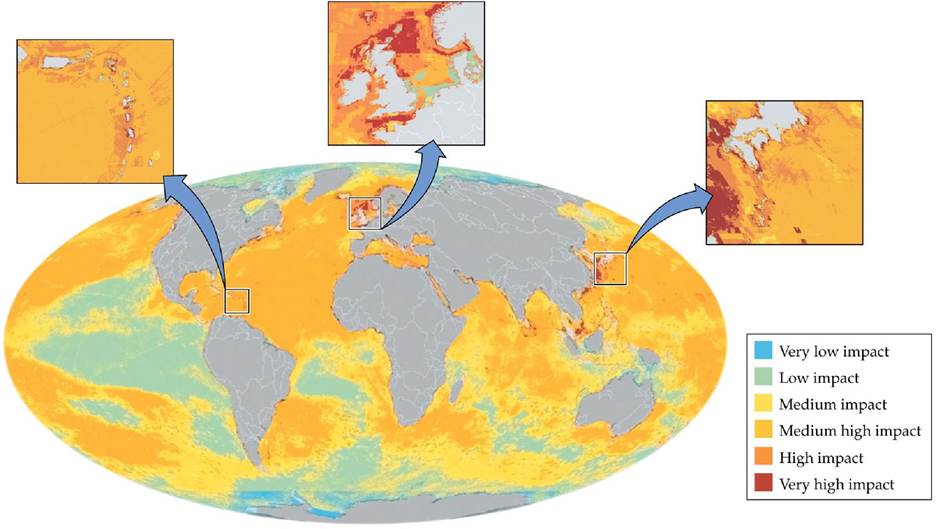
FIGURE 3.27 HumanlmpactsontheOceans Theimpactsofgreenhousegasemissions, pollutant inputs, and overfishing have varied in different regions of the oceans. The colors represent the degree of impact, which was quantified using expert judgments of 17 different environmental impact factors. The enlarged areas from the Caribbean Sea (left), North Atlantic Ocean (center), and western Pacific Ocean (right) show greater detail of more heavily impacted areas. Note the correspondence between the areas of high and very high impact with areas of significant human impact in the adjacent terrestrial regions in Figure 3.5. (From B. S. Halpern et al. 2008. Science 319: 948-952.) View larger image
A Case Study Revisited
The American Serengeti—Twelve Centuries of Change in the Great Plains
Humans have been implicated in several major biological changes in the grasslands of the world. One of the earliest was the disappearance of large mammals from North America during the late Pleistocene. Paul Martin, an early proponent of this hypothesis, noted the strong correspondence between extinction events on several continents and the arrival of humans on those continents, principally Europe, North and South America, and Australia (Martin 1984, 2005). Martin suggested that the rapidity of the extinctions and the greater proportion of large animals that disappeared reflected the hunting efficiency of those early humans. Larger animals have lower reproductive rates than smaller animals, so they cannot recover from increases in predation as quickly. Martin's suggestion therefore took on the unfortunate label of “the overkill hypothesis.”
Since it was first proposed, the overkill hypothesis has received increasing support (Surovell et al.
2016). Archaeological research has uncovered numerous butchering sites containing remains of extinct animals. Spearheads have been found among the bones, and some of the bones have scrape marks made by tools found at the sites. Other strong evidence indicates that human arrival on small, isolated oceanic islands led to large numbers of extinctions due to predation by humans and by other animals they introduced (e.g., rats and snakes). While most scientists now accept that hunting of megafauna by humans had a role in some of the continental extinctions in the late Pleistocene, other causes have been proposed as well. These causes include the spread of diseases carried by humans and possibly by the domesticated dogs that accompanied them (MacPhee and Marx 1997). Another hypothesis suggests that the loss of some animals on which other species depended, such as mastodons, led to more widespread extinctions (Owen-Smith 1987). No one hypothesis explains the extinctions of all the megafauna on all the continents, however. A combination of climate change and the arrival of humans probably contributed to their demise (Barnosky et al. 2004).Although the diversity of large mammals on the Great Plains was greatly diminished following the Pleistocene, large mammals were still abundant. Bison may have numbered 30 million, and numerous elk (wapiti), pronghorn, and deer roamed the plains. These animals continued to be hunted by humans, who also began to use fire on the eastern edge of the Great Plains as a tool for managing the habitat of their prey, as well as for small-scale agriculture (Delcourt et al. 1998). The writings of travelers to the Great Plains in the early 1800s indicate that the eastern deciduous forest began farther east than it does today, probably because of the influence of human-set fires.
Between 1700 and 1900, ecological changes occurred in the Great Plains that profoundly transformed both the plants and the animals. The reintroduction of horses into North America by Spanish explorers facilitated the development of a Native American culture centered on the hunting of bison.
The arrival of Euro-Americans, and their subsequent conflicts with Native Americans, led to the near extinction of bison and other large Plains animals by the late 1800s (FIGURE 3.28). With the arrival of cattle and mechanized agriculture after 1850, the Great Plains became a domesticated landscape. The moister eastern tallgrass prairie was converted into monocultures of corn, wheat, soybeans, and other crops; today, only 4% of tallgrass prairie remains. A larger proportion of the mixed- grass and short-grass prairies to the west remained intact, but overgrazing and unsustainable agricultural practices led to serious degradation of some of these areas during the Dust Bowl of the 1930s, when drought and massive windstorms resulted in substantial losses of fertile topsoil (see the Case Study in Chapter 25).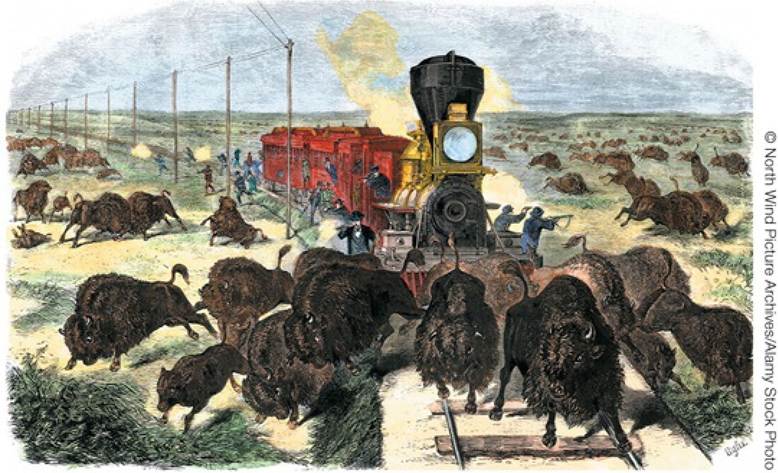
FIGURE 3.28 BuffaloHunting The arrival of large numbers of Euro-Americans in the Great Plains in the nineteenth century led to a mass slaughter of bison, facilitated by the construction of railroad lines and the use of high-powered rifles. View larger
I image
Connections in Nature
Long-Term Ecological Research
Most terrestrial biomes and marine biological zones across the globe are experiencing changes due to human activities (see Figures 3.5 and 3.27). Even remote, seemingly pristine areas are subject to the effects of climate change and air pollution. Recognizing the effects of human activities on these systems, as well as our incomplete understanding of those effects, the U.S. National Science Foundation initiated the Long-Term Ecological Research (LTER) Network of study sites in 1980. Initially consisting of 5 sites, the network has grown to 28 sites representing a diversity of terrestrial biomes, from tropical to polar, as well as marine biological zones, croplands, and urban centers (FIGURE 3.29). The formation of the U.S. LTER program has spurred the formation of an international network of LTER sites, facilitating international collaborative research to better understand Earth's ecological systems.
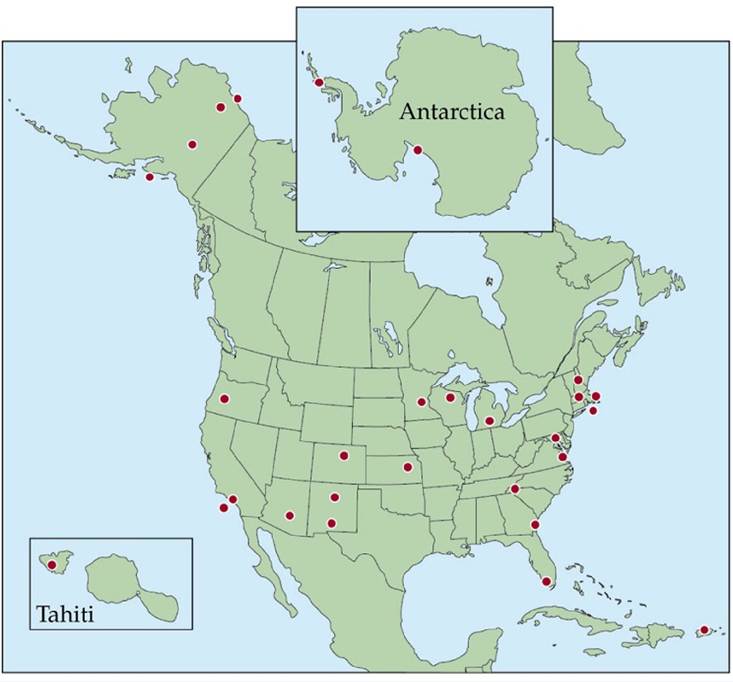
FIGURE 3.29 Long-Term Ecological Research Sites Twenty-eight research sites constitute the U.S.
Long-Term Ecological Research (LTER) Network. These sites encompass deserts, grasslands, forests, mountains, lakes, estuaries, agricultural systems, and cities. Researchers measure long-term changes in ecosystems and perform experiments at these sites to better understand ecological dynamics over decades to centuries. View larger imageLong-term ecological research has advanced our understanding of ecological changes that occur at decadal and longer time scales. For example, research at LTER sites in the western United States has led to an understanding of the influence of El Nino Southern Oscillation and Pacific Decadal Oscillation (two climate cycles discussed in Concept 2.5) on the grassland biome. The legacy of climate change since the last glacial maximum, discussed in the Case Study at the opening of this chapter, is also better understood as a result of this research. Finally, research at LTER sites is providing a view of how environmental change, including climate change, may influence terrestrial biomes and marine biological zones in the future.
In this chapter, we've learned that grasslands are the biome most heavily impacted by human activities due to agricultural development. The Konza Prairie LTER site, located in the Flint Hills of northeastern Kansas, is a remnant tallgrass prairie—a very heavily impacted grassland type with very little of its original cover remaining. Research at the Konza Prairie site has focused on conserving this endangered biome in the face of rapid climate and land use change by examining the interactive roles of fire, grazing, and climate in the tallgrass prairie ecosystem. This research has included experiments varying the frequencies of fire and grazing in large landscape units to investigate their importance in maintaining the dominance of the grasses that characterize the grassland biome (FIGURE 3.30). Researchers have also examined the potential effects of changes in precipitation by varying the amount, intensity, and timing of watering. Results from this research have provided important insights into how climate change may affect the grassland biome, indicating that extremes in rainfall are important controls on its diversity and function (Knapp et al. 2002). Research at this and other LTER sites will enhance our ability to conserve native biodiversity in the face of accelerating environmental change.
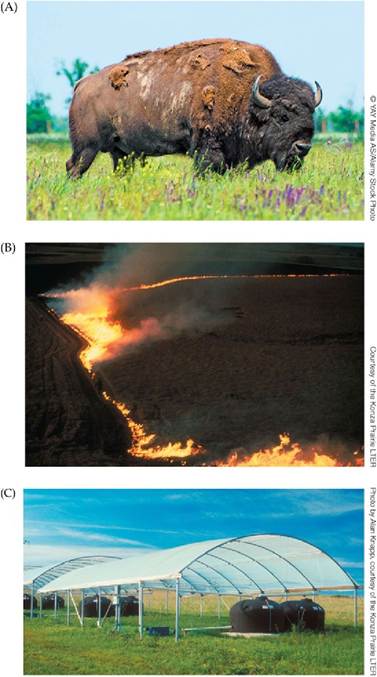
FIGURE 3.30 Research at the Konza Prairie LTER Site Long-term research and experiments are investigating the effects of the frequencies of (A) grazing, (B) fire, and (C) precipitation on the diversity and function of the tailgrass prairie ecosystem. View larger image
More on the topic Marine biological zones have been impacted by human activities:
- Which biomes and marine biological zones have the highest NPP and, as a consequence, the greatest effect on atmospheric CO2 dynamics?
- Reviewers
- SUMMARY