Multiple models of succession were stimulated by lack of scientific consensus
Fascination with the mechanisms responsible for succession, and attempts to integrate the controversial theories of Clements, Cowles, and Elton, led ecologists to use more scientifically rigorous methods to explore succession, including comprehensive reviews of the literature and manipulative experiments.
Joseph Connell and his collaborator Ralph Slatyer (1977) surveyed the literature and proposed three models of succession that they believed to be important (FIGURE 17.8).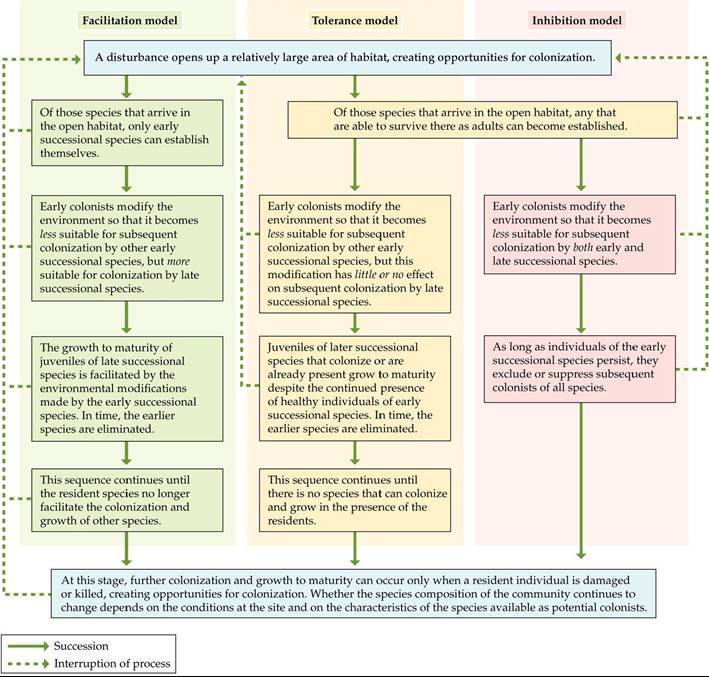
FIGURE 17.8 ThreeModelsofsuccession Connellandsiatyerproposedthree conceptual models—the facilitation, tolerance, and inhibition models—to describe succession.
(After J. H. Connell and R. O. Slatyer. 1977. Am Nat 111: 982.) View larger image
• The facilitation model, inspired by Clements, describes situations in which the earliest colonizers modify the environment in ways that ultimately benefit later-arriving species but hinder their own continued dominance. These early successional species have characteristics that make them good at colonizing open habitats, dealing with physical stress, growing quickly to maturity, and ameliorating the harsh physical conditions often characteristic of early successional stages. Eventually, however, a sequence of species facilitations leads to a climax community composed of species that no longer facilitate other species and are displaced only by disturbances.
• The tolerance model also assumes that the earliest colonizers modify the environment, but in neutral ways that neither benefit nor inhibit later species. These early successional species have life history strategies that allow them to grow and reproduce quickly. Later species persist merely because they have life history strategies such as slow growth, few offspring, and long life that allow them to tolerate increasing environmental or biological stresses that would hinder early successional species.
• The inhibition model assumes that early successional species modify the environment in ways that hinder later successional species. For example, these early colonizers may monopolize resources needed by subsequent species. This suppression of the next stage of succession is broken only when stress or disturbance decreases the abundance of the inhibitory species. As in the tolerance model, later species persist merely because they have life history strategies that allow them to tolerate environmental or biological stresses that would otherwise hinder early successional species.