The early history of ecology is a study of succession
The modern study of ecology had its beginnings at the turn of the twentieth century. At that time, it was dominated by scientists who were fascinated with plant communities and the changes they undergo over time.
One of these pioneers was Henry Chandler Cowles, who studied the successional sequence of vegetation in sand dunes on the shore of Lake Michigan (FIGURE 17.6). In this ecosystem, the dunes are continually growing as new sand is deposited at the shoreline. This new sand is blown onshore when shorelines are exposed during droughts. Cowles was able to infer the successional pattern along a dune by assuming that the plant assemblages farthest from the lake's edge were the oldest and that the ones nearest the lake, where new sand was being deposited, were the youngest. As you walked from the lake to the back of the dune, he believed, you were traveling forward in time and able to imagine what the areas you had just passed through would look like in centuries to come. The first stages were dominated by a hardy ecosystem engineer, American beach grass (Ammophila breviligulata). Ammophila (whose genus name literally means “sand lover”) is excellent at trapping sand and creating hills, which provide refuge on their leeward side for plants less tolerant of the constant burial and sand scouring experienced on the beachfront.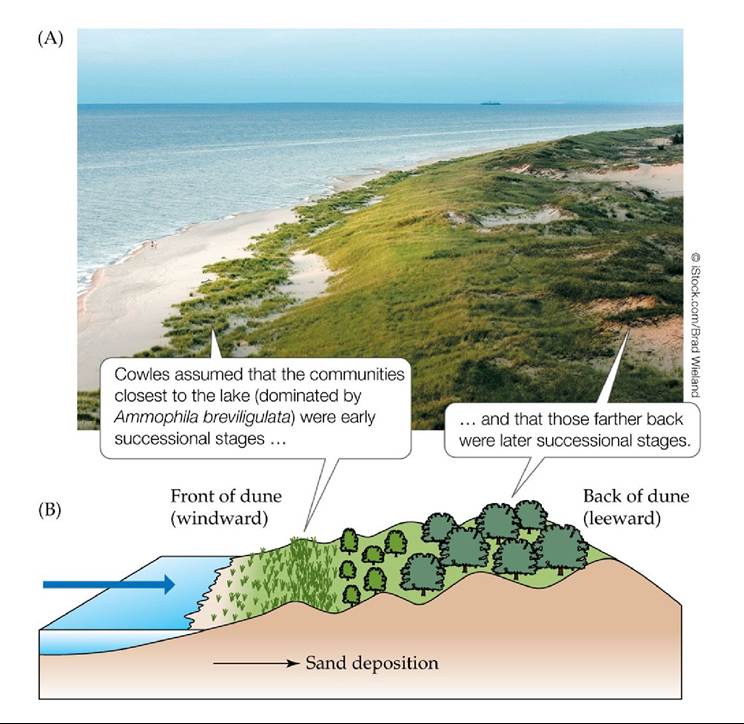
FIGURE 17.6 SpaceforTimeSubstitution (A) The portion of a dune nearest the shoreline on Lake Michigan is covered with Ammophila. (B) When Henry Chandler Cowles studied succession on these dunes, he assumed that the earliest successional stages occurred on the newly deposited sand at the front of the dune, and that later successional stages occurred at the back of the dune. View larger image
Cowles (1899) made the assumption that the different plant assemblages—or “societies,” as he called them—that he saw in different positions on a dune represented different successional stages.
That assumption allowed him to predict how a community would change over time without actually waiting for the pattern to unfold, which would have taken decades to centuries. This idea, known as the “space for time substitution” (Pickett 1989), is used frequently as a practical way to study communities over time scales that exceed the life span of an ecologist. It assumes that time is the main factor causing communities to change and that unique conditions in particular locations are inconsequential. These are big assumptions, and they have fueled a debate about the predictability of community dynamics over time. We will discuss this debate in more detail in Concept 17.4, when we deal with alternative stable state theory.Henry Cowles was not alone in his interest in plant succession. His peers included Frederick Clements and Henry Gleason, two men who had completely different and contentious views on the mechanisms driving succession (Kingsland 1991). Clements, who in 1907 wrote one of the first formal books on the new science of ecology, believed that plant communities were like “superorganisms,” groups of species that worked together in a mutual effort toward some deterministic end. Succession was similar to the development of an organism, complete with a beginning (embryonic stage), middle (adult stage), and end (death). Clements (1916) thought that each community had its own predictable life history and, if left undisturbed, ultimately reached a stable end point. This “climax community” was composed of species that dominated and persisted over many years and provided the type of stability that could potentially be maintained indefinitely.
Gleason (1917) thought that viewing a community as an organism, with various interacting parts, ignored the responses of individual species to prevailing conditions. In his view, communities were not the predictable and repeatable result of coordinated interactions among species, but rather the random product of fluctuating environmental conditions acting on individual species.
Each community was the product of a particular place and time and was thus unique in its own right.Looking back, it is clear that Gleason and Clements had extreme views of succession. As we will see in the next section, we can find elements of both theories in the results of studies that have accumulated over the last century. First, however, it is important to mention one last ecologist, Charles Elton
(FIGURE 17.7A), whose perspective on succession was shaped not only by those of the botanists who came before him, but also by his interest in animals. He wrote his first book, Animal Ecology (1927), in 3 months' time at the age of 26. The book addresses many important ideas in ecology, including succession. Elton believed that organisms and the environment interact to shape the direction succession will take. He presented an example from pine forests in England that were being subjected to deforestation. After the felling of the pines, the trajectory of succession varied depending on the moisture content of the environment (FIGURE 17.7B). Wetter areas developed into sphagnum bogs, while slightly drier areas developed into wetlands containing rushes and grasses. Eventually, these communities all became birch scrub, but then ultimately diverged into two types of forest. Through these observations, Elton demonstrated that the only way to predict the trajectory of succession was to understand the biological and environmental context in which it occurred.
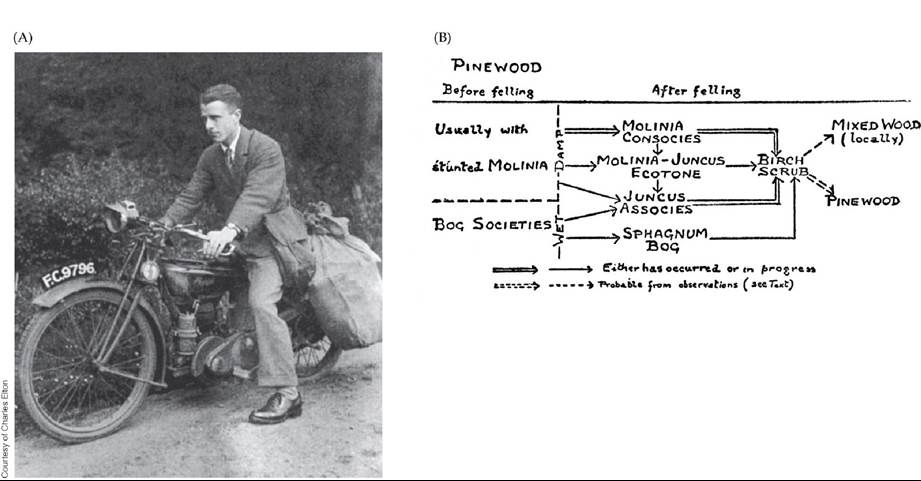
FIGURE 17.7 Elton's Context-Dependent View of Succession (A)CharlesEltonatthe age of 25, a year before the publication of his first book, Animal Ecology (1927). (B) Elton's book contained this diagram of succession in pine forests after logging. The successional trajectory differed depending on the moisture content of a particular area: wetter areas became sphagnum bogs, while slightly drier areas became wetlands containing rushes (Juncus) and grasses
(Molinia). Eventually, these communities all became birch scrub but then ultimately diverged into pine woods or mixed woods, again depending on moisture. (B from V. S. Summerhayes and P. H. Williams. 1926. JEcol 14: 203-243.) View larger image
Elton's greatest contribution to the understanding of succession was his acknowledgment of the role of animals. Up to that point, most ecologists believed that plants drove succession, while animals were passive followers. Elton provided many examples showing how animals could create successional patterns by eating, dispersing, trampling, and destroying vegetation in ways that greatly affected the sequence and timing of succession. We will review some examples of animal-driven succession in the next section, but it is clear that the observations and conclusions Elton made 90 years ago still hold today.
More on the topic The early history of ecology is a study of succession:
- In this book, ecology is defined as the scientific study of interactions between organisms and their environment.
- Brief history of Ecology
- CONCEPT 1.2 Ecology is the scientific study of interactions between organisms and their environment.
- Primary succession and secondary succession differ in their initial stages
- How Do We Study Islamic Legal History?
- Any study of sexual and family violence in early modern Europe must first acknowledge and confront the problems of language and meaning.
- One The Early History
- 2. The Early Centuries: The Common History
- Box 1.1 Early history of the epidemic
- THE CONTEXT IN TERMS OF CULTURAL HISTORY AND THE STUDY OF RELIGION
- Chapter 3 Early history to 1340
- Violence in Early Chinese History
- Piecing Together Early Sumatran History: The Pearl Route
- Early History of Lawyers 1300-1700
- Natural history and management of early HIV infection
- Module 1. The History of Ukraine in the Middle Ages and the Early Modern Period