Populations respond to environmental variation through adaptation
Within the geographic range of a species, particular populations occur in unique environments (e.g., cool climates, saline soils) that may have initially been stressful to the organisms when they first occupied them.
Genetic variation among the individuals within such populations, in physiological, morphological, or behavioral traits that influenced their survival, functioning, and reproduction in the new environment, would have led to natural selection favoring those individuals whose traits made them best able to cope with the stressful conditions. The underlying genetic basis for these traits would have resulted in a change over generations in the genetic makeup of the population as the abundance of individuals with the favored traits increased (see Concept 6.3). Such traits are known as adaptations. Over many generations, these unique, genetically based solutions to environmental stress would have become more frequent in the population.Adaptation is similar to acclimatization in that both processes involve a change that lowers stress, and the ability to acclimatize represents a type of adaptation. However, adaptation differs from acclimatization in being a long-term, genetic response of a population to environmental stress that increases its ecological success under the stressful conditions (FIGURE 4.6). Populations with adaptations to unique environments are called ecotypes. Ecotypes may represent responses to both abiotic (e.g., temperature, water availability, soil type, salinity) and biotic (e.g., competition, predation) environmental factors. Ecotypes can eventually become separate species as the physiology and morphology of individuals in different populations diverge and the populations eventually become reproductively isolated.
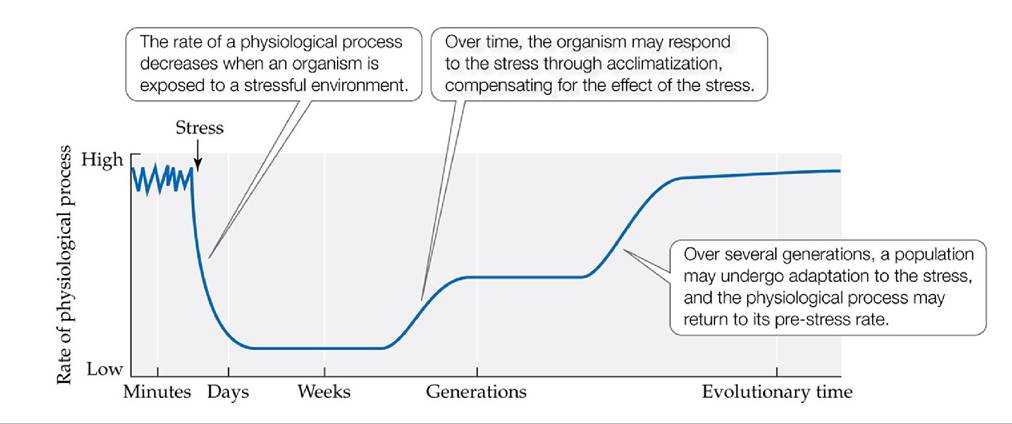
FIGURE 4.6 OrganismalResponsestoStress Organismsrespondtostressoverdifferent time scales.
(After H. Lambers et al. 1998. PlantphysiologicalEcology. Springer: New York.) View larger imageReturning to our previous example of stress at high elevations, some human populations have lived continuously in the Andean highlands for at least 10,000 years. When Spanish explorers first settled in the Andes alongside the native people in the sixteenth and seventeenth centuries, their birth rates were lower than those of the natives for two to three generations, probably because of poor oxygen supply to developing fetuses (Ward et al. 1995). The same held true for the domesticated animals they brought with them. This comparison provides anecdotal evidence that the native Andean populations had become adapted to the low-oxygen conditions at high elevations. Research in the twentieth century showed that adaptations to high elevations by Andean natives include higher red blood cell production and greater lung capacity (Ward et al. 1995).
Adaptations to environmental stress can vary among populations. In other words, the solution to a particular environmental problem may not be the same for each population, as demonstrated by a comparison of human populations native to the Andean and Tibetan highlands. The adaptations to high elevations in Andean populations (high red blood cell concentration and large lung capacity) are not the same as those found in Tibetan populations (Beall 2007). Tibetan populations have red blood cell concentrations similar to, and blood oxygen concentrations lower than, populations at sea level, but they have a higher breathing rate, which enhances the exchange of oxygen with the blood system, and higher blood flow, which improve delivery of oxygen to vital organs such as the brain. Thus, there are at least two different ways in which human populations have adapted to the hypoxic stress imposed by living at high elevations.
Acclimatization and adaptation are not “free”; they require an investment of energy and resources by the organism.
They represent possible trade-offs with other functions of the organism that may also affect its survival and reproduction. Acclimatization and adaptation must therefore increase the survival and reproductive success of the organism under the specific environmental conditions in order to be favored over other patterns of energy and resource investment. Trade-offs in energy and resource allocation are discussed in Concept 7.3.In the remaining two sections, we will examine the factors that determine organisms' temperatures, water content, and water uptake, and we will consider examples of acclimatization and adaptation that allow organisms to function in the face of varying temperatures and water availability.
1
- Animal physiologists use the term acclimatization to refer to the short-term response of an animal to changes in the physical environment under field conditions and use acclimation to refer to a short-term response under controlled laboratory conditions.