Individuals respond to environmental variation through acclimatization
Any physiological process, such as growth or photosynthesis, has a set of optimal environmental conditions most conducive to its functioning. Deviations from those optimal conditions cause a decrease in the rate of the process (FIGURE 4.5).
Stress is the condition in which an environmental change results in a decrease in the rate of an important physiological process, thereby lowering the potential for an organism's survival, growth, or reproduction. For example, when you travel to high elevations, typically above 2,400 m (8,000 feet), the lower partial pressure of oxygen in the atmosphere (see Concept 3.2) results in the delivery of less oxygen to your tissues by your circulatory system. This condition, known as hypoxia, results when the amount of oxygen picked up by hemoglobin molecules in your blood decreases. Hypoxia causes “altitude sickness,” a type of physiological stress, decreasing your ability to exercise and think clearly and making you feel nauseated.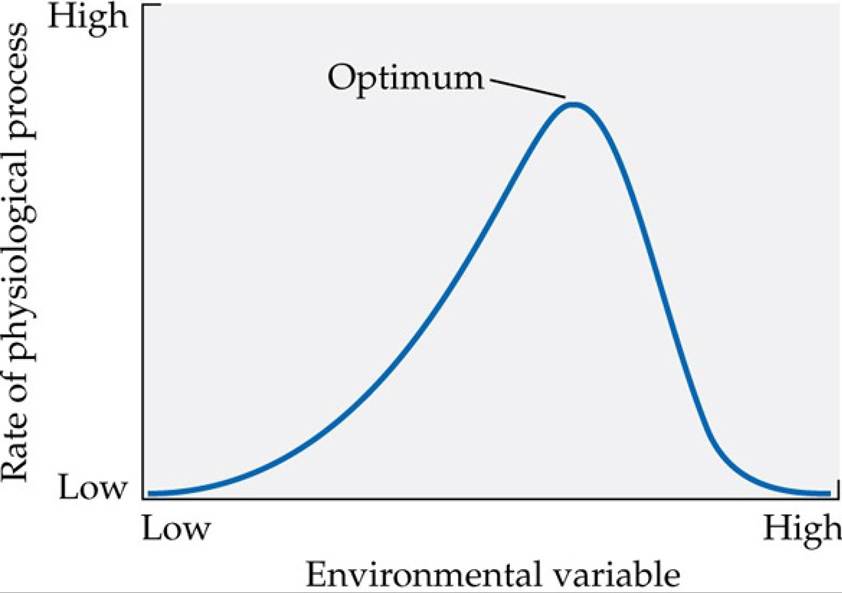
FIGURE 4.5 EnvironmentaicontrolofphysiologicalProcesses Theratesof physiological processes are greatest under a set of optimal environmental conditions (e.g., optimal temperature, optimal water availability). Deviations from the optimum cause a decrease in the rates of physiological processes. View larger image
Many organisms have the ability to adjust their physiology, morphology, or behavior to lessen the effect of an environmental change and minimize the associated stress. This kind of adjustment, known as acclimatization,1 is usually a short-term, reversible process. Your body acclimatizes to a high elevation if you remain there for several weeks (but only below 5,500 m, or 18,000 feet). Acclimatization to high elevations involves higher breathing rates, greater production of red blood cells and associated hemoglobin, and higher pressure in the pulmonary arteries to circulate blood into areas of the lung that are not used at lower elevations (Hochochka and Somero 2002). The outcome of these physiological changes is the delivery of more oxygen to your tissues. The acclimatization process reverses when you return to lower elevations.