Species distributions reflect environmental influences on energy acquisition and physiological tolerances
The potential geographic range of a species is ultimately determined by the physical environment, which influences an organism's ecological success (its survival and reproduction) in two important ways.
First, the physical environment affects an organism's ability to obtain the energy and resources required to maintain its metabolic functions, and therefore to grow and reproduce. Rates of photosynthesis and abundances of prey, for example, are controlled by environmental conditions. Therefore, the ability of a species to maintain a viable population is constrained at the limits of its potential geographic range. Second, as we saw in Concept 2.1, an organism's survival can be affected by extreme environmental conditions. If temperature, water supply, chemical concentrations, or other physical conditions exceed what an organism can tolerate, the organism will die. These two influences—the availability of energy and resources and physical tolerance limits—are not mutually exclusive, as energy supply influences an organism's ability to tolerate environmental extremes. Furthermore, it is important to keep in mind that the actual geographic distribution of a species differs from its potential distribution because of other factors, such as dispersal ability (see Concept 18.1), disturbance (e.g., fire; see Concept 17.1), and interactions with other organisms, such as competition (see Unit 4) (FIGURE 4.3).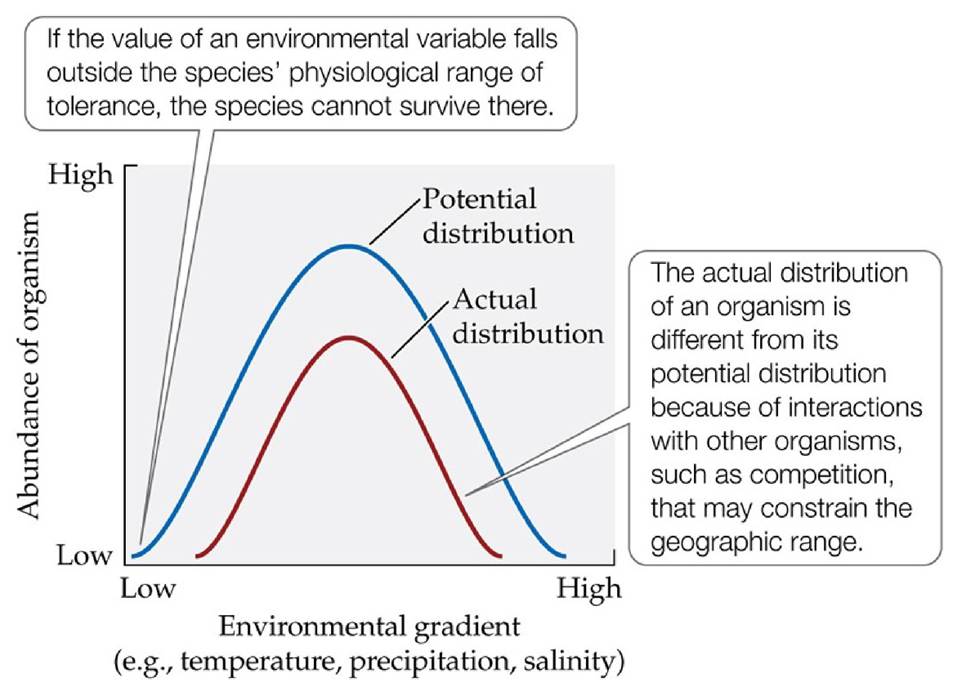
FIGURE 4.3 AbundancevariesacrossEnvironmentalGradients Theabundanceofan organism reaches a theoretical maximum at some optimal value across an environmental gradient and drops off at either end at values that constrain the potential geographic distribution of the organism. The actual abundance curve is likely to differ from the potential abundance curve because of biological interactions.
View larger imageAs we saw in Concept 3.1, the immobility of plants makes them good indicators of the physical environment. Farmers are acutely aware of the effects of extreme events on the survival of crop plants, which are often grown outside the geographic ranges where they evolved. Frosts or extreme droughts can result in catastrophic crop losses. Aspen (Populus tremuloides) provides a good example of a native species whose geographic range is related to its climate tolerance. Aspen occurs in boreal forests and mountain zones throughout North America. Its geographic distribution can be predicted fairly accurately from the observed effects of climate on its survival and reproduction (Morin et al. 2007) (FIGURE
4.4A). The climate factors that limit its distribution include the effects of low temperatures on its reproductive success and the effects of drought and low temperatures on its survival (FIGURE 4.4B). The range of climate conditions under which a species occurs—its climate envelope—provides a useful tool for predicting its response to climate change (see Chapter 25).
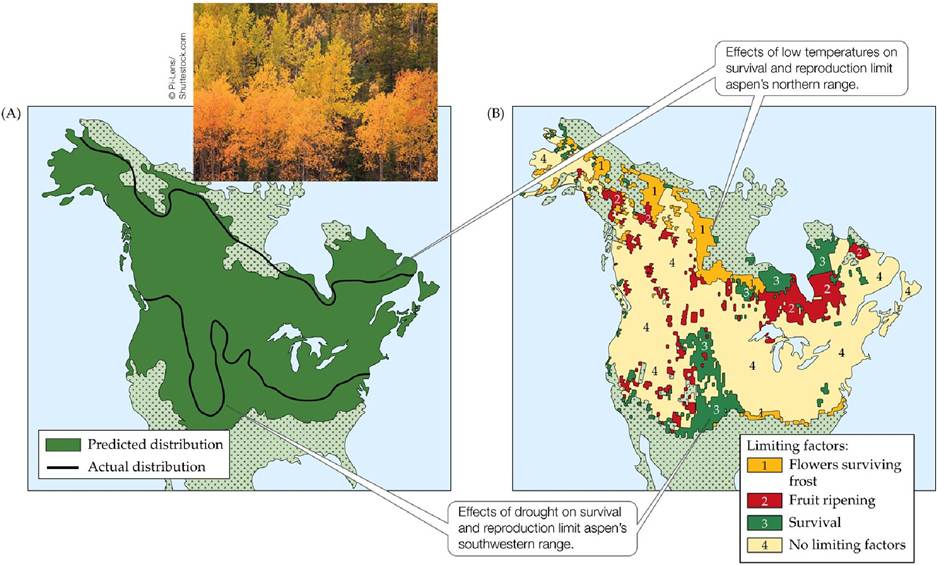
FIGURE 4.4 ClimateandAspenDistribution Thegeographicdistributionoftheaspen (Populus tremuloides; golden trees in the photo) is associated with climate. (A) Predicted distribution of aspen, based on the effects of climate factors on survival and reproduction observed in natural populations, mapped with the actual distribution. (B) Climate factors limiting the distribution of aspen, based on observations of natural populations.
The future climate is predicted to be warmer throughout the interior of western North America and drier in the central portions of the continent. How will these changes influence the geographic distribution of aspen?
(After X. Morin et al. 2007. Ecology 88: 2280-2291.) View larger image