Positive interactions may be more common in stressful environments
In recent decades, studies have shown that positive interactions are important in a number of ecological communities, such as oak woodlands, coastal salt marshes, and marine intertidal communities.
Many of these studies have focused on how individuals of a target species are affected by nearby individuals of one or more other species. These effects can be assessed by comparing the performance of the target species when neighbors are present with its performance when neighbors are removed. Although results from such studies cannot be used to determine whether mutualism, commensalism, or competition is occurring (because two-way interactions are not examined), they do provide a rough assessment of whether positive interactions are common in ecological communities.In one of the most comprehensive studies of this type, an international group of ecologists tested the effects that neighboring plants had on a total of 115 target plant species in 11 regions worldwide (Callaway et al. 2002). In 8-12 replicate plots for each treatment of each target species, neighbors were either left in place or removed from the vicinity of the target species. The “relative neighbor effect” (RNE, defined as the growth of the target species with neighbors present minus its growth when neighbors were removed) was then measured. The researchers found that RNE was generally positive at high-elevation sites, indicating that neighbors had a positive effect on the target species, but negative at low- elevation sites (FIGURE 15.9). In addition, neighbors tended to reduce the survival and reproduction of target species individuals at low-elevation sites, but to increase their survival and reproduction at high-elevation sites. Callaway et al. determined that the RNE was negatively related to the maximum temperature in the summer, suggesting that positive interactions were more common in colder, more stressful environments and competition was more common in warmer, less stressful environments (FIGURE 15.10). Similar results have been found in salt marsh communities (see Figure 16.13 and Figure 17.14) and intertidal communities (Bertness 1989; Bertness and Leonard 1997).
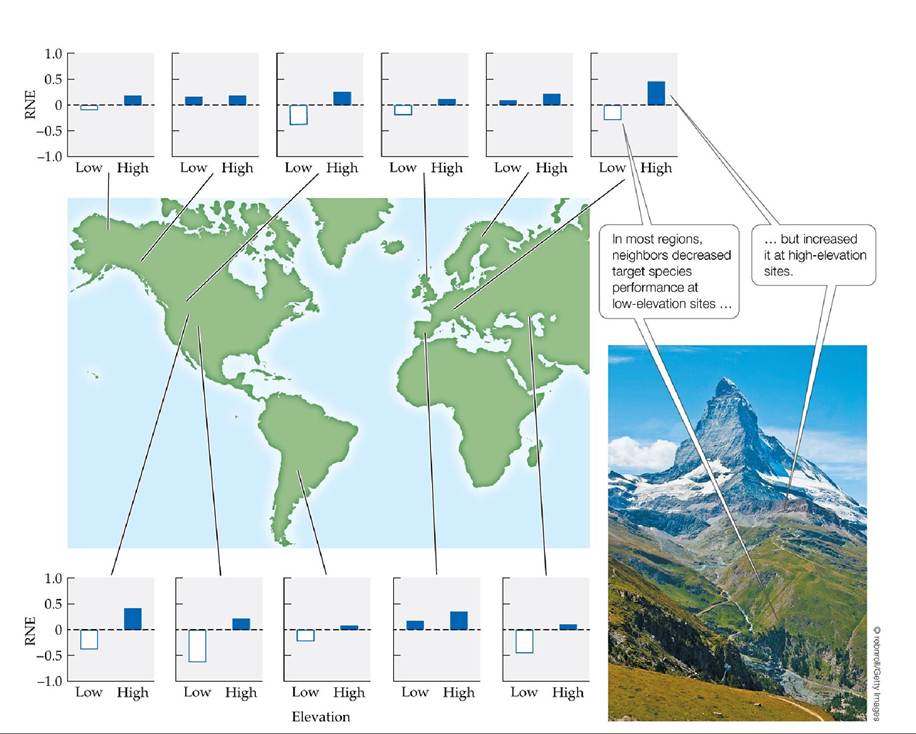
FIGURE 15.9 Neighbors Increase Plant Growth at High-Elevation Sites Therelative neighbor effect (RNE, defined as the growth of the target plant species when neighboring plants are present minus its growth when neighbors are removed) of alpine plants was measured in plots at high and low elevations in 11 regions. Plant growth was measured as change in biomass (for most sites) or in leaf number. RNE values greater than zero (in blue) indicate that neighbors increased the growth of target species; RNE values less than zero (in white) indicate that neighbors decreased the growth of target species. (After R. M. Callaway et al. 2002. Nature 417: 844-848.) View larger image
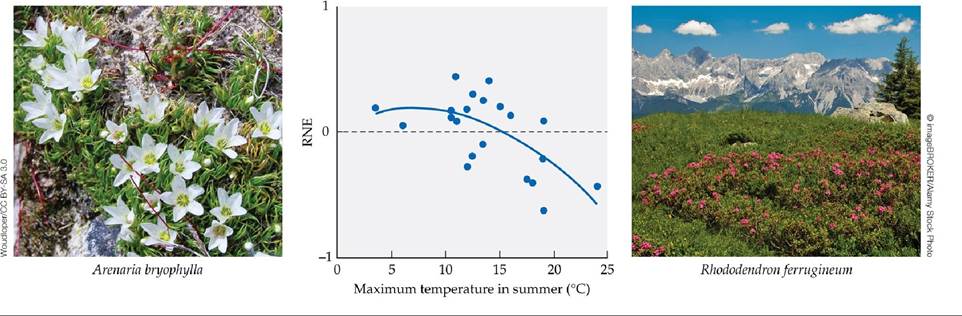
FIGURE 15.10 Neighbors Ameliorate Cold Temperatures in Alpine Plants Therelative neighbor effect (RNE, defined in Figure 15.9) of alpine plants changes from positive (above zero) to competitive (below zero) as temperature increases at lower elevations. (After R. M. Callaway et al. 2002. Nature 417: 844-848.) View larger image
With this discussion of positive interactions as background, let's examine some of the characteristics that are unique to mutualism. Our discussion will place special emphasis on what can be learned from studies that document the costs and benefits of mutualistic interactions.